What Juice Is Good for Constipation? Prune Juice's Evidence and the Truth About the Rest
Prune juice is the only constipation juice with randomized-trial support, and sorbitol is the active ingredient. How much per day works, whether pear or apple juice is worth it, juice versus whole fruit, and the limits of the juice approach.
By WellTao · Published: · Editorial Policy
More articles in this topicTable of contents
The short version
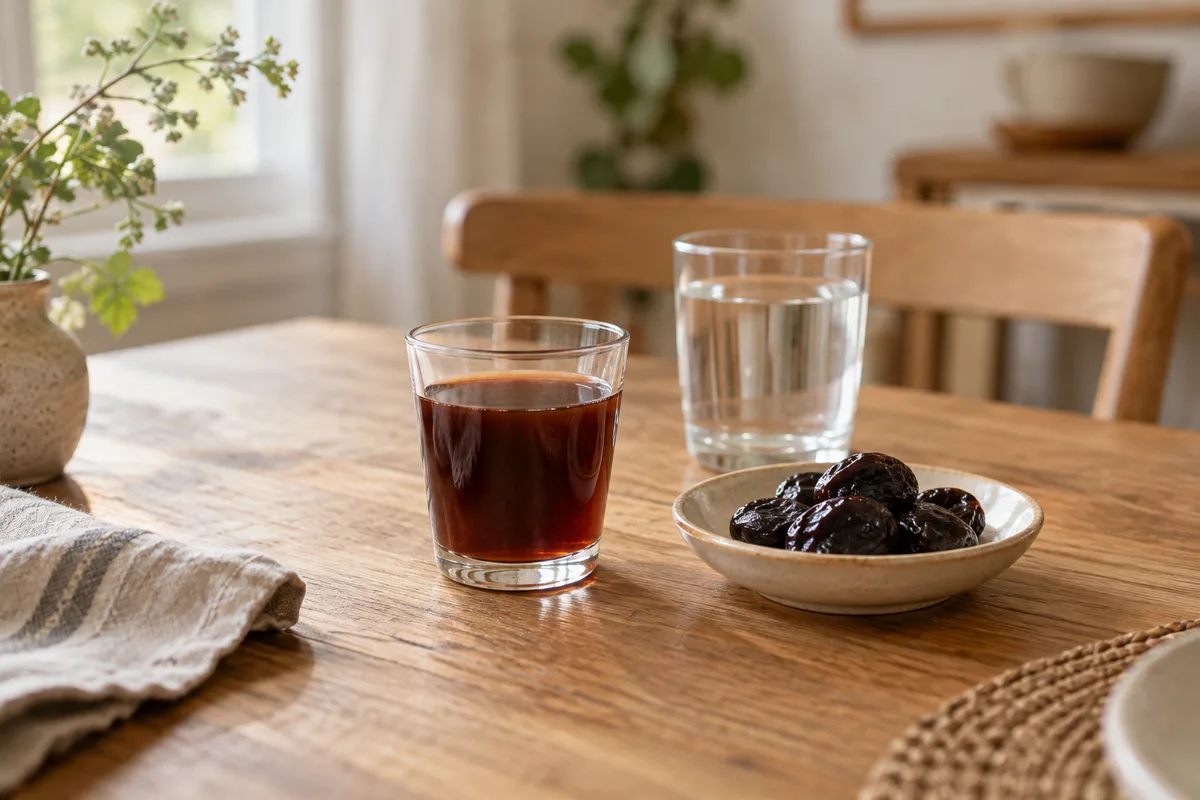
One juice has real evidence for constipation: prune juice. In a randomized placebo-controlled trial (American Journal of Gastroenterology, 2022), adults with chronic constipation who drank prune juice daily saw softer stools and fewer subjective complaints. The active ingredient is sorbitol — a slowly absorbed sugar alcohol that holds water in the intestine. Pear and apple juice contain some sorbitol at far lower concentrations, so the effect is weaker; orange juice mainly contributes water.
Two things up front: juice suits the hard, dry-stool kind of constipation and does little for weak-propulsion or incomplete-emptying kinds. And juice can’t replace whole fruit — juicing strips most of the fiber. If you manage blood sugar or have IBS, read the limits below before pouring.
Does juice fit your case
- Good fit: hard dry stools with low fluid intake, or anyone who struggles to chew or swallow whole fruit — juice is a gentle liquid alternative.
- Limited help: stool that isn’t hard but won’t pass or never feels finished. That’s a propulsion or coordination issue juice can’t touch.
- Caution: with IBS or sorbitol sensitivity, sorbitol may trigger bloating or diarrhea; avoid it or seek individualized advice before trying it, and stop if symptoms worsen. If you manage blood sugar, count juice in your day’s carbohydrate total and favor whole fruit.
What modern medicine says
Why prune juice works: three components in combination. A review of dried plum composition and health effects attributes the effect to sorbitol (osmotic water retention), pectin and other fibers (bulk), and phenolic compounds — a package, not a single molecule. That’s why sorbitol powder isn’t a straight substitute. Sorbitol content varies by product; a single concentration cannot be assumed for all prune juices.
What “osmotic” means. Sorbitol absorbs slowly in the small intestine; the unabsorbed fraction reaches the colon and osmotically pulls water into the stool. That’s a different mechanism from drinking water — absorbed early, regulated by the kidneys. This helps explain why sorbitol and plain water can affect bowel function differently.
Dose and side effects are the same dial. One small trial studied 54 g a day of a specific prune-juice product for eight weeks; that amount is not interchangeable with a volume of ordinary juice. There is no established universal dose. Sorbitol can cause gas or diarrhea, so follow the product label and stop if it worsens symptoms.
Where other juices land. Pear and apple juice carry sorbitol at much lower concentrations; matching prune juice’s effect means drinking enough to overshoot on sugar. Orange and grape juice mainly contribute water and vitamin C. The NHS advises choosing sorbitol-containing fruit for constipation (apples, apricots, grapes, raspberries, strawberries) — in whole-fruit form first.
How Chinese medicine understands it
Traditional Chinese medicine has no category for “juice” as a modern product, but the logic of how it uses fruit carries over: what’s moist in texture moistens the intestine, and extracting juice has always had a place in traditional food practice. Pear juice taken fresh appears in classical literature for “generating fluids and moistening dryness,” while stewed pear in its own liquid serves “moistening the Lung and nourishing yin.” Fruit consumed as liquid is not a modern invention. In traditional food culture, dark plums (wu mei) and plums were used to generate fluids, and pears to moisten dryness — all pointing at the same dry kind of constipation.
The traditional frame adds two observations about juice that still hold up. First, juice is “slipperier” than fruit: without the fiber’s buffer, the loosening effect arrives faster — so sensitive constitutions start small, which matches the modern observation about sorbitol dose-response. Second, juice is “colder” than fruit: liquid, usually chilled, drunk fast — a bigger shock to a weak digestive engine than chewing a pear. This is a traditional empirical model, not modern pharmacology (for an overview, see NCCIH’s TCM page).
Applied person by person:
- The dry kind (hard stool, dry mouth): juice is the right format; prune or pear both fit, and yin-deficiency constitution tendencies suit them best.
- The underpowered kind (effortful passage, cold intolerance, fatigue): juice is not the main tool — if you drink it, take it at room temperature, with a meal, in a small glass. Yang-deficiency leanings can cut juice with warm water or switch to warm tremella soup or congee broth instead.
- The bloated-stuck kind: juice’s fermentation can worsen the bloating — the real lever there is rhythm and mood, covered in can stress make you constipated.
The link runs one way: a yang-deficiency leaning means watching cold drinks, not that discomfort from iced juice proves a constitution. Patterns mix and shift; formal differentiation takes an in-person TCM practitioner.
Everyday way to drink it
Turning study doses into a habit:
- If you choose prune juice, begin with a small serving and follow the product label. The trial amount refers to a specific product and does not establish a universal serving size.
- Don’t drink large amounts on an empty stomach — sorbitol hits the intestine faster that way, raising the odds of bloating and diarrhea.
- Juice days still count as water days. Juice doesn’t replace your fluid budget; the overall schedule is in what to drink when constipated.
- Buy 100% prune juice — the ingredient list should read prunes (or prune concentrate plus water), nothing else. Sugared or blended versions dilute the sorbitol below useful levels.
- Two weeks with no result means stop — switch to the whole-fruit plan or the broader diet strategy.
TCM methods
The five categories below work alongside the juice habit, each marked with the constitution tendencies it suits. Everything in the food section is a food-therapy use of culinary ingredients; if you intend to use them as medicinal herbs, consult a licensed TCM practitioner.
Acupressure and self-massage
After breakfast, overlapping the juice window. Press with a fingertip pad, firm enough for a mild, bearable ache:
- Tianshu (ST25): about three finger-widths to either side of the navel, 60 seconds per side. Traditionally regulates Large Intestine conduction — pairs with the breakfast juice.
- Zhaohai (KI6): the hollow below the tip of the inner ankle bone, 60 seconds per side. Traditionally nourishes yin and moistens dryness — for the dry-mouth, dry-stool kind; yin-deficiency leanings can press it after an evening foot soak.
- Zhigou (TE6): back of the forearm, four finger-widths above the wrist crease, between the two bones, 60 seconds per side. Traditionally the empirical constipation point.
- Belly rub: palm on abdomen, slow strokes along the colon’s path (lower right → upper right → upper left → lower left) for 3–5 minutes, especially on bloated days. Direction matters.
Cautions: pregnant women should not press abdominal points or do the belly rub; skip over unhealed abdominal surgery or hernias; stop if it hurts. Yang-deficiency leanings warm their hands first.
Food therapy
Chinese home-style track (the traditional versions of the “juice idea” — moist, fluid-generating, gentle; ingredients at Asian supermarkets or online):
- Tremella and pear soup: soak 5 g tremella (snow fungus), add half a pear, skin on, chopped, simmer in 500 ml water for 40 minutes. Traditionally nourishes yin and moistens dryness — the dry kind’s match; yang-deficiency leanings eat it warm.
- Honey water: 1 teaspoon honey in 250 ml warm water in the morning. Traditionally moistens the intestine; not for blood-sugar management, never for infants under one.
- Rice water (congee broth): 30 g rice simmered in 600 ml water for 40 minutes; drink the top layer. Traditionally nourishes the Stomach and generates fluids — the alternative for people who bloat on juice; yang-deficiency leanings add a slice of ginger.
Western everyday track:
- Prune yogurt cup: 150 g unsweetened yogurt with 3 chopped prunes and 2 tablespoons oats. Prune’s active package plus a fermented dairy base as a snack; with blood-sugar concerns, cut to 2 prunes.
- Warm apple juice: 150 ml pure apple juice cut with equal warm water, microwaved 20 seconds. The compromise for yang-deficiency leanings — keeps the sorbitol, drops the chill.
Emotional care
If your constipation reliably worsens under pressure, travel, or broken routines, juice is a supporting act — work the rhythm first: can stress make you constipated and why travel causes constipation. The two minutes with the glass can be a small ritual too: sit, no phone, drink it slowly — for qi-stagnation leanings, let that be the first pause of the day.
Movement
A 10-minute walk after breakfast, in sync with the juice, at a talkable pace. Movement promotes colon motility and complements sorbitol’s softening. In the traditional exercise set, the baduanjin (“eight brocades”) move “raise one arm to regulate the Spleen and Stomach” suits mornings — 4–6 repetitions, morning and evening. Qi-deficiency leanings start with 5 minutes of walking; yin-deficiency leanings stop at a light glow.
Sleep and daily rhythm
- Fix the juice at breakfast — a reflex needs repetition to establish.
- No juice after dinner — overnight fermentation means more gas, and late fluids mean nighttime bathroom trips.
- For travel, where reliable juice is hard to source, pack dried prunes instead — the checklist is in why travel causes constipation.
Juice chooser table
| Juice | Key ingredient | Daily amount | Notes |
|---|---|---|---|
| Prune | Sorbitol, pectin, and polyphenols; one small trial of a specific product | No universal dose established | May cause gas or diarrhea |
| Pear | Sorbitol (lower) + fructose | 150–250 ml | Weaker than prune; choose cloudy, with pulp |
| Apple | Sorbitol (lower) | 150 ml | Cloudy (with pulp) beats clear |
| Orange | Mostly water and vitamin C | 150 ml | Weak for constipation; don’t drink it for that |
| Mixed fruit-veg | Depends on recipe | 150 ml | Choose no added sugar, with pulp |
How to use: if you try juice, keep the serving modest, follow the label, and note whether symptoms improve or worsen. Do not increase the amount simply because you have not improved.
How long until you see improvement
In the cited trial, stool-form changes were measured over several weeks. That result does not predict how quickly a person will respond to ordinary juice. Stop if symptoms worsen, and seek medical advice if constipation persists or worsens despite self-care.
When to see a doctor
- Blood in the stool, unexplained weight loss, or persistent fatigue;
- Persistent or worsening abdominal pain, vomiting, fever, or inability to pass gas — prompt care;
- A sudden change in bowel habits, especially new after age 40;
- Constipation that persists despite self-care, worsens, or keeps disrupting daily life.
With IBS, diabetes, or regular medication, loop in a doctor or registered dietitian before adding juice. This article is general health education and can’t replace a doctor’s diagnosis or individualized advice.
Common questions
Is homemade prune juice the same as bottled?
Blending dried prunes with water produces a drink whose concentration depends on the recipe. It cannot be assumed equivalent to bottled prune juice. Check the ingredient list and serving instructions on bottled products.
Can kids drink prune juice for constipation?
This article’s advice is for adults. Children’s constipation has different dietary and medication boundaries — ask a pediatrician first, and don’t scale adult doses down by weight on your own.
Prune juice gave me diarrhea — now what?
Stop drinking it if diarrhea develops. If you want to try again after symptoms settle, follow the product label and start with a small amount; stop if symptoms return. There is no universal dose. Persistent diarrhea, pain, or fever deserves medical advice.
For whole fruit, read what fruit is good for constipation; for the overall fluid plan, what to drink when constipated; the full framework is in the constipation hub.
Two weeks of juice and nothing? The juice may not be the issue
Juice only helps one kind of constipation: hard, dry, under-hydrated stool. When the problem is weak propulsion or incomplete emptying, juice can't reach it. The free constitution test shows your tendencies from a traditional wellness perspective and pairs well with the chooser table in this article. It's a self-observation tool, not a medical diagnosis.
References5 sources
- 01
The American Journal of Gastroenterology (PubMed / NIH)
- 02
Critical Reviews in Food Science and Nutrition (PubMed / NIH)
- 03
UK National Health Service (NHS)
- 04
U.S. National Institute of Diabetes and Digestive and Kidney Diseases (NIDDK / NIH)
- 05
U.S. National Center for Complementary and Integrative Health (NCCIH / NIH)
Personalized guidance
Use the app for constitution-friendly ideas and structured plans when available.
Download the App
Get personalized TCM health recommendations