Why Do I Wake Up at 3am Every Night?
Waking at the same time every night isn't random. What sleep science and Chinese medicine each say about 3am waking, the four common patterns, a one-week tracking diary, and what to actually do about it.
By WellTao · Published: · Last updated: · Editorial Policy
More articles in this topicTable of contents

The Short Answer First
Waking at the same time every night usually isn’t a sign of something seriously wrong. It’s typically three things stacking together: your sleep gets naturally lighter in the second half of the night, your stress system fires its wake-up response too early, and your brain has been trained to expect that exact time. In the early morning hours, shallow sleep dominates, so any small trigger (a noise, light, a full bladder, one anxious thought) is enough to wake you fully. And once you’ve woken at 3am a few nights running, your brain starts anticipating it. The accident becomes a habit.
An occasional 3am wake-up is normal and nothing to worry about. What’s worth taking seriously: at least three nights a week for more than a month, with clear tiredness or fog during the day. The order of operations is simple: work out which pattern your waking follows (next section), fix the cheapest triggers first, track for one to two weeks. If 2–4 weeks of honest effort changes nothing, or you notice loud snoring, choking, chest symptoms, or a low mood that won’t lift, that’s a doctor’s job. The full list is in the red-flag section.
Which Kind of 3am Waker Are You
“3am” on the clock can mean very different things underneath. Three quick checks to place yourself:
- Normal fluctuation: a night or two a week, you roll over or use the bathroom and drift back off, and your days feel fine. Nothing to fix here, and the more you fret about it, the more likely it is to set in.
- Worth self-managing: waking at a fixed time three-plus nights a week, taking 20 minutes or more to fall back asleep, and starting to feel it by day. That’s who this guide is for.
- See a doctor first: waking with loud snoring, choking or gasping, chest tightness or a pounding heart, or a low mood that’s lasted two weeks or more. Self-care won’t solve these. Go straight to when to see a doctor.
Then the finer cut: pay attention to the state you wake up in. It says more than the time on the clock:
- You wake wired or irritated, with tense, busy dreams, and you’re sigh-prone and quick to snap by day;
- You wake overheated, maybe sweaty, with warm palms and soles and a dry mouth;
- The slightest sound wakes you, your heart is fluttering and hard to settle, and you’re drained by day;
- You wake with a stuffy chest or a bloated stomach, a bitter or coated taste, clearly worse after late, rich dinners.
These four states map onto the patterns the Chinese medicine section walks through. Keep your closest match in mind.
What Sleep Science Says
First, why the same time keeps happening. Then what’s feeding it.
Why the Same Time Every Night?
A fixed wake-up time is a clue: your night-waking isn’t random; it has a pattern.
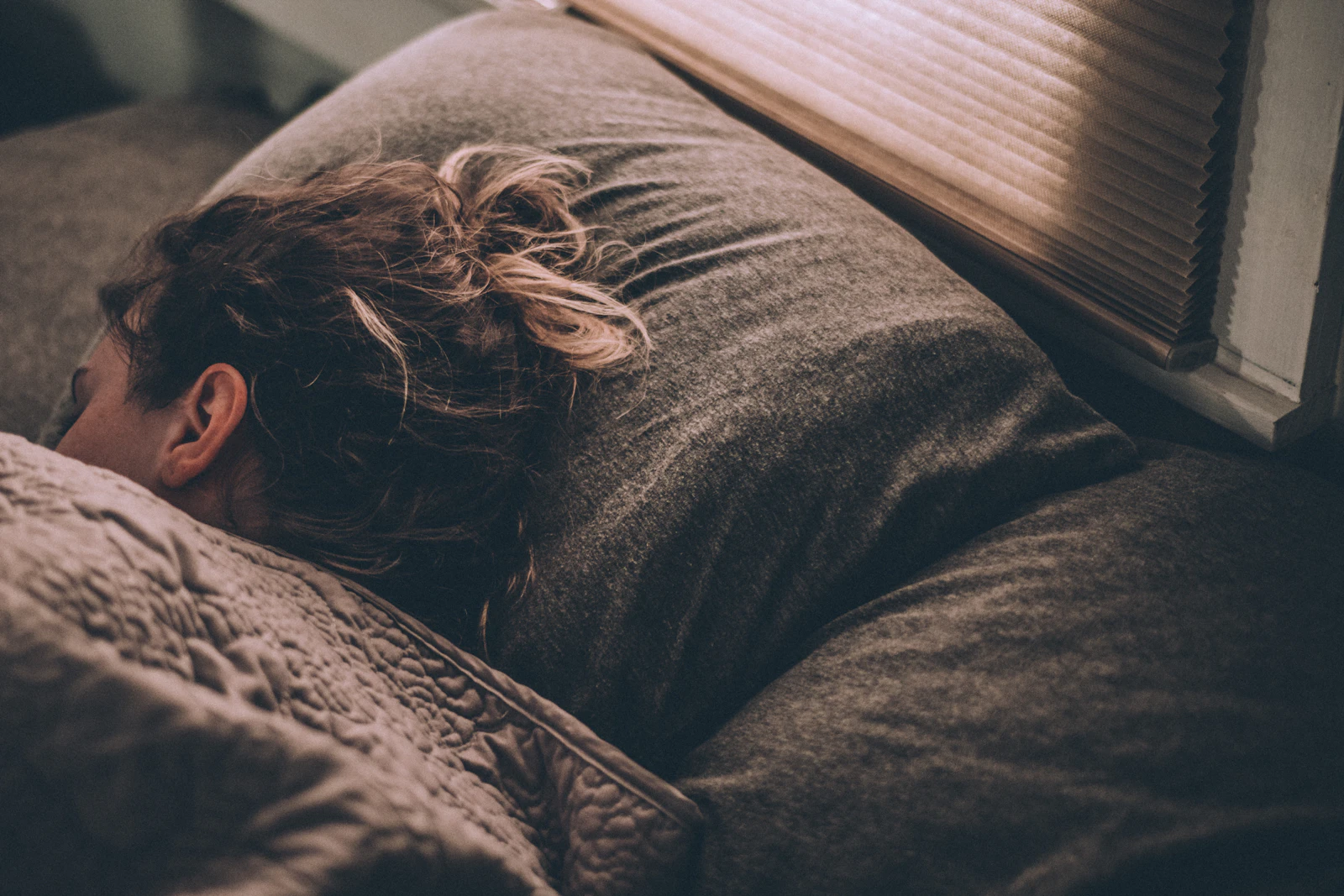
Sleep runs in cycles of roughly 90 minutes. Deep sleep clusters in the first half of the night; the second half is mostly light sleep and REM (dream) sleep. Around 3–4am your sleep is at its most fragile: deep sleep is nearly done, and your body temperature and cortisol are already beginning their pre-dawn rise toward morning. Your defenses are at their lowest, so any disturbance, internal or external, can wake you completely.
Then the conditioning loop kicks in. If you wake at 3am a few nights in a row and look at the clock, your brain memorizes that time and starts raising alertness right on schedule. The more you worry “will I wake at 3am again tonight?”, the more likely it becomes. Which is why the first step in breaking the pattern is usually not “try harder to sleep” but stop checking the time, and stop fighting wakefulness.
The Seven Usual Suspects
These factors, alone or combined, are what usually drive second-half-of-the-night waking. Check yourself against each one.
- Stress and anxiety: the most common driver. When stress hormones fall out of rhythm, the arousal response fires too early; once awake, rumination (replaying work, relationships, health worries) keeps you from drifting back.
- Alcohol: it helps you fall asleep, but as your body metabolizes it there’s a rebound effect that sharply increases early-morning waking. A 3–4am wake-up after drinks is textbook.
- Caffeine sensitivity: caffeine’s half-life is 5–6 hours. In sensitive people, one coffee at noon can still be fragmenting your sleep after midnight.
- Blood-sugar swings and late meals: eating heavily or drinking close to bed can trigger night waking via blood-sugar fluctuations; some people on very long fasting gaps may also wake from a mild dip.
- Nighttime urination: fluids before bed, alcohol, and age-related hormone shifts all increase nighttime bathroom trips. The real problem usually isn’t waking to pee; it’s lying awake for an hour or two afterward.
- Hormonal changes: staying asleep naturally gets harder after 40. For women in perimenopause, 3am waking with hot flashes and night sweats is especially common.
- Things to rule out medically: sleep apnea (with loud snoring, choking or gasping), thyroid issues, restless legs, and depression (a classic sign is waking 1–2 hours earlier than usual and being unable to fall back asleep). These don’t respond to self-care; see the medical guidance at the end.
One side note: if your 3am waking often comes with a headache on waking, that’s a different set of clues: fragmented sleep, teeth grinding, and sleep apnea can sit behind both. Read why you might wake up with a headache every morning.
How Chinese Medicine Looks at 3am Waking
Chinese medicine doesn’t treat waking at 3am as an isolated symptom. It reads the time you wake, what you feel when you wake, and how you function during the day as one picture. What follows is the traditional framework, offered for self-observation. It’s a traditional model, not a medical diagnosis in the modern sense.
The Body Clock View: Why 3am Specifically?
Chinese medicine works with an ancient “body clock”: the day is divided into twelve two-hour windows, each linked to an organ system. Pairing the hours with organ systems goes back to the Huangdi Neijing, some two thousand years old, while ziwuliuzhu, the systematic time-selection theory built on that idea, took shape in the Song, Jin and Yuan eras, roughly eight hundred years ago. On this clock, 1–3am belongs to the Liver system, and 3–5am to the Lung system. Note that the “Liver” and “Lung” here aren’t just the anatomical organs; they’re functional systems. The Liver system governs the smooth flow of emotions and the storage of blood; the Lung system governs breathing and the distribution of energy through the body. For the full clock and what each window traditionally calls for, see the Chinese body clock.
The organ-hour clock is a traditional framework, not a tested explanation for waking at 3am. There is no reliable evidence that the hour alone identifies an organ problem or constitution. Consider common sleep and health factors, and seek assessment for persistent or concerning symptoms.
One layer deeper, classical texts explain sleep itself through wei qi, which you can picture as your body’s “wakefulness security guard.” By day it patrols the surface and keeps you alert; by night it retreats deep inside, and you sleep. Waking too early means the guard clocked in ahead of schedule. Why early? Tradition gives three categories of cause: not enough “yin” (the body’s cooling, nourishing reserves) to hold it inside; excess internal “heat” driving it out; or emotional stagnation blocking its path. The four patterns below are different faces of this one mechanism.
There’s also the classical idea that “the Liver stores the hun,” roughly the part of your mind that wanders in dreams. When Liver blood is abundant, the hun settles into the blood at night and sleep is quiet. When it’s not, the hun “has nowhere to rest,” and the result is vivid, tense dreams and easy waking, which is why so many 3am wakers say they “spent the whole night in stressful dreams.” Nearly 1,800 years ago, the classic Jin Gui Yao Lue recorded the famous formula Suan Zao Ren Tang (sour jujube seed decoction) for exactly this “exhausted but too wired to sleep” state. This is classical background, not a prescription; any herbal use should be guided by a qualified practitioner.
Four Common Patterns
Match these against the state you wake in:
The “wired and frustrated” pattern (wake with emotion, tense dreams) Most common in people under sustained stress. You wake feeling irritable, or with an emotional charge; dreams are frequent and stressful; by day you’re quick to sigh, quick to snap, with a tight or stuffy feeling in the chest or under the ribs; nights after conflict or high-pressure days are clearly worse. Traditionally this is read as constrained Liver qi: emotion that never got an outlet during the day tends to push you awake at the night’s most fragile handover. Daily direction: more movement and emotional outlets by day, a wind-down ritual at night.
The “hot and bothered” pattern (wake overheated, maybe sweating) You wake feeling hot, possibly sweaty, with warm palms and soles, a dry mouth, a noticeable heartbeat when lying down, and dry eyes by day. Common in chronic night-owls, people running on empty, and women around menopause. Traditionally read as depleted “yin” with restless internal heat: the cooling reserves run too low to hold that wakefulness energy inside, so it surfaces early, and warm. Daily direction: cut late-night spicy food, alcohol, and heavy screen time; skip evening workouts that leave you sweating.
The “light sleeper” pattern (wake at every sound, heart fluttering, hard to settle) You wake at the slightest noise, with a mildly racing heart that’s hard to calm; by day you’re fatigued, appetite is so-so, memory feels duller, complexion a bit sallow. Common in people who overthink, eat irregularly, and carry others’ worries. Traditionally read as undernourished “qi and blood” failing to settle the mind: without enough nourishment to anchor it, the mind won’t stay parked. Daily direction: regular meals and a regular schedule are more fundamental here than any calming trick.
The “heavy and bloated” pattern (wake with chest or stomach discomfort) You wake with a stuffy chest or a bloated stomach, a bitter taste or a coated, sticky feeling in the mouth, a thick tongue coating; clearly worse after late, rich dinners; often in people carrying extra weight. The classical phrase for this, from the Suwen, is “an unsettled stomach makes for unsettled sleep”: if your gut is still on the night shift when you lie down, your body can’t fully hand over to sleep. Daily direction: a light dinner, finished at least 3 hours before bed, to relieve the digestive load first.
Traditional accounts also discuss tendencies using categories such as qi-stagnation constitution, yin-deficiency constitution, the nine TCM constitution types. These are classifications within the traditional framework, not validated predictions of symptoms or explanations of a medical cause. A few episodes, a clock time or a quiz result cannot establish a diagnosis. Persistent symptoms need medical assessment; any TCM pattern needs individual practitioner assessment. See the NCCIH overview for research and safety limits.
The evidence boundary deserves the same plainness: NCCIH’s overall assessment of Chinese medicine is that acupuncture has been studied relatively well for some pain conditions, while research quality in many other areas, including herbal medicine, is too uneven for firm conclusions. So treat the TCM content here as a self-observation and daily-care framework, not a substitute for evaluation and treatment.
Everyday Adjustments
In the order you can start them tonight:
- No clock-watching, no phone. Turn the clock around. Checking the time reinforces the 3am conditioning; screen light pushes alertness even higher. This is step one in breaking the loop.
- Don’t force sleep. Still awake after roughly 20 minutes? Get up, go somewhere dim, do something boring (a paper book), and return when drowsy. This is “stimulus control,” a core technique of CBT-I, the recommended first-line treatment for chronic insomnia.
- Breathe low and slow. In for 4 seconds, out for 6–8. Emphasizing the exhale helps bring your nervous system down from alert mode.
- No caffeine after 2pm, no alcohol or big meals within 3 hours of bed. The three most common fixable causes of second-half waking; the NHS goes further and says no alcohol, tea, or coffee for at least 6 hours before bed.
- Fix your wake-up time, weekends included (within an hour). It’s the strongest anchor for your body clock, and far easier to execute than “try to fall asleep earlier.”
- Cool, dark bedroom. Body temperature naturally rises in the second half of the night; a cooler room (around 64–68°F / 18–20°C) reduces heat-triggered waking.
- Regular daytime exercise. One of the best-supported sleep improvers there is, but keep vigorous workouts out of the last 2–3 hours before bed, since raised body heat and alertness take hours to come down.
TCM Methods
Five categories, matched to the four patterns. Start with the one or two easiest to sustain; you don’t need everything at once.
Acupressure
Each night before bed, press the following points with a fingertip, 30–60 seconds each, breathing slowly, pressure just firm enough to feel a mild ache. Harder is not better.
Shenmen (HT7, “Spirit Gate”) Location: On the wrist crease, on the little-finger side, in the hollow just inside the tendon. Traditional use: The best-known calming point in Chinese medicine, traditionally used for restlessness and dream-disturbed sleep. 60 seconds per wrist. Suits all four patterns.
Taichong (LR3, “Great Rushing”) Location: On the top of the foot, in the depression where the bones of the big toe and second toe meet as you slide up toward the ankle. Traditional use: Traditionally used to ease bottled-up emotional tension, the match for the wired-and-frustrated pattern. 60 seconds per foot.
Sanyinjiao (SP6, “Three Yin Intersection”) Location: About four finger-widths above the inner ankle bone, just behind the edge of the shin bone. Traditional use: Traditionally linked to the Liver, Spleen, and Kidney systems at once, suited to the hot, sweaty pattern. 60 seconds per leg. Do not use during pregnancy.
Anmian (“Peaceful Sleep” point) Location: Midway along the line between Yifeng (the hollow behind the earlobe) and Fengchi (the hollows at the base of the skull, either side of the neck). Traditional use: An extra point whose name literally means “peaceful sleep.” Gently rub 1–2 minutes before bed.
This set mostly calms the mind and eases constraint, so it fits the qi-stagnation and yin-deficiency tendencies best. Skip skin that’s broken, red, or swollen, and press more lightly if you’re generally frail.
Food Therapy
Chinese home-style track:
- Millet and lily bulb congee: 50 g millet plus 20 g dried lily bulbs (50 g if fresh), rinsed and simmered in about 800 ml of water for 30 minutes into a thin porridge. Have it as the dinner staple or a small warm bowl about 2 hours before bed. Millet (sold as hulled millet in Asian supermarkets, health-food stores, or online) is traditionally considered settling for the stomach and calming for the mind; lily bulbs (bai he, pale dried petals from an Asian grocer or online) traditionally clear restlessness. Suits the hot, bothered direction.
- Lotus seed, longan, and red date tea: 15 g dried lotus seeds (lian zi, white dried seeds, cored; Asian supermarket or online), 5 dried longans (gui yuan rou, a small chewy dried fruit in the lychee family, same sources), and 3 red dates (jujubes, sold dried at Asian grocers or online), split open, simmered in about 600 ml of water for 30 minutes; drink warm about 2 hours before bed. Traditionally nourishes the heart-and-spleen direction, suited to light sleepers who feel drained by day. Go easy if you tend to run hot or feel heavy and congested.
- A light dinner, finished 3 hours before bed. The everyday answer to “an unsettled stomach makes for unsettled sleep”: let digestion be mostly done before you lie down. If you’re the heavy-bloated pattern, run this one change for a week first.
- Cut back at night: spicy food, greasy food, and alcohol, all considered “heat-stirring” in the traditional view; the hot pattern should be strictest about them.
Western everyday track:
- Banana oatmeal bowl: simmer 50 g rolled oats in 250 ml milk or water for 5 minutes, slice in half a banana, dust with cinnamon. Serve as a light dinner or a snack 2–3 hours before bed. Warm, soft, and easy to digest, the same idea as the millet congee: don’t give your gut a night shift. Suits the heavy-bloated and light-sleeper patterns.
- Warm milk with honey: a cup of warm milk (about 200 ml) an hour before bed, with a teaspoon of honey stirred in. The classic Western bedtime drink, working the same “settle the stomach, settle the evening” direction.
- Chamomile tea: one tea bag steeped 5 minutes in hot water, after dinner. A standard supermarket herbal tea, traditionally used for winding down before bed, and the Western counterpart to the lily bulb direction, suited to the wired and the hot patterns.
- Make dinner smaller, period: Western sleep hygiene advice says the same thing the Chinese track does: nothing heavy within 3 hours of bed. For sleep-maintenance problems, a late, rich dinner is the first thing to remove.
Everything here is a food-therapy use of culinary-grade ingredients; if you intend to use any of them as medicinal herbs, consult a licensed TCM practitioner first.
Emotional Care
A traditional saying goes: “Calm the mind first; the eyes will follow.” If the day’s business isn’t put down, closing your eyes won’t help. This section matters most for the wired-and-frustrated pattern and qi-stagnation tendency, but anyone in a high-pressure stretch can use it.
- Give emotions a daytime outlet. Walking, exercise, talking it out, journaling. The Liver system’s job is keeping emotions moving, and what moves by day doesn’t jam at night.
- Write a “park-it list” before bed. Everything still on your mind goes on the list, each with a note for when tomorrow you’ll handle it — once written, it stays on the desk, not in your head at 3 a.m.
- Don’t fight wakefulness. The more anxious you get about being awake, the more alert you become; traditional wisdom and modern CBT-I completely agree on this one.
Movement and Gentle Exercise
- Regular daytime exercise is one of the best-supported sleep improvers there is. Traditionally it moves energy and releases stagnation, and modern research says the same.
- Gentle traditional practices like baduanjin (Eight Brocades qigong) or tai chi suit the early evening. If you run hot and restless, the “sway the head and swing the tail to cool the heart-fire” movement is the traditional favorite.
- Avoid vigorous exercise within 2 hours of bed; the raised body heat and alertness take hours to come down.
Sleep and Daily Rhythm
- A fixed wake time matters more than a fixed bedtime. It’s the strongest anchor for your body clock; keep it within an hour, even on weekends (the same advice as the modern section above, in two vocabularies).
- Aim for lights-out by 11pm. On the traditional clock, 11pm–1am belongs to the Gallbladder system and 1–3am to the Liver, and chronic late nights are said to tax both; in modern terms, late nights also cut into your deep sleep.
- Keep naps to 20–30 minutes. Longer naps dip into deep sleep and can steal your night.
Different patterns call for different emphasis, and that’s by design: the wired pattern works on emotional outlets first, the hot pattern on cooling the evenings down, the light sleeper on regular meals, and the heavy-bloated pattern on dinner itself. If you’re torn between patterns, the free constitution test below can narrow it down — it marks where you sit among the nine tendencies, and what to fix first follows from that. Consider it self-observation, not diagnosis.
A One-Week Night-Waking Diary
Seven days of notes will tell you more about your night-waking than any generic advice. Each morning, jot down four things:
| What to record | How to record it | Example |
|---|---|---|
| Wake-up time | Check once, write it down, then no more clock | 3:10 (roughly fixed?) |
| How you felt on waking | Match against the four patterns | Irritated / hot & sweaty / racing heart / bloated / needed the bathroom |
| The day before | Alcohol, caffeine timing, dinner time and content, stressful events, exercise timing | 2 glasses of wine; coffee at 3pm; 9pm hotpot |
| How long to fall back asleep | Estimate | 20 minutes / over an hour |
After a week, look for the pattern: if waking follows drinks or big meals, start with diet; if it follows stressful days, focus on emotional outlets; if it comes with heat and sweating, that points toward the hot direction. Your notes will tell you which one thing to change first, and that beats trying ten things at once. If you make changes after two weeks, log another round to see what actually moved. And if the diary shows three-plus bad nights a week for three months, bring it to your appointment; it’s exactly the sleep record a doctor would ask for, and far more useful than describing nights from memory.
How Long Until You See Improvement
- Dropping the clock-check + the 20-minute rule: conditioned responses take time to fade. Give it 1–2 weeks; “time to fall back asleep” usually starts shrinking first.
- Caffeine, alcohol, and dinner changes: if your waking tracked these triggers, expect to feel a difference in 3–7 days.
- Fixed wake-up time: re-anchoring the body clock takes 1–2 weeks, and you may feel sleepier at first. Don’t quit early.
- Acupressure, food therapy, emotional care, and gentle exercise: use 2–4 weeks as one observation cycle, comparing against your diary.
Whichever method you picked, if two to four full weeks go by with zero movement, don’t stack on another technique. Book the evaluation — effort is no longer the missing ingredient.
When to See a Doctor
Self-care suits occasional and mild night-waking. Please prioritize a professional evaluation, not just self-care, if any of these apply:
- Waking comes with loud snoring, choking, or gasping, or severe daytime sleepiness: sleep apnea needs to be ruled out;
- Waking with chest tightness, chest pain, or a pounding heart: cardiac causes need to be ruled out;
- Two weeks or more of low mood, loss of interest in everything, or anxiety that clearly impairs your days;
- Poor sleep at least three nights a week for more than three months: that meets the definition of chronic insomnia, and CBT-I (cognitive behavioral therapy for insomnia) is a well-evidenced first-line treatment your doctor or a sleep specialist can guide you to;
- Night sweats that soak through clothes or bedding, especially with unintended weight loss or fever: other causes need checking.
This article is for general health education and can’t replace a doctor’s diagnosis or individualized advice. If you take sleep or psychiatric medication, talk to your doctor before making any changes. Don’t stop medication on your own.
Common Questions
Does waking at 3am mean something is wrong with my liver or lungs?
Not in the way people fear. On the traditional clock, “Liver” and “Lung” name functional systems, not the anatomical organs; a TCM practitioner saying “Liver blood is low” is not commenting on your liver enzymes. And traditional diagnosis never concludes from a wake-up time alone; it always weighs what you feel on waking and how you function by day. If you’re genuinely worried about your liver or lungs, the signals that matter are things like persistent fatigue, yellowing skin or eyes, or a chronic cough, plus proper lab work, not the position of the clock hands.
Will melatonin help me stay asleep?
Probably not much. Melatonin works more like a “time to sleep” signal than a sleeping pill: its strongest evidence is for jet lag and for falling asleep faster. For sleep-maintenance problems (waking in the night and struggling to drift back), studies show little benefit, and the American Academy of Sleep Medicine’s chronic-insomnia guideline recommends against melatonin for chronic insomnia (a weak recommendation, based on limited evidence). If you’re considering taking it long-term, check with your doctor first, especially alongside other medications.
To explore the constitution framework further, read The Nine TCM Constitution Types, Explained Without the Hype; for the full traditional clock, see The Chinese Body Clock; and for a broader look at sleep and Chinese medicine, visit the insomnia topic page.
Which night-waking pattern sounds like you?
The free constitution test shows your tendencies across nine traditional body types — a useful lens for why the same 3am wake-up can call for different daily routines. It is for self-reflection, not medical diagnosis.
References9 sources
- 01
U.S. National Heart, Lung, and Blood Institute (NHLBI / NIH)
- 02
MedlinePlus, U.S. National Institutes of Health
- 03
UK National Health Service (NHS)
- 04
U.S. National Center for Complementary and Integrative Health (NCCIH / NIH)
- 05
Annals of Internal Medicine
- 06
U.S. National Center for Complementary and Integrative Health (NCCIH / NIH)
- 07
U.S. National Center for Complementary and Integrative Health (NCCIH / NIH)
- 08Huangdi Neijing (The Yellow Emperor's Inner Classic)
Foundational text of Chinese medicine
- 09Jin Gui Yao Lue (Essential Prescriptions from the Golden Cabinet), Zhang Zhongjing
Classic of Chinese medicine, ~2nd century CE
Personalized guidance
Use the app for constitution-friendly ideas and structured plans when available.
Download the App
Get personalized TCM health recommendations