
Health article
The Nine TCM Constitution Types, Explained Without the Hype
A clear guide to the nine-type TCM constitution framework: what each traditional pattern means, where the classification is standardised, and what research has not yet proved.
By WellTao · Last updated:
Table of contents
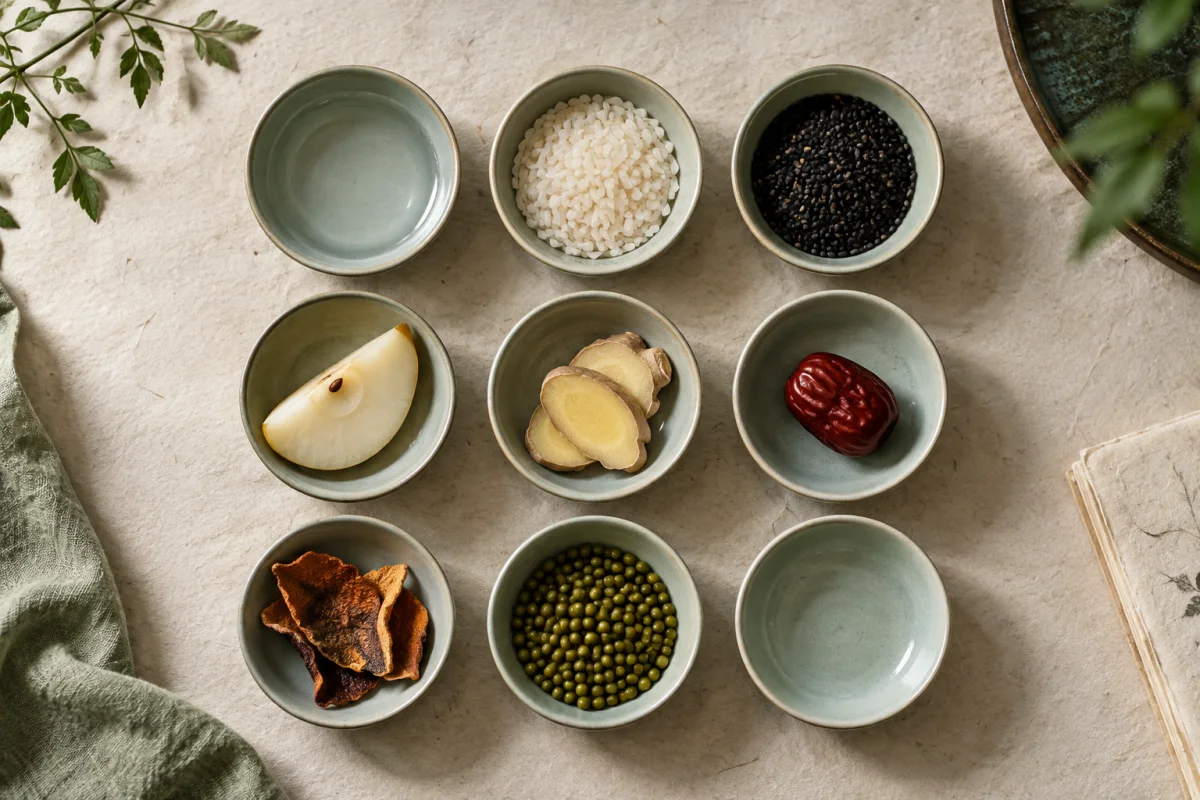
What the Nine-Type Framework Is
The nine constitutions are one modern classification used within traditional Chinese medicine (TCM). The model describes one comparatively balanced constitution and eight patterned tendencies: Qi Deficiency, Yang Deficiency, Yin Deficiency, Phlegm-Dampness, Damp-Heat, Blood Stasis, Qi Stagnation and Allergic Constitution.
In this context, constitution does not mean a fixed personality or a hidden disease. It is the Chinese medicine idea that people show relatively stable differences in how they tend to experience energy, temperature, digestion, body fluids, emotion and the surrounding environment.
That definition belongs to the traditional framework. It should not be mistaken for an established biomedical mechanism, a laboratory measurement or a diagnosis.
The nine-type system is also not the whole of Chinese medicine. Practitioners may use other theories and pattern-identification methods, and not every body-type questionnaire follows the same standard or scoring method.
How the Classification Is Standardised
The nine categories were codified in a 2009 professional association standard in China. A current national standard, GB/T 46939-2025, Classification and determination of constitution in traditional Chinese medicine, was published on December 31, 2025 and took effect on April 1, 2026. The official record lists China’s National Administration of Traditional Chinese Medicine as both the responsible and organising department.
Standardisation matters because it gives writers, researchers and practitioners a shared vocabulary. The World Health Organization has also published international standard terminology for TCM so that technical concepts can be communicated more consistently across languages.
Neither document says that a short consumer quiz can diagnose illness. A classification standard defines the framework; the quality of a questionnaire still depends on its actual items, scoring and validation.
The Nine Types at a Glance
| Constitution | Traditional emphasis | Important boundary |
|---|---|---|
| Balanced | Relative steadiness and adaptability | Does not mean perfect health |
| Qi Deficiency | Low functional energy | Is not a synonym for fatigue |
| Yang Deficiency | Insufficient warmth and activity | Is not diagnosed by cold hands |
| Yin Deficiency | Insufficient cooling and moistening | Is not diagnosed by thirst or poor sleep |
| Phlegm-Dampness | Heaviness, accumulation and sluggish movement | Does not mean literal “toxins” or excess mucus |
| Damp-Heat | Heaviness or stickiness combined with heat | Is not a diagnosis of acne or inflammation |
| Blood Stasis | Impeded movement of blood in TCM theory | Is not a biomedical blood clot diagnosis |
| Qi Stagnation | Constrained movement and regulation | Is not a diagnosis of anxiety or depression |
| Allergic Constitution | Recurring sensitivity in the nine-type model | Cannot identify a specific allergy |
Balanced Constitution: 平和质
The Balanced constitution is the relatively even category in this model. Traditional descriptions emphasize stable energy, comfortable digestion, sound sleep, an even emotional state and ordinary tolerance of seasonal change.
It is a reference category, not a medical certificate. Someone classified as Balanced can still become ill or have a health condition. Read the full Balanced constitution profile.
Qi Deficiency: 气虚质
In Chinese medicine, qi is a broad concept connected with function and activity. Qi Deficiency descriptions commonly group tiring easily, a quiet voice, breathlessness with mild effort and spontaneous sweating.
The category cannot explain why a person is fatigued or short of breath. Persistent symptoms need an appropriate clinical assessment. Read the Qi Deficiency profile.
Yang Deficiency: 阳虚质
Yang represents warmth and activity within the traditional yin-yang model. Yang Deficiency is therefore described through a pattern of cold sensitivity, cold limbs, a preference for warmth and reduced drive or activity.
These are broad experiences, not a diagnostic formula. Read the Yang Deficiency profile.
Yin Deficiency: 阴虚质
Yin represents the cooling, moistening and nourishing side of the traditional model. Yin Deficiency descriptions may include dryness, warmth later in the day, warm palms or soles, restless sleep and night sweating.
TCM language such as “insufficient yin” does not map directly onto a hormone, fluid level or other single biomedical measure. Read the Yin Deficiency profile.
Phlegm-Dampness: 痰湿质
Phlegm-Dampness describes heaviness and accumulation in Chinese medicine theory. Traditional accounts may group a heavy body sensation, fullness, sluggishness and a greasy complexion.
The term dampness is theoretical language. It does not justify detox products, extreme diets or self-prescribed herbs. Read the Phlegm-Dampness profile.
Damp-Heat: 湿热质
Damp-Heat combines the traditional qualities of heaviness or stickiness with warmth or irritation. Oily skin, a bitter taste, digestive discomfort and feeling worse in humid heat are among the features described in this model.
Those features can occur for many unrelated reasons. They should not be treated as proof of a constitution or a disease. Read the Damp-Heat profile.
Blood Stasis: 血瘀质
Blood Stasis is the traditional idea that the movement of blood is impeded. Constitution descriptions may mention discomfort that remains in one place, easy bruising or darker color in the lips or complexion.
It is particularly important not to translate this term into a biomedical diagnosis. Suspected clots, sudden pain, swelling or breathing difficulty require medical care. Read the Blood Stasis profile.
Qi Stagnation: 气郁质
Qi Stagnation describes constrained movement and regulation in TCM theory. Traditional descriptions connect it with frequent sighing, a sensation of tightness, irritability, low mood or changes that appear alongside stress.
It is not a mental health diagnosis. Ongoing anxiety, depression or physical symptoms deserve the appropriate form of care. Read the Qi Stagnation profile.
Allergic Constitution: 特禀质
Te bing zhi is translated in several ways, including Allergic Constitution and Special Diathesis. In the nine-type model it is associated with recurring sensitivity and allergic tendencies.
The category does not identify an allergen and cannot predict the severity of a reaction. Read the Allergic constitution profile.
What Questionnaire Research Shows
Researchers have studied the Constitution in Chinese Medicine Questionnaire (CCMQ), particularly versions that score all nine categories.
A 2013 study in 1,084 Hong Kong participants found that the questionnaire could classify participants into one or more constitution groups. Its ability to predict practitioner classifications varied across the scales, however, and should not be summarized as a single “accuracy” figure.
A 2022 study of 1,571 adults in three villages in southern China broadly supported the nine-factor structure and found reasonable reliability. The authors also reported weaker items and strong overlap between some constitution scales. In other words, the research supports continued use and refinement of that questionnaire; it does not make the categories perfectly distinct.
A 2020 review found 1,639 observational studies linking constitution types with diseases. Most were cross-sectional. Such studies can show that two things appear together in a sample, but they cannot establish that a constitution caused a disease or can predict what will happen to an individual.
What the Research Does Not Show
Current evidence does not establish that:
- every online nine-type quiz is validated;
- a constitution result diagnoses a disease;
- one type has a single genetic, microbiome or biochemical cause;
- a food, herb or acupoint can “correct” a type for everyone;
- constitution-based advice should replace medical care.
Exploratory laboratory studies are interesting, but an association found in a small or specific sample is not a biological proof of the full nine-type model. Claims should stay as narrow as the study that produced them.
A Sensible Way to Use the Model
Use the nine constitutions as a way to read and discuss traditional Chinese medicine more clearly. A careful result may help you notice recurring experiences and organise questions. It should leave room for uncertainty.
Read the plain-English body-type guide before trying to identify with a label. When you are ready, take the free constitution self-check and look at all nine scores together.
Do not use the result to self-prescribe herbs, acupuncture or moxibustion. NCCIH advises against using TCM to replace or delay conventional care and notes real safety concerns with improperly delivered acupuncture and some herbal products. If symptoms are persistent, severe or changing, speak with a qualified healthcare professional.
Take action
Explore the framework through your own answers
The free self-check shows all nine scores together. It is designed for learning and reflection, not medical diagnosis.
References6 sources
- 01
National Standard Information Public Service Platform, China
- 02
World Health Organization (2022)
- 03
Evidence-Based Complementary and Alternative Medicine (2013)
- 04
Patient Preference and Adherence (2022)
- 05
Journal of Traditional Chinese Medicine (2020)
- 06
National Center for Complementary and Integrative Health
WellTao app
Personalized guidance
Use the app for constitution-friendly ideas and structured plans when available.
Download the App
Get personalized TCM health recommendations