How to Sleep With a Headache: Relieve It First, Then Get in Bed
A headache that won't let you sleep calls for a sequence: ease the pain first, then lie down. Cold vs. warm compresses by headache type, acupressure with exact locations, sleep-position parameters, why sleep and headaches feed each other, a one-week tracking log, and clear lines for when to see a doctor.
By WellTao · Published: · Last updated: · Editorial Policy
More articles in this topicTable of contents

The Short Version
How to sleep with a headache comes down to sequence: relieve it first, then get in bed. Don’t just lie there and tough it out. Tonight you can follow this order: rest in a dim, quiet room; choose a cold or warm compress based on your headache type (cold on the forehead for migraine, warm on the neck and shoulders for tension-type); drink a glass of warm water; spend a few minutes on acupressure; then set your sleep position before you lie down. The big rules for position: on your back, neck in a neutral line, pillow neither too high nor too low; if one side of a migraine can’t take pressure, keep that side off the pillow; if your head feels stuffy and congested, prop your upper body up.
Sleep and headaches push each other in both directions: a bad night makes headaches more likely and more painful, and a genuinely good night of sleep is itself pain relief. That’s why the methods in this guide work on two levels, the emergency handling for tonight and the routine adjustments for the next week or two.
One situation is not covered by anything here: if the headache arrived suddenly like an explosion, or comes with vomiting, fever, trouble speaking or seeing, or weakness in a limb, get medical care immediately. The full list is in the doctor’s section at the end.
Which Headache Is Keeping You Up
Most people who can’t lie down because of a headache fall into one of three scenarios, and the handling differs slightly:
- Tight-band (tension-type direction): both sides of the head feel squeezed by a strap or pressed down, the neck and shoulders are stiff, and you can function normally but the pain won’t let you sleep. Stress, sleep problems, and caffeine are its common triggers. Sleeping with a tension headache is mostly about releasing the neck and shoulders before you lie down.
- Pulsing (migraine direction): one side throbs in time with your pulse, light and noise hurt, and nausea is possible. This kind is sensitive to the environment, so a dark, quiet room is itself part of the treatment.
- Stuffy pressure (nasal congestion and facial fullness): with a cold or blocked sinuses, the forehead and face feel swollen and heavy, and lying flat is worse than standing. If your headache reliably gets worse when you lie down, read why headaches get worse when lying down.
A bad night once in a while, handled and slept off, is normal fluctuation. What deserves real attention: headaches several times a week, headaches that regularly wake you at night, or headaches that keep getting worse. That’s no longer a “how do I sleep tonight” problem but a sign to get evaluated, covered at the end of this guide.
How Sleep and Headaches Feed Each Other
Headaches and sleep are neighbors in the brain. The hypothalamus and other regions that regulate sleep overlap anatomically and functionally with the trigeminovascular system that carries head and face pain, so the two drag each other down easily. A review on sleep disorders and headache sums up several key points:
- Short sleep lowers your pain threshold. In studies of healthy volunteers, cutting sleep time lowered pain tolerance; extending sleep lowered pain sensitivity. A sleep-deprived brain is, in effect, undefended against pain: the same stimulus simply hurts more.
- Insomnia raises headache risk. People with insomnia develop migraine and tension-type headache at roughly 2 to 3 times the average rate, and the two form a loop: pain blocks sleep, and poor sleep brings more pain the next day.
- A good night’s sleep genuinely relieves pain. Clinicians have long recorded migraine attacks ending in deep sleep. Melatonin, beyond setting your sleep rhythm, has some pain-relieving action of its own, and people with chronic migraine plus insomnia often test low on melatonin secretion.
- But oversleeping triggers headaches too. The Mayo Clinic lists both too little and too much sleep as migraine triggers. Catching up until noon on a weekend and waking with a headache is the classic oversleep headache. If mornings are when your head hurts, read why you wake up with a headache every morning.
Two sleep-related headaches are worth knowing by name:
Hypnic headache is a rare headache that only strikes during sleep, mostly after age 50, waking people at almost the same time every night, often between 2 and 4 a.m. If you or an older family member has this alarm-clock pattern of nighttime headaches, it needs a neurological evaluation; self-adjustment won’t fix it.
Medication-overuse headache is the other trap: taking painkillers too often causes headaches by itself. The Mayo Clinic’s thresholds: ibuprofen- or aspirin-type painkillers on more than 14 days a month, or triptans on more than 9, can cause rebound. An occasional dose at the labeled amount is fine; adding doses or frequency on your own to get to sleep points in the wrong direction.
The Chinese Medicine View
In traditional theory, sleep is the process of “yang entering yin,” and a headache often means yang energy is floating up top and can’t settle back down. What follows is a traditional empirical model, offered for self-observation, not a diagnosis in the modern medical sense.
Chinese medicine describes a day-night rhythm system called wei qi, or “defensive qi”: by day it circulates at the body’s surface (the yang side) and you stay alert; by night it returns to the interior (the yin side), and only then can you fall asleep. The Lingshu says “when yang qi is exhausted and yin qi prevails, the eyes close.” Its chapter on delusion describes the mechanism of insomnia as “wei qi unable to enter the yin, always remaining in the yang… therefore the eyes do not close”: the energy that should withdraw stays out at the surface, and you lie there wanting sleep that won’t come.
A headache is exactly a state of “yang flaring upward” or “no flow, therefore pain”: qi and blood stagnating or surging in the head and face make it even harder for wei qi to enter the yin. That is the traditional reading of why headache nights so often turn into sleepless nights. In reverse, short sleep wears down qi and blood, and the next day’s headache comes more easily. Traditional theory and modern medicine are describing the same loop in two languages.
Three presentation patterns account for most nights of headache-driven insomnia:
Tense and worry-driven: the headache feels like a tight band, the neck and shoulders are rigid, it worsens after pressure or bottled-up frustration, and once horizontal the mind won’t stop turning things over. The daily direction here is to give the emotions and the neck-and-shoulder tension an outlet.
Fixed and stabbing: the pain sits in one spot like a needle or an awl, has been going a long time, and is often more obvious at night. Traditional theory holds that night belongs to yin and blood moves more slowly after dark, so stagnant pain stands out at night. The daily direction is to avoid long sitting and get the body moving during the day.
Heavy and stuffy: the head feels wrapped, swollen, and foggy, often alongside nasal congestion, chest tightness, and poor appetite. It’s more common in people carrying extra weight with a thick, greasy tongue coating, and lying flat makes the stuffiness worse. The daily direction: a light dinner at seventy percent full, and the upper body propped up in bed.
Traditional accounts also discuss tendencies using categories such as qi-stagnation constitution, blood-stasis constitution, phlegm-dampness constitution, the nine TCM constitution types. These are classifications within the traditional framework, not validated predictions of symptoms or explanations of a medical cause. A few episodes, a clock time or a quiz result cannot establish a diagnosis. Persistent symptoms need medical assessment; any TCM pattern needs individual practitioner assessment. See the NCCIH overview for research and safety limits.
Where the evidence stands: the NCCIH’s assessment of Chinese herbal research is that study quality varies and no firm conclusions about effectiveness can be drawn. So the TCM sections of this guide are positioned as self-observation and daily care within a traditional framework, not a substitute for evaluation and treatment.
What to Do Tonight
Following the “relieve first, then bed” order, complete these steps 30 to 60 minutes before you lie down:
- Move to a dark, quiet place. Anyone in the migraine direction needs this most, since light and sound directly intensify the pain. Turn the bedroom light off or all the way down, and put the phone down.
- Pick cold or warm by headache type. For pulsing pain, use cold: wrap an ice pack in a towel and hold it to your forehead or temples for 10 to 15 minutes. For a tight band with a stiff neck, use warmth: a warm towel or hot water bottle on the neck and shoulders for 15 to 20 minutes. The NHS advice for neck pain with headache is the same pairing: hot or cold compresses plus one low, firm pillow. For the stuffy, congested type, hold a warm towel over the nose for a few minutes to help it open.
- Drink a glass of warm water. Dehydration can trigger or worsen a headache on its own. Have one small glass before bed, not a large amount, or you’ll be up again in the night.
- No more caffeine tonight. Caffeine is an ingredient in many combination painkillers (the high-risk overuse combination the Mayo Clinic names is exactly aspirin, acetaminophen, and caffeine together), but its half-life runs about 5 to 6 hours, so a late dose sits on your sleepiness and buys you a milder headache plus a wide-awake brain. The FDA’s reference limit for most adults is about 400 milligrams a day, two or three cups of coffee, and the NHS advises people with tension-type headache to cut caffeinated drinks outright. The working rule: no new caffeine after 2 p.m. If you drink coffee every day, don’t quit cold tonight either, since withdrawal causes headaches of its own; taper gradually instead.
- Take painkillers at the labeled dose, and never add extra to get to sleep. An occasional dose is no problem. If you notice you’re reaching for them several times a week, read the doctor’s section first; the medication-overuse trap is right down that road.
- Set your sleep position before you lie down. First choice is on your back, with the pillow filling the gap between your neck and the mattress so your cervical spine stays neutral, chin neither tucked to the chest nor tipped back. If you’re a side sleeper, put a pillow between your knees to keep your pelvis level. If one side of a migraine can’t tolerate pressure, sleep on the other side or on your back. For the stuffy, congested type, raise your upper body 15 to 30 degrees, with two pillows or a wedge, to reduce blood pooling in the head and face.
The Chinese Medicine Toolkit
The five categories below correspond to the three patterns above. Start with the one or two easiest to do tonight; there’s no need to do everything at once.
Acupressure
All of these can be done at your bedside. Use the pad of a finger and press until you feel a mild, slightly sore ache.
Hegu (LI4) Location: on the back of the hand, between the first and second metacarpal bones, roughly level with the midpoint of the second metacarpal. Traditional use: traditionally summed up as “Hegu commands the face and mouth,” the most-used point for head and face pain. Press each side for 60 seconds. Do not use during pregnancy.
Taiyang (EX-HN5) Location: in the hollow about one finger-width behind the midpoint of a line drawn from the outer tip of the eyebrow to the outer corner of the eye. Traditional use: traditionally used for headache and eye pressure. Rub gently with a fingertip for 1 to 2 minutes before bed. Keep the pressure light, and never press toward the eyeball.
Fengchi (GB20) Location: at the base of the skull, in the hollow between the upper ends of the two large neck muscles (the sternocleidomastoid and the trapezius). Traditional use: traditionally disperses wind and clears the head. Press each side for 60 seconds when a tight-band headache comes with a stiff neck.
Sanyinjiao (SP6) Location: about four finger-widths above the tip of the inner ankle bone, at the back edge of the shinbone. Traditional use: connects to the Liver, Spleen, and Kidney channels at once. Use it when headache comes with poor sleep and frequent waking: 60 seconds per side before bed. Do not use during pregnancy.
This set centers on unblocking the head and face and settling the mind, and suits both qi-stagnation and blood-stasis tendencies. For the heavy, stuffy pattern, add Zusanli (ST36), four finger-widths below the outer hollow under the kneecap. One evidence boundary to state plainly: for acupuncture as migraine and tension-type headache prevention, the NCCIH cites Cochrane reviews showing moderate-quality evidence that it reduces attack frequency. Those studies used needling, and their results cannot be transferred to bedtime self-acupressure. Pressing these points is a relaxation aid, not a treatment.
Food Therapy
- Dinner at seventy percent full, finished 2 to 3 hours before bed, avoiding spicy and greasy food. The heavy, stuffy pattern especially needs this rule: a heavy digestive load at night makes the fullness in the head and face more obvious.
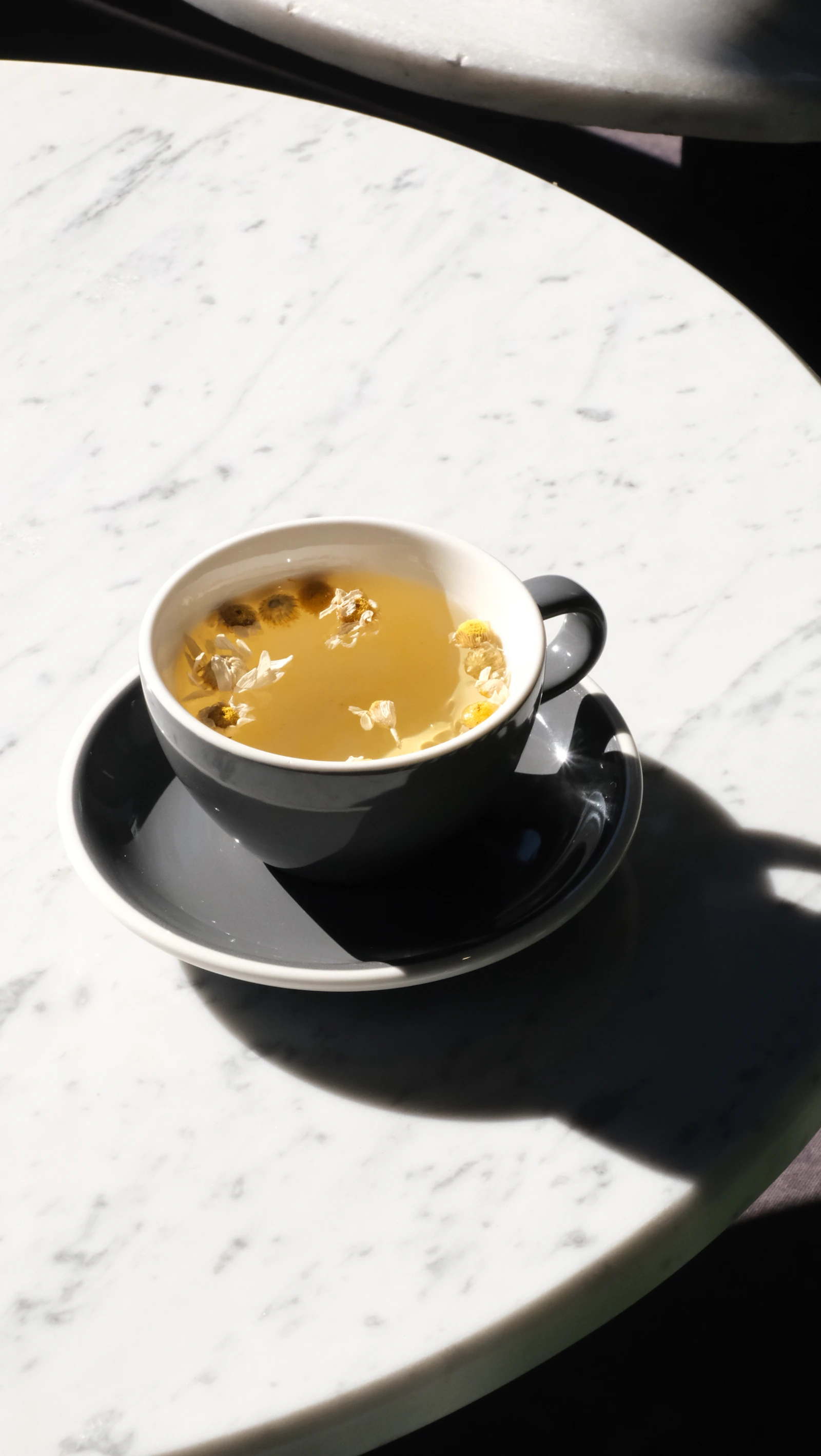
- One warm, caffeine-free drink an hour before bed: chamomile tea (2 to 3 grams of dried flowers steeped in 300 milliliters of hot water for 5 minutes) or 200 milliliters of warm milk. To be honest about the evidence: the NCCIH’s assessment of chamomile for sleep is that there is very little research, and what exists shows no clear effect. Its value lies more in the relaxation signal of a warm, caffeine-free, fixed ritual. Skip it if you’re allergic to plants in the daisy family, such as ragweed.
The Chinese home-style track
- Lily bulb and lotus seed millet congee: 10 grams of dried lily bulbs (bai he, the dried petals of the edible lily, sold at Asian supermarkets or online), 15 grams of shelled, cored lotus seeds (lian zi, same sources), and 50 grams of millet, simmered in 800 milliliters of water for 40 minutes into a porridge. Serve as the dinner staple or a small bowl two hours before bed. Traditionally, lily bulb and lotus seed nourish the heart and settle the mind, suiting the tense, worry-driven pattern. (Food-therapy use; consult a licensed TCM practitioner before using these as medicinal herbs.)
- Longan and red date tea: 3 to 4 dried longan fruits (gui yuan, dried longan flesh, Asian supermarkets or online) and 3 red dates (jujubes, hong zao, same sources, split open), simmered in water for 15 minutes and sipped as tea. Traditionally it replenishes qi and blood and settles the mind, suiting people with a long-standing dull ache and daytime fatigue. Stop drinking it during a heat flare, with a dry or bitter mouth. (Food-therapy use; consult a licensed TCM practitioner before using these as medicinal herbs.)
The Western everyday track
- Banana cinnamon oatmeal: 50 grams of rolled oats simmered in 250 milliliters of milk or water for 5 minutes, topped with half a sliced banana, a pinch of cinnamon, and a spoonful of honey. Serve as the dinner staple or a small bowl two hours before bed. The direction is the same as the lily bulb and lotus seed congee: warm, easy on the stomach, and settling before sleep, suiting the tense, worry-driven pattern.
- Date and ginger tea: 3 dates, pitted and torn open, plus 2 thin slices of fresh ginger, simmered in 300 milliliters of water for 10 minutes and sipped as tea. The direction matches the longan and red date tea: gently warming and replenishing, suiting a long-standing dull ache with daytime fatigue. Stop during a heat flare with a dry or bitter mouth.
- Pumpkin, lentil, and chicken soup: 200 grams of chicken thigh, 150 grams of pumpkin in chunks, 50 grams of dried lentils, and half a carrot, simmered in 1 liter of water for 40 minutes with light salt, served at dinner with a small bowl of rice. Light, gently warming, and easy to digest. If you run the heavy, stuffy pattern, switching dinner to a soup-and-rice combination like this, together with the seventy-percent-full rule, takes some of the fullness out of your head and face.
The food section centers on settling the mind and the stomach: a qi-stagnation tendency points first to the lily bulb congee or the banana cinnamon oatmeal, paired with the emotions section; a phlegm-dampness tendency points first to a light dinner at seventy percent full; a blood-stasis tendency carries no special dietary restrictions, and its real work is in the movement section.
Emotional Care
A tense, worry-driven headache is half tight neck and shoulders, half a tight mind.
- The park-it list: before bed, write down everything on your mind, one item per line, with a note of when tomorrow you’ll handle it. Hand it to the paper, not your pillow. The writing itself is an outlet for bound-up qi.
- Belly breathing: lying on your back or sitting propped up, breathe in through the nose for 4 counts and out through the mouth for 6 to 8, for 5 to 10 minutes. The longer exhale tells the nervous system it’s time to stand down. You can do it mid-headache, and it works better in a dark room.
This section maps most directly onto a qi-stagnation tendency, but anyone under heavy daytime pressure can use it, whatever their constitution.
Movement
- A 20 to 30 minute evening walk: moving the body during the day keeps the blood flowing, and fixed, stabbing nighttime headaches often ease along with it. Avoid vigorous exercise within 2 hours of bed; with heart rate and body temperature still elevated, sleep comes harder.
- Gentle neck and shoulder stretches before bed: slowly lower and raise your head and tilt it to each side, holding 15 to 20 seconds per direction, then circle both shoulders 10 times. Work to a light pulling sensation only, never for range. Do this before lying down with a tight-band headache and your neck and shoulders will let go noticeably.
Gentle movement suits all three tendencies, qi stagnation, blood stasis, and phlegm dampness. People with the heavy, stuffy pattern can sweat a bit more during the day, still stopping short of feeling wiped out.
Daily Rhythm
This section is the root of the matter. Emergency measures cover tonight; rhythm covers everything after:
- Fix your wake time, within one hour even on weekends. As covered earlier, too much sleep triggers headaches as reliably as too little, and a weekend sleep-in binge is a classic cause of waking up with a headache.
- In bed and asleep by 11 p.m. That matches the traditional “yang entering yin” window, and it leaves enough deep-sleep time to restore your pain threshold.
- A 90-minute runway before sleep, taking an 11 p.m. bedtime as the example: at 9:30, dim the lights and switch the phone to night mode or put it down; at 9:45, soak your feet for 15 minutes in water around 40°C (104°F), above the ankles; at 10:00, do your acupressure and belly breathing; at 10:30, get in bed. The point of the routine is the fixed order, which lets the body build a conditioned response.
- Cap naps at 30 minutes and finish them before 3 p.m., so they don’t eat into the night’s sleepiness.
Rhythm is constitution-blind and suits everyone. Add the emotional care section for a qi-stagnation tendency and hold the two dinner rules for a phlegm-dampness tendency, and the effect compounds.
How nighttime headache patterns relate to constitution tendencies is covered above. If you want to know which way you lean, the free constitution test at the end of this page is a self-observation tool, not a diagnosis: it shows your tendencies across the nine constitutions and helps you decide which category of adjustment to start with.
A One-Week Headache and Sleep Log
Track seven days in a row and you’ll see exactly how your headaches and sleep push each other around. One minute morning and night:
| What to record | How | Example |
|---|---|---|
| Headache at bedtime | Location, character, intensity (0–10) | Both sides, tight band, 5 |
| What you did that night | Which methods, how long to relief | Warm compress on neck 20 min, eased in about half an hour |
| Sleep | When you got in bed and fell asleep, pain-awakenings | In bed 10:40 p.m., woke once |
| Morning state | Headache still there, and how strong | Down to a 2 |
| Caffeine and screens | Time of last coffee, screen time before bed | Coffee 3 p.m., phone until 11 |
| Stress and mood that day | Any obvious tension | Deadline crunch, wound tight all afternoon |
| Position and pillow | Back or side, pillow changes | On back, switched to a lower pillow |
Read it back after a week. Bedtime pain moving in step with stressful days points toward the tense, worry-driven direction; waking with pain at the same time every night raises the question of hypnic headache; pain worse in the morning than at bedtime suggests the sleep itself has a problem (snoring with apnea and oversleeping are both candidates). Taking this log to an appointment beats any verbal description.
How Long Until It Helps
Treat review dates as opportunities to assess symptoms, not guarantees of relief. Headache courses differ, and self-pressure, tea, posture or routine changes do not share an established timetable for benefit.
- During an attack: note whether rest or optional gentle pressure makes you more comfortable. Stop if it does not help, worsens symptoms or hurts; do not delay your agreed treatment to finish a routine.
- Review your diary weekly: summarize headache days, severity, associated symptoms and medicine days. The record helps a clinical conversation; it cannot establish a cause.
- Get assessed when needed: first exertional headache, pain worsened lying down, or new, changing or persistent headache warrants assessment rather than a mandatory one- or two-week trial. Discuss frequent acute-medicine use with a clinician; they decide any medication change. The emergency signs below need immediate help.
See MedlinePlus advice on seeking care.
When to See a Doctor
The methods in this guide are for occasional, mild to moderate headaches that disturb sleep. Following MedlinePlus and Mayo Clinic guidance, get immediate or emergency care, with no self-treatment, for any of these:
- A headache that arrives suddenly, like an explosion, or is the worst headache of your life;
- Headache with fever, a stiff neck, vomiting, or confusion, or with slurred speech, vision changes, or weakness or numbness on one side;
- A headache that starts after a head injury;
- Severe pain around one eye with a red eye;
- A chronic headache clearly worsened by coughing, straining, or bending over.
Book an appointment promptly, within days to a couple of weeks, for any of these:
- Headaches that regularly wake you from sleep, or come often enough to keep you from falling asleep. MedlinePlus lists headaches that wake you from sleep as a sign to get evaluated promptly;
- Headaches several times a week, growing more frequent or more severe, or clearly different from your usual pattern;
- A new headache after age 50, or a new headache with any history of cancer;
- No improvement after 2 to 4 weeks of self-adjustment, or painkiller use on more than 10 to 14 days a month.
Bring your headache and sleep log to the appointment, and describe how often attacks come, how often pain wakes you at night, and what you’ve already adjusted.
This article is general health education and cannot replace a doctor’s diagnosis or individualized advice. If you take any prescription medication, especially migraine preventives, anticoagulants, or sleep medication, talk to your doctor before any dose change, and don’t stop medication on your own or stack over-the-counter painkillers or melatonin on top.
Common Questions
Why does a headache sometimes just vanish after sleep?
It’s not a coincidence. During sleep the brain’s sensory gates filter out incoming stimulation, deep sleep restores your pain tolerance threshold, and melatonin, secreted at night, has some pain-relieving action of its own. A solid night of sleep lets the trigeminovascular system step down from its hair-trigger state. That’s also why pushing through without sleep usually makes a headache worse, though overshooting the other way doesn’t help either, since too much sleep is itself a migraine trigger.
Can I take melatonin or a sleeping pill when a headache keeps me up?
Not on your own. The studies of melatonin in people with chronic headache were all run as add-on therapy under medical guidance, with deliberate doses and durations, and sleeping pills can mask a nighttime headache that needs evaluating. Work the non-drug methods in this guide for a week or two first. If you genuinely need medication to sleep, bring your log to a doctor and let them decide what to use and for how long.
Headache and insomnia are often the two ends of one vicious loop, and loosening either end relaxes the other. For the fuller picture of headache types and the care framework, start at the headache topic page. If lying down makes yours worse, read why headaches get worse when lying down; if mornings are the problem, read why you wake up with a headache every morning. To sort out your constitution tendency, read the nine TCM constitution types first, then take the free constitution test below.
Same sleepless headache, different body types — which way do you lean?
The free constitution test shows your tendencies across nine traditional body types. The tight, worry-driven headache and the heavy, stuffy one call for different bedtime adjustments. It is a self-observation tool, not a medical diagnosis.
References9 sources
- 01
National Health Service (NHS), UK
- 02
Mayo Clinic, U.S.
- 03
MedlinePlus, U.S. National Institutes of Health
- 04
Pain and Therapy (PubMed Central)
- 05
U.S. Food and Drug Administration (FDA)
- 06
U.S. National Center for Complementary and Integrative Health (NCCIH / NIH)
- 07
U.S. National Center for Complementary and Integrative Health (NCCIH / NIH)
- 08
U.S. National Center for Complementary and Integrative Health (NCCIH / NIH)
- 09Huangdi Neijing, Lingshu (The Yellow Emperor's Inner Classic, Spiritual Pivot)
Classic of Chinese medicine
Personalized guidance
Use the app for constitution-friendly ideas and structured plans when available.
Download the App
Get personalized TCM health recommendations