How Long Do Hot Flashes Last? The Data on Years, Timelines, and Your Stage
The strongest long-term study puts frequent hot flashes at a median 7.4 years — but earlier onset doubles it and postmenopausal onset halves it. Where you sit, what shapes the runway, and how to manage through it.
By WellTao · Published: · Editorial Policy
More articles in this topicTable of contents

The Short Answer First
The best-evidenced long-term study — SWAN, the Study of Women’s Health Across the Nation — puts the median total duration of frequent hot flashes at about 7.4 years: flashes end sooner for half, later for the other half; and after the final period, the median is roughly 4.5 more years. The study followed 3,302 women from multiple ethnic groups for over a decade and represents the strongest estimate available (see the SWAN duration study).
But 7.4 years is not one shared answer. Earlier onset and heavier emotional strain at the start stretch the total; flashes that begin after menopause run a median of only about 3.4 years. So the accurate question isn’t “how long do hot flashes last” but “which lane is mine” — and that’s what this article helps you sort out.
“How long before I see a doctor” differs from “how long before this stops”: any time flashes degrade sleep and quality of life is a good reason to see a doctor. Suddenly heavy bleeding or palpitations follow their own red lines (see when to see a doctor).
Which Stage Are You In?
Four common stages — find your position:
- Early perimenopause: periods mostly regular with wobble; occasional daytime flashes, nights not yet dense. Frequent flashes starting here carry the longest expected total (median beyond 11.8 years in the study).
- Late perimenopause: skipped cycles, stretches of 2–3 months without a period, then a return; flashes and night sweats rising, more nighttime wake-ups.
- First years after menopause: after the final period many women still flash — a median 4.5 more years, but intensity usually eases year by year.
- Years into postmenopause, still flashing: some women persist longer. A clear re-intensification many years after menopause deserves medical re-evaluation to rule out new causes.
The anchor for placing yourself is your period: 12 months since the last one with no return marks the postmenopausal line. Menstrual changes are both the stage coordinate and the basis for many decisions that follow.
What Modern Medicine Says
Reading the data. The SWAN cohort tracked 1,449 women with frequent flashes using a uniform frequency standard (≥6 days per two weeks counts as “frequent”):
| Measure | Median | Meaning |
|---|---|---|
| Total duration of frequent flashes | 7.4 years | half finish within that span, half run longer |
| Persisting after menopause | 4.5 years | the last period isn’t the finish line |
| Onset before / early perimenopause | >11.8 years total | earlier start, longer runway |
| Onset after menopause | 3.4 years total | the shortest lane |
These come from observational research — population patterns, not a personal forecast. The NIA makes the same point: onset and duration vary widely across groups, with some groups flashing distinctly longer. “About seven years on average” is a coordinate for expectations, not a fortune.
Why individual spread is so large. Factors linked to longer runs in SWAN include: starting at an earlier reproductive stage, depression or anxiety symptoms present at onset, higher perceived stress, and lower education level. Mechanistically, the reading rests on two dials — hormone-fluctuation amplitude and the nervous system’s reactivity. The temperature-control center’s sensitivity sets the “amplification” of each hormonal swing, and it gradually settles as hormones stabilize, though the recovery pace differs from person to person.
“Just push through” is oversold. Cleveland Clinic classifies flashes as a quality-of-life issue: not dangerous in themselves, but years of them accumulate costs across sleep, mood, bone density, and cardiometabolic health. The research shows good management removes most of that pain — which is exactly why the through-line here is “don’t endure; evaluate whenever life is affected.”
How Chinese Medicine Reads the Duration
The traditional model segments life by stages; perimenopause unfolds as kidney qi waning → yin-yang losing coordination → kidney water too low to moderate fire. The Suwen’s “at seven times seven” marks the stage: the exhaustion of tiangui as natural aging. Duration, in this frame, is the length of the transition period — how long the yin-yang imbalance lasts. (This is the traditional model’s inference, not a modern diagnostic step.)
One genuinely useful angle: regulating your body’s rhythms can speed the return to natural balance. Traditional care doesn’t watch for “when the flashes disappear”; it watches “how long the imbalance lasts and how costly it is” — total flash frequency, morning resting heart rate, and overall sleep quality are its routine monitoring items.
The three common patterns (framed in the nighttime flashes article) differ in their time courses: yin-fire tends to decline naturally after menopause; the mixed hot-cold pattern fluctuates most through the transition and recovers more slowly; stagnation-fire rises and falls with emotional pressure, so change there can come fastest.
Constitution links: yin deficiency, yang deficiency, qi stagnation. Tendency informs pattern in one direction; the actual pace and plan belong to a licensed practitioner’s in-person assessment.
Everyday Adjustments
Stage-matched practical items (following the placements above):
- Habits built early pay most: starting tracking and management in early perimenopause is the realistic window for compressing “seven years” — regular sleep, weight control, regular exercise all support the factors linked to duration.
- Keep the nighttime cooling setup: layered bedding, cool water at the bedside, a fan in reach, room temperature adjustable. See the four-pack in the nighttime flashes article.
- Complete the health checks for these years: the years around menopause are the important monitoring window for lipids, blood pressure, and bone density — run them in parallel with flash management, because the same lifestyle investments move all three.
- Don’t hand every body-and-mind change to hormones: ages 40–50 stack work and family pressures too. If mood, sleep, or energy clearly worsens, lay the factors out with a doctor together — misattribution and missed problems both cost.
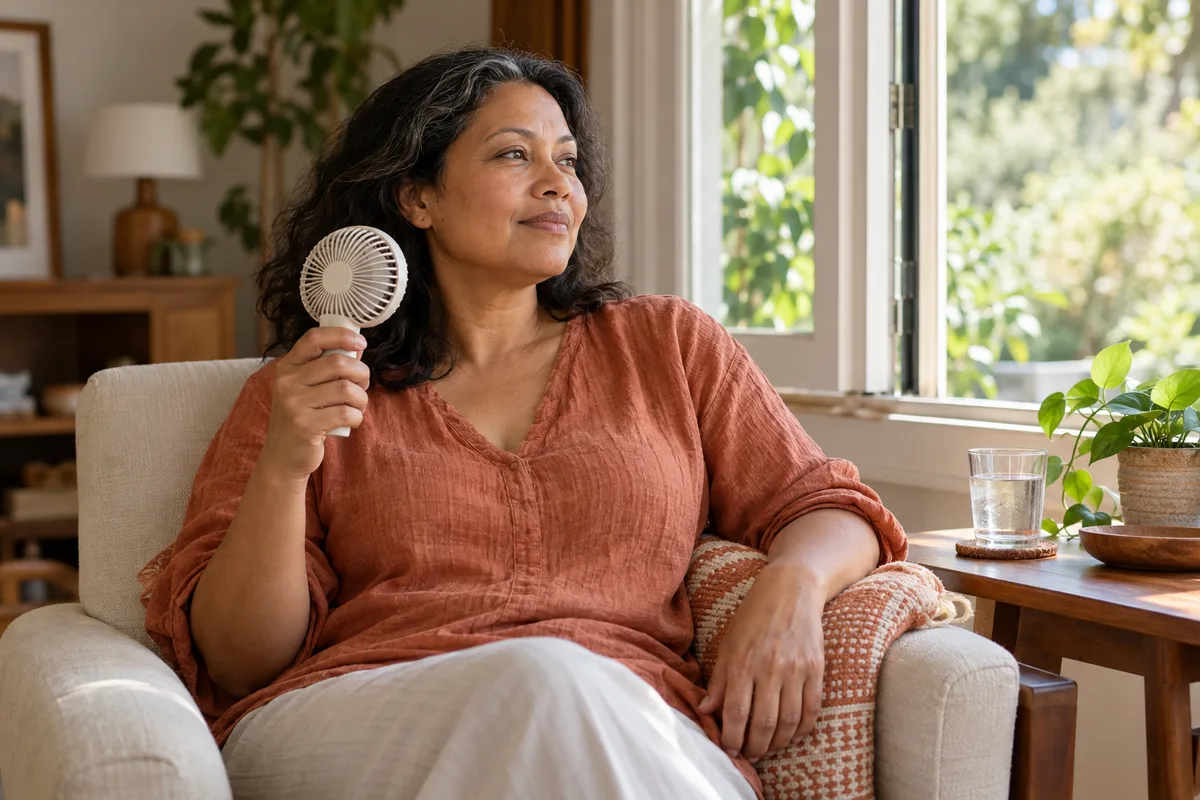
Chinese Medicine Methods
Five categories for long-horizon management, each marked with the tendency it suits and cautions. Food therapy uses food amounts; consult a practitioner before using any ingredient as a medicinal herb.
Acupressure
For the long run: fixed points, gentle technique, no overnight promises.
- Taixi (hollow between the inner ankle and Achilles tendon): the traditional main point for nourishing kidney yin; morning and evening, 60 seconds each — long-term maintenance for the yin-fire tendency.
- Sanyinjiao (four finger-widths above the inner ankle): a classic for regulating periods and nourishing blood, heavily used through perimenopause; 60 seconds each side; contraindicated in pregnancy, check first with any bleeding tendency.
- Zusanli (four finger-widths below the outer knee): traditionally fortifies digestion and builds up the “acquired foundation”; suits long-term pressing for those who fatigue easily with a qi-deficiency tendency.
- Pacing: fixed daily slots (one round at waking, one before sleep) and at least four weeks before judging.
Food Therapy
Eastern-style:
- Chinese yam and lily porridge: 80g Chinese yam sliced, 10g dried lily bulbs, 50g rice, 600ml water, simmered 30 minutes; three dinners a week. Traditionally firms digestion and moistens yin — the staple porridge of long-term care; tighten portions if blood sugar is a concern.
- Mulberry and black-bean water: 10g dried mulberries and 20g black beans simmered 40 minutes, taken as a drink. Traditionally nourishes yin and blood, for long-term use against afternoon flash clusters; reduce the beans if stools loosen.
- Rose flower tea: the standing afternoon tea of the stagnation-fire tendency — 5 buds steeped 5 minutes, used in step with the emotional work above.
Western-style:
- The longevity-plate baseline: whole grains (quinoa, oats) + legumes (four times weekly) + deep-sea fish (twice weekly) + a small handful of nuts — the long-run ratio serving both “healthy weight” and “cardiovascular protection,” matching the decade-scale health management SWAN’s findings imply.
- Warm red-date and longan tea: one autumn/winter morning cup (3 dates, 5 longans, simmered 10 minutes), suited to cold-limbed yang-deficiency days; not for pronounced yin-deficiency heat.
- The colorful dinner baseline: greens always present, one palm of protein (fish, beans, lean meat in rotation), staple cut to half a bowl; the ground rule of postmenopausal metabolic years.
Emotional Regulation
- Be honest about “long-term”: the key psychological prep is “short-term wobble, long-term decline” — a given week may worsen, but across months the trend falls. Keep the expectation calibrated and you stop asking “why is it still here?”
- A monthly review: at each month’s end, ten minutes on four items — sleep, mood, energy, flash frequency. Continuous worsening in any of them deserves its own evaluation (mood, sleep, and bone density each have specialists).
- Sleep is the direct amplifier of duration: perceived flash scores run clearly higher among people with insomnia; fixing sleep outranks every special food or tea (see perimenopause insomnia for specifics).
Movement
- The baseline: 150 minutes of brisk walking weekly plus two strength sessions — the floor for bone density, metabolism, cardiovascular risk, and flash burden alike.
- One dedicated weight-bearing session weekly: postmenopause is when bone density falls fastest; resistance and weight-bearing training are the long-term option for preserving bone and improving sleep.
- Baduanjin qigong or tai chi, one of the two, 15 minutes daily: gentle and sustainable, doubling as a wind-down close to the evening.
Sleep Routine
- Fix the wake time within ±30 minutes no matter how the night went — sleeping in for recovery only dilutes tonight’s sleep pressure.
- After a nighttime wake-up, run the fixed restart sequence (the response card in the nighttime article): towel off → sip water → three rounds of breathing → then choose: stay lying down or briefly get up.
Three patterns, three long-term rhythms. Duration is a question your own observation answers with the precision your notes allow. The free constitution test at the end of this article is a reference, not a diagnostic scale — it helps you notice your own tendencies.
The Stage-and-Expectation Table
Put SWAN’s numbers next to your own state; fill in one column at each month’s end:
| Dimension | Early perimenopause | Late perimenopause | First 4–5 postmenopausal years | Still strong years later |
|---|---|---|---|---|
| Period status | regular with wobble | skipped cycles, long gaps | 12+ months since last | same |
| Expected flash intensity | onset, ramping monthly | the heaviest stretch | declining yearly | re-intensification needs evaluation |
| Management focus | trigger hunt, sleep, exercise | nighttime toolkit, medical evaluation | bone density, metabolic checks | rule out new causes with a doctor |
| Psychological frame | median runs long | think in years, not weeks | the declining stretch | a new development = a new question |
How to use: place yourself by period status first, then compare this month’s record (frequency / intensity / sleep impact) against the expected shape — moving clearly against the expectation (for example, worsening years after menopause) is a reason to see a doctor, not “individual variation.”
How Long Until It Helps
- Lifestyle adjustment (sleep, exercise, weight, trigger control): judge by month-to-quarter, not week to week; that matches the cadence of the underlying research.
- Nighttime tools and environment: visible the first night in reduced chaos; the long-term gain is a smaller total of tormented nights.
- Traditional care direction: two to four weeks as the observation unit, with direction (flash density, night wake-ups, sleep quality) as the metric; two months of no movement should go back for medical evaluation. Logs can’t predict when improvement lands, and the combined effect with medical care varies person to person.
When to See a Doctor
- Flashes affecting sleep, mood, and quality of life at any point — seek help without waiting out the years first; the threshold for treatment evaluation is life impact, not duration.
- Flash re-intensification many years after menopause needs re-evaluation of causes (the NIA and SWAN both note flashes typically decline well after menopause).
- Suddenly heavy periods, longer periods, or bleeding between periods — prompt care; this line is independent of flashes (see the irregular-periods article in this hub).
- When psychological load is heavy (low mood past two weeks, loss of interest in daily activities), mood and sleep evaluations move up the queue; mental and physical symptoms tend to arrive together and improve together.
This article is general health information, not a substitute for diagnosis or individualized advice.
Common Questions
Tonight was worse. Does that mean “longer”?
A single bad night is inside the noise. The overall trend is read month against month — SWAN’s key numbers are annual-grade. When a single week worsens, environment, emotion, or sleep usually moved first; hunt triggers before discussing trend.
If flashes started early, am I locked into ten-plus years?
The study reports correlation, not destiny: the early-onset group’s median is longer, but the spread within the group is vast, and both lifestyle management and medical evaluation can change how the years actually feel. Run your own log (frequency / intensity / sleep / mood) as the primary coordinate; don’t turn a population median into a personal forecast.
Does hormone therapy also take “many years” to work?
Efficiency isn’t the open question — when to start, how long it runs, and which regimen all depend on your bleeding pattern (perimenopause), postmenopausal stage, risk factors, and symptom load, decided individually with your care team. Carrying that question into an appointment beats hunting for a fixed answer in an article.
For the fuller arc of this stage, read the menopause hub; for in-the-moment tooling, see how to stop hot flashes fast; for systematic night management, see hot flashes at night.
Duration varies person to person — so does the traditional pattern behind your flashes
The free constitution test maps your tendencies across nine traditional types and pairs well with the monthly stage check below. For self-reflection, not medical diagnosis.
References3 sources
- 01
JAMA Internal Medicine / PubMed Central
- 02
U.S. National Institute on Aging (NIA / NIH)
- 03
Cleveland Clinic Health Essentials
Personalized guidance
Use the app for constitution-friendly ideas and structured plans when available.
Download the App
Get personalized TCM health recommendations