How to Handle Pressure: What to Do 24 Hours, 10 Minutes, and 1 Minute Before
Choking under pressure is usually arousal, not ability. Preparation that simulates the moment, a short pre-event routine, and one in-the-moment reset are more useful than telling yourself to relax.
By WellTao · Published: · Editorial Policy
More articles in this topicTable of contents
The short version
Under pressure, the body mobilizes: heart rate rises, attention narrows, hands get cold. That is useful up to a point. Past that point, working memory gets crowded and you lose access to skills you already have — what people call choking.
Handle it in three time windows. Twenty-four hours out, rehearse under mild stress and prepare the first 60 seconds precisely. Ten minutes out, do slow exhales and a physical warm-up. One minute out, use a single reset: a long exhale, feet on the floor, and one concrete cue.
These steps do not remove nerves. They keep nerves from taking over the task.
How pressure shows up for you
- Body: pounding heart, dry mouth, shaky hands, cold fingers, urgent need for the bathroom;
- Mind: thoughts speed up and narrow to worst cases; you forget a word or a number you know;
- Behavior: rushing, over-explaining, avoiding eye contact, or going blank at the start;
- After: replaying mistakes for hours, which ruins the next day’s preparation.
Notice your earliest signal. For many people it is jaw tension or shallow breathing, and it appears minutes before the obvious symptoms. Catching it early is easier than reversing a full surge.
If you have repeated panic attacks in performance situations, or you are avoiding them entirely, that is closer to social anxiety or panic disorder and deserves assessment.
What modern medicine says
Arousal and performance follow an inverted U. Moderate arousal improves speed and focus; high arousal impairs complex motor and cognitive tasks. NCCIH’s stress overview describes the underlying response — sympathetic activation and cortisol release — as adaptive in short bursts.
Choking is a shift in attention. Under threat, attention moves from the task to self-monitoring (“my hands are shaking, they can see”). Explicit monitoring disrupts automated skills. The counter is to anchor attention on an external cue — the next sentence, the audience’s faces, the rhythm of your breathing — rather than on your own state.
Rehearsal under mild stress reduces the surprise. Practicing in a slightly uncomfortable condition — standing, speaking louder, with someone watching — makes the real moment less novel. This is the same principle as exposure: the body learns the situation is survivable.
Slow exhales lower arousal quickly. NCCIH reports that relaxation techniques including slow breathing can reduce heart rate and blood pressure modestly. A longer exhale is the fastest voluntary lever.
Sleep the night before matters more than one more hour of prep. Sleep loss impairs working memory and emotional control, exactly the functions pressure demands. A late-night cram session usually costs more than it adds.
The TCM view of qi binding under pressure
Traditional Chinese medicine describes acute pressure as qi binding in the chest. The free flow of qi is said to be disrupted by fear and overthinking, producing chest tightness, a lump in the throat, sighing, and cold hands. If the binding persists, it can turn to heat, with irritability and a bitter taste, or press on the spleen, causing poor appetite before events.
This is an observational model, not a physiological explanation. NCCIH’s TCM overview notes that traditional theory should not be read as modern diagnosis.
As patterns:
- Qi stagnation: chest tightness, sighing, overthinking before the event;
- Qi deficiency: fading energy, weak voice, feeling drained afterward;
- Yin deficiency: dry mouth, palpitations, wired rather than sleepy the night before.
Patterns are directions, not labels. They can guide whether you need to move more or rest more before a high-stakes moment.
The 24-hour, 10-minute, 1-minute protocol
24 hours before
- Prepare the first 60 seconds precisely — the opening sentence, the first slide, the first question you will ask. Starting well reduces the chance of spiraling.
- Rehearse once under mild stress: stand up, speak at performance volume, record yourself, or present to one person.
- Write the three things that must land. Not ten. Three.
- Set out clothes, materials, and travel plan. Remove morning decisions.
- Protect sleep. If you cannot sleep, rest in dim light without a screen; do not keep rehearsing in bed.
10 minutes before
- Six slow breaths: in for 4, out for 6.
- Stand, roll your shoulders, shake out your hands, and walk for two minutes. Cold hands improve with movement.
- Review the first sentence and the three key points — not the whole script.
- Put your feet flat, drop your shoulders, and unclench your jaw.
1 minute before
- One long exhale, longer than the inhale.
- Pick an external anchor: the first person you will look at, the first slide, or the timer.
- Say the opening sentence silently once, then go.
During
- Speak slightly slower than feels natural; pressure speeds speech.
- Pause after key points. Silence reads as confidence and gives you time to think.
- If you blank, say “let me come back to that,” move to the next point, and return later. The audience rarely notices.
After
- Write down one thing that worked and one to change. Stop there. Extended replay strengthens the threat memory.
TCM methods
These target the tight-chest, cold-hands pattern. Recipes are culinary uses; for medicinal use, consult a licensed practitioner.
Acupressure and self-massage
- Neiguan (PC6): three finger-widths above the inner wrist crease, between the tendons. Press for one minute per side, ten minutes before an event.
- Hegu (LI4): on the back of the hand, between the first and second metacarpal bones. One minute for tension headaches or a clenched jaw. Avoid during pregnancy.
- Tanzhong (CV17): midpoint of the breastbone. Place a flat palm there with slow exhales for 30 seconds.
Food support
Eastern route
- Rose tea: 3 dried rose buds in 300 ml of 90°C water for 8 minutes. Traditionally used for chest tightness before stressful events. Skip during heavy periods.
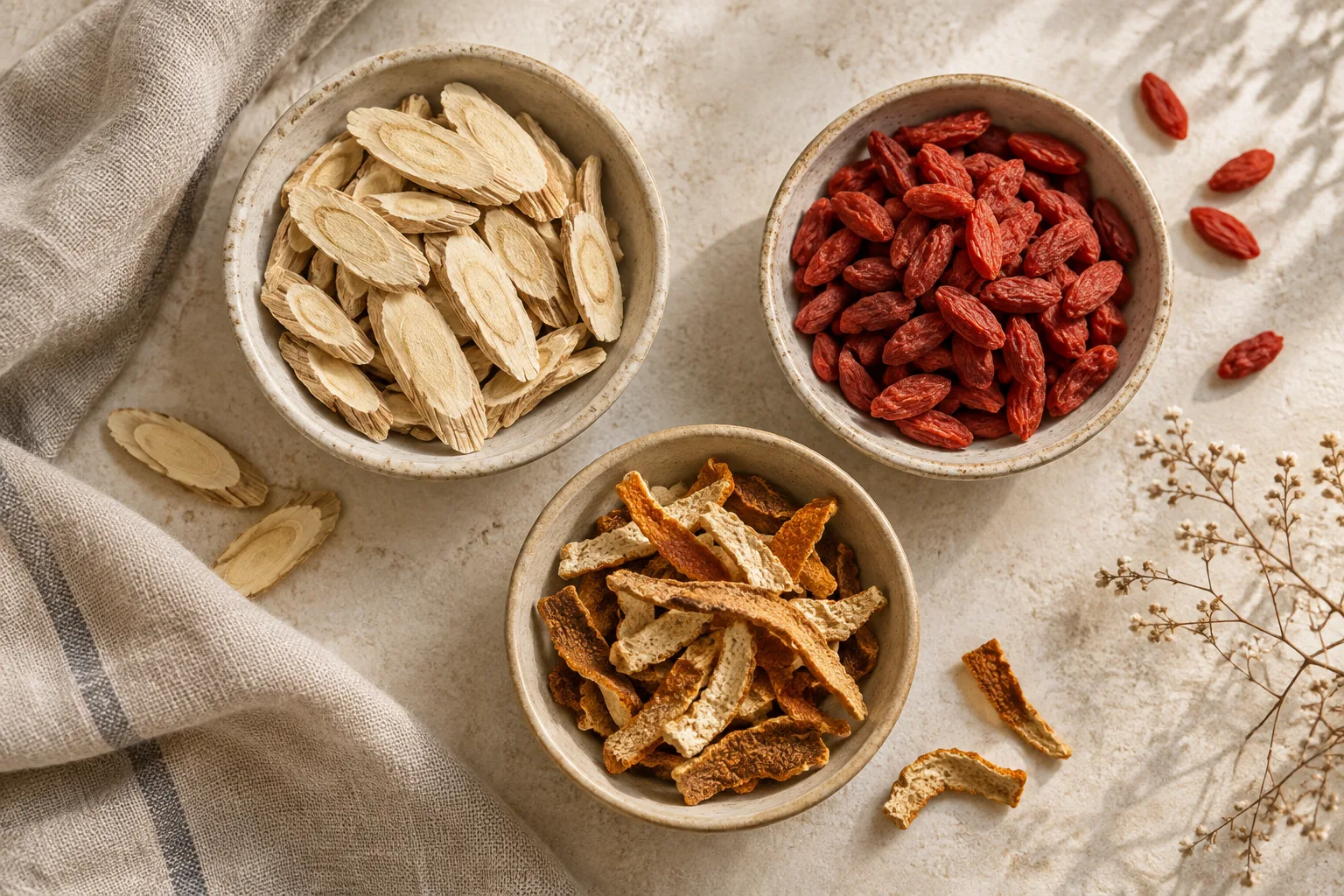
- Dried tangerine peel and honey: 3 g peel in 300 ml water, honey to taste. Traditionally used for belching and chest fullness.
- Warm millet porridge before an event: easy to digest and avoids the empty-stomach jitters that coffee alone creates.
Western route
- A small breakfast with protein and a banana: steady glucose and potassium, less tremor than coffee on an empty stomach.
- Water, not a second coffee, in the final hour.
Emotional care
- Name the stakes precisely. “This matters because it affects my review” is more manageable than “everything is riding on this.”
- Separate the outcome from the performance. You control preparation and the first minute; you do not control the audience’s reaction.
- Use a pre-event ritual. Same song, same walk, same breathing pattern. Ritual reduces uncertainty.
Movement
Two minutes of walking, shoulder rolls, and gentle stretching before the event. Traditional: “drawing the bow” and “punching with a glare” from baduanjin, 3–4 slow repetitions, to release chest and shoulder tension.
Daily rhythm
- The night before: no new material after 9 p.m., screens off an hour before bed.
- Morning: daylight, protein, and a short walk.
- After: 10 minutes of walking before returning to normal tasks.
Constitution can explain why pressure hits you the way it does; the constitution test is a self-observation tool, not a diagnosis.
Pressure rehearsal sheet
| Field | Your answer |
|---|---|
| Event and stakes | |
| First 60 seconds (written out) | |
| Three things that must land | |
| Rehearsal done (date, condition) | |
| Earliest body signal | |
| One-minute reset | |
| Post-event note |
Rehearse once at 70 percent effort rather than five times at full effort. The goal is familiarity, not exhaustion.
How long until it helps
- Breathing and reset: immediate, within 60 seconds.
- Pre-event routine: 2–3 events to feel natural.
- Rehearsal under mild stress: 3–4 exposures for a noticeable drop in blanking.
- Overall confidence: 6–8 weeks of regular high-stakes practice.
If pressure is affecting sleep for weeks or you are avoiding opportunities, the issue is bigger than performance technique.
When to see a doctor
- Panic attacks during presentations, meetings, or exams;
- Persistent avoidance of situations that matter to your career or relationships;
- Anxiety most days for six months or more;
- Palpitations with chest pain, breathlessness at rest, or fainting;
- Low mood or hopelessness alongside the pressure.
This article is health education and does not replace individual medical advice.
Common questions
Does “calm down” ever work?
Rarely in the moment. Trying to suppress arousal often increases it. Reframe instead: “I’m ready, and my body is mobilizing.” Then use an external anchor.
Should I take a beta blocker?
Only if prescribed for a medical condition. Using them for performance anxiety without medical advice carries risks, including masking symptoms of other problems. Discuss with a clinician.
What if I blank mid-sentence?
Pause, breathe out, and say “let me come back to that.” Move to your next point. The pause feels much longer to you than to the audience.
Is pressure always bad?
No. Moderate pressure improves focus and makes practice feel relevant. The aim is not zero arousal but usable arousal.
For the ongoing workplace version, see managing stress at work. For immediate relief, see fast stress relief.
Why do some people rise to the occasion and others freeze?
Arousal tolerance varies. People leaning toward qi stagnation often tighten and overthink; those leaning toward qi deficiency may fade under sustained pressure. The free constitution test is a self-observation tool, not a diagnosis.
References4 sources
- 01
U.S. National Center for Complementary and Integrative Health (NCCIH / NIH)
- 02
U.S. National Center for Complementary and Integrative Health (NCCIH / NIH)
- 03
U.S. National Institute of Mental Health (NIMH / NIH)
- 04
U.S. National Center for Complementary and Integrative Health (NCCIH / NIH)
Personalized guidance
Use the app for constitution-friendly ideas and structured plans when available.
Download the App
Get personalized TCM health recommendations