How to Lower Cortisol Naturally: What Actually Moves the Needle
Cortisol is not a villain — it follows a daily rhythm and rises when you are awake and challenged. Sleep, resistance training, caffeine timing, and alcohol are the levers with the clearest evidence. What to expect, and why most supplements are a dead end.
By WellTao · Published: · Editorial Policy
More articles in this topicTable of contents
The short version
Cortisol is a steroid hormone released by the adrenal glands, and it is supposed to rise and fall. Typically it peaks 30–45 minutes after waking, then declines through the day. It goes up with exercise, brief stress, and caffeine, and it stays elevated when sleep is short or stress is chronic.
The levers that reliably shift it are unglamorous: protect 7–9 hours of sleep, do regular moderate exercise and some resistance training, keep caffeine to the morning, cut alcohol to near zero, and build recovery into the week. Supplements marketed as “cortisol blockers” have thin evidence and, in some cases, safety problems.
If fatigue, weight, or blood pressure changes persist for weeks without a clear explanation, see a clinician rather than diagnosing yourself from symptoms or wearables.
Signs cortisol may be part of the picture
Cortisol itself does not produce a single signature symptom. What you notice usually comes from the stress system as a whole:
- Waking already tired, then getting a second wind at 10 p.m.;
- Cravings for sugar and fast carbohydrates, especially in the afternoon;
- Belly weight gain while appetite elsewhere is normal;
- Feeling “tired but wired”: exhausted body, racing mind;
- Slow recovery from workouts, frequent colds;
- Anxiety or irritability that is worse when sleep is short.
These patterns overlap with other medical conditions, which is why a symptom list cannot diagnose a hormonal state. If they persist for more than a few weeks, start with a primary care visit and bring a sleep and stress log.
What modern medicine says
Cortisol follows a rhythm, not a flat line. Cleveland Clinic explains that cortisol helps regulate blood sugar, blood pressure, and the sleep-wake cycle, and rises in response to stress. Healthy levels vary widely between people and across the day. Levels also vary with sampling time, which is why MedlinePlus notes that testing is used when a clinician suspects a disorder, not to grade everyday stress.
Sleep loss raises evening cortisol. Short sleep and circadian misalignment increase cortisol in the afternoon and evening, which in turn makes the next night’s sleep harder. This is the most common self-reinforcing loop behind “high cortisol” symptoms.
Exercise raises cortisol briefly and lowers it across the day. Moderate aerobic exercise and resistance training are associated with better stress regulation and sleep. Very high volumes of intense training without recovery can keep the stress axis elevated — the practical takeaway is regular and moderate, not maximal.
Caffeine and alcohol both act on the axis. Caffeine raises cortisol acutely and, taken after about 2 p.m., delays sleep. Alcohol fragments the second half of the night. Both are common reasons a person feels worse despite “doing everything right.”
Supplements are not a shortcut. Products sold as cortisol blockers or adrenal support usually rely on small studies or none. Some herbal products interact with medications or contain unlisted ingredients. NCCIH recommends treating such claims cautiously and discussing supplements with a clinician.
The TCM view of depletion and heat
Traditional Chinese medicine reads chronic stress through two directions: deficiency and heat. Long-term overwork is said to consume qi and yin — the body’s substance and cooling reserves — producing fatigue alongside dryness, night sweats, and irritability. In the other direction, unexpressed frustration can turn into liver fire, with headaches, a bitter taste, and sudden anger. The kidney in this model stores essence and governs the deep reserves that prolonged stress draws down.
This is a traditional framework, not an endocrine model, and cortisol has no equivalent in it. NCCIH’s TCM overview cautions that traditional concepts should not be read as modern diagnoses.
As patterns:
- People leaning toward yin deficiency often describe a dry mouth and throat, warm palms and soles, night sweats, and a mind that will not switch off at night;
- People leaning toward qi deficiency often describe waking unrefreshed, a weak voice, and feeling worse after exertion;
- People leaning toward qi stagnation often describe chest tightness, sighing, and irritability tied to specific frustrations.
Patterns mix, and only an in-person practitioner can assess them. They are self-care directions, not a hormone diagnosis.
The five levers that matter
1. Sleep window before sleep hygiene. Pick a fixed wake time, seven days a week, and count backward 7.5–8 hours for lights out. Keep the room dark and cool, and charge the phone outside the bedroom. If you wake at 3 a.m. with a racing mind, get up, sit in dim light, and write the thoughts down rather than lying there.
2. Train most days, but not to exhaustion. Aim for about 150 minutes of moderate aerobic activity weekly — brisk walking, cycling, swimming — plus two sessions of resistance training. During high-stress periods, keep intensity moderate; hard intervals every day without recovery can keep the stress axis switched on.
3. Move caffeine earlier and reduce the dose. Caffeine’s half-life is roughly five hours, longer in some people. Have your last cup by 2 p.m., and replace the afternoon cup with ten minutes outdoors. If you drink more than three cups daily, taper by half a cup every few days to avoid withdrawal headaches.
4. Treat alcohol as a sleep disruptor. A drink may help you fall asleep faster, but it fragments the second half of the night and raises overnight heart rate. Aim for several alcohol-free nights a week, and none within three hours of bed.
5. Schedule recovery, not just rest. Recovery is active: a walk without your phone, a meal with someone, 20 minutes of reading on paper. Passive scrolling does not restore attention and often raises arousal. Put two recovery blocks in the calendar each week, as you would a meeting.
Food matters mostly through these levers: regular meals with protein and fiber support stable blood sugar, which reduces the afternoon crash that people mistake for adrenal fatigue. Very low-calorie dieting is itself a stressor and tends to raise cortisol.
TCM methods
Traditional care for depletion emphasizes nourishment and rest; for heat, clearing and calming. Each method notes who it suits. Recipes are culinary uses; for medicinal use, see a licensed TCM practitioner.
Acupressure and self-massage
- Sanyinjiao (SP6): four finger-widths above the inner ankle bone, just behind the shin. One minute per side in the evening. Traditionally used for sleep and gynecological symptoms. Avoid during pregnancy.
- Zusanli (ST36): four finger-widths below the kneecap, one finger outside the shin. One minute per side for fatigue. Halve the pressure if you lean toward qi deficiency.
- Taixi (KI3): in the depression between the inner ankle bone and the Achilles tendon. Gentle pressure for 30 seconds per side, traditionally described as supporting kidney reserves. Plain-text location because no dedicated page exists yet.
Stop if pressure causes sharp pain. Avoid deep abdominal or leg work if you are pregnant or have poor circulation.
Food support
Eastern route
- Black sesame and walnut powder: 15 g each, ground, mixed into warm milk or porridge. Traditionally used for dryness and fatigue in later life. High in calories; keep to one serving daily.
- Lily bulb and lotus seed soup: 10 g dried lily bulb, 15 g lotus seeds, 500 ml water, simmered 30 minutes. Traditionally used for restless sleep with a dry mouth. Not for loose stools.
- Goji berry and chrysanthemum tea: 10 goji berries and 3 dried chrysanthemum flowers in 300 ml of 90°C water. Traditionally used for eye strain and dryness. Skip if you take blood-thinning medication and ask a pharmacist about interactions.
Western route
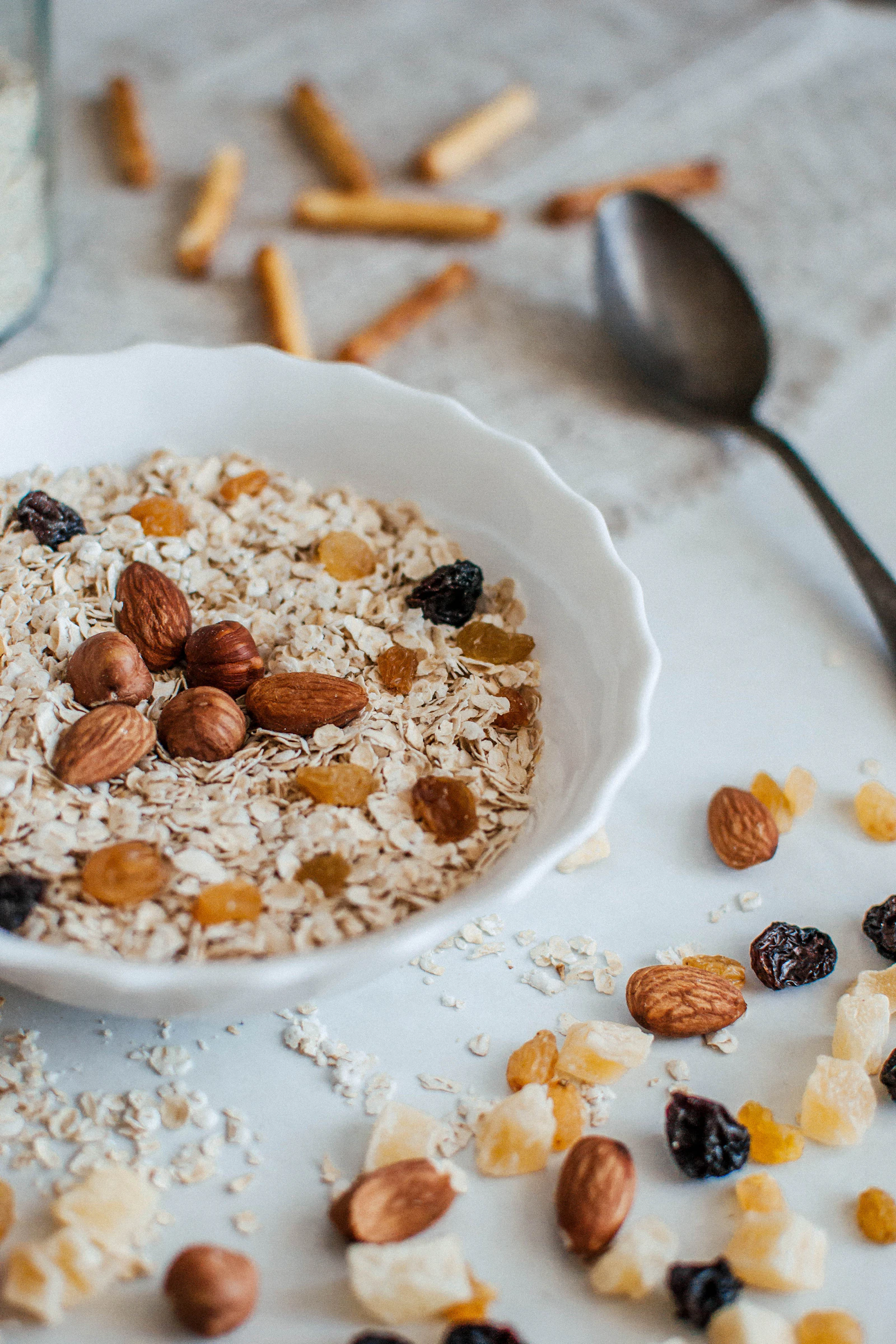
- Oatmeal with Greek yogurt and berries: 40 g oats, 150 g yogurt, a handful of berries. Protein plus fiber for a slower glucose rise.
- Salmon with greens and olive oil, twice a week: omega-3 fats and magnesium-rich greens; both are associated with better stress regulation in observational studies.
Emotional care
- Write the 3 a.m. thought down. Naming it on paper reduces replay; bring the paper to your next appointment if it recurs.
- Set one boundary you can keep for a month. A fixed end to the workday, one meeting-free morning, or no email after dinner. One kept boundary beats five intended ones.
- Watch the “I’ll rest when” story. If rest is always conditional on finishing everything, it never happens. Rest is part of the schedule, not a reward.
Movement
Walking 20–30 minutes daily, plus two resistance sessions weekly. Traditional options: baduanjin “two hands holding up the sky” and “drawing the bow” — slow, 4–6 repetitions, long exhales. If you lean toward yin deficiency, avoid late-night vigorous exercise; if toward qi deficiency, keep sessions short and stop before exhaustion.
Daily rhythm
- Get 10 minutes of morning daylight within an hour of waking; it anchors the cortisol rhythm.
- Eat meals at consistent times; skipping breakfast and overeating at night worsens the glucose swing.
- Stop screens an hour before bed; if you must use them, dim the brightness and avoid news.
- Take a 10-minute walk after dinner; it lowers post-meal glucose and aids sleep.
These adjustments are general wellness steps, not a treatment for a hormonal disorder. If symptoms persist, ask a clinician about testing; the constitution test is only a self-observation tool.
Two-week rhythm log
| Day | Wake time | Lights out | Caffeine (time, cups) | Alcohol | Exercise (type, minutes) | Energy 1–10 | Night waking |
|---|---|---|---|---|---|---|---|
| Mon |
After two weeks, compare the highest-energy days with the previous night’s sleep and caffeine timing. These are associations, not proof, but they often reveal one lever worth changing. Bring the log to a clinician if you seek testing.
How long until it helps
- Sleep regularity: 1–2 weeks for easier mornings; 4 weeks for stable energy.
- Caffeine change: 3–7 days for the withdrawal to settle and sleep to improve.
- Exercise: 3–4 weeks for mood and sleep benefits to be noticeable.
- Alcohol reduction: within a week for sleep continuity; 3–4 weeks for resting heart rate.
- Perceived stress: 4–8 weeks of consistent changes.
There is no “cortisol detox.” If someone promises a rapid reset with a supplement or a juice cleanse, the claim is not supported.
When to see a doctor
- Fatigue, weight, or blood pressure changes that persist for weeks without an explanation;
- Dizziness on standing that keeps recurring;
- Prescription medication use, especially steroids — do not change the dose without medical advice;
- Periods, libido, or energy changes that persist and affect daily life;
- Anxiety, depression, or insomnia that is worsening despite lifestyle changes;
- Thoughts of harming yourself — seek emergency help immediately.
A clinician can decide whether testing is needed. Do not take herbal “adrenal support” products without discussing them, especially if you take prescription medication.
This article is health education and does not replace individual medical advice.
Common questions
Can I test my cortisol at home?
Home kits are sold, but results are easy to misread. If you suspect a disorder, ask a clinician whether testing is needed. For general wellness tracking, sleep and energy logs are more useful than a single number.
Does coffee raise cortisol?
Acutely, yes, especially on an empty stomach and in people who do not drink it regularly. Regular drinkers develop tolerance to the acute rise. The bigger issues are dose and timing, because late caffeine delays sleep.
Is intense exercise bad for cortisol?
Not inherently. Hard training raises cortisol transiently and is part of adaptation. The problem is hard training every day with short sleep. Alternate hard days with easy movement.
Do adaptogens work?
Some small trials report modest effects for certain extracts, but evidence is limited by size, quality, and product variability. Discuss with a clinician, especially if you take medication.
For the mechanism, see what cortisol does in your body. For broader stress habits, see reducing stress naturally.
Are you wired at night but exhausted in the morning?
That mismatch can reflect constitution as well as sleep debt. People leaning toward yin deficiency often feel dry and restless at night; those leaning toward qi deficiency tend to wake unrefreshed. The free constitution test is a self-observation tool, not a diagnosis or a hormone test.
References4 sources
- 01
Cleveland Clinic
- 02
MedlinePlus (U.S. National Library of Medicine)
- 03
U.S. National Center for Complementary and Integrative Health (NCCIH / NIH)
- 04
World Health Organization (WHO)
Personalized guidance
Use the app for constitution-friendly ideas and structured plans when available.
Download the App
Get personalized TCM health recommendations