Bloated After Eating? Common Causes, TCM Care, and When to See a Doctor
Post-meal bloating usually comes down to swallowed air, gut fermentation, and how quickly your stomach empties — but sometimes it needs a doctor. How modern medicine and Chinese medicine each explain it, the self-care that actually helps, a one-week tracking log, and the red flags that mean get checked.
By WellTao · Published: · Last updated: · Editorial Policy
More articles in this topicTable of contents
The short version
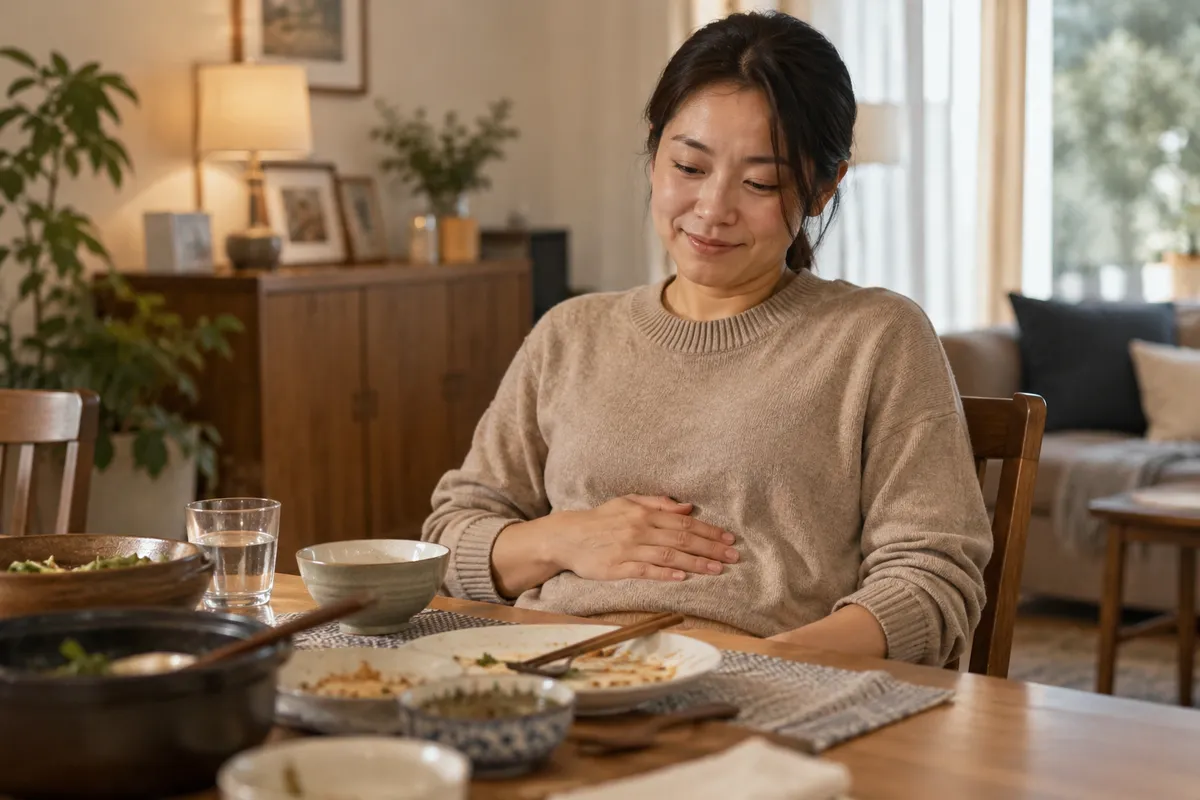
Feeling bloated after eating is, most of the time, not a disease. Gas in your gut has only two sources: the air you swallow and the gas your gut bacteria produce when they ferment food. The first comes from eating fast, talking while you chew, and fizzy drinks. The second comes from carbohydrates your small intestine can’t absorb, which get passed down to the colon as a bonus meal for bacteria. If the bloating is occasional and settles within a few hours, changing how you eat is usually enough.
What deserves real attention is a different pattern: bloating several times a week that doesn’t settle for weeks, or bloating that arrives with weight loss, blood in the stool, or anemia. That sits outside self-care territory — go straight to when to see a doctor.
Which kind of bloating is yours
First, make sure we’re talking about the same thing. Bloating typically means your belly feels full and tight after eating, looks rounder than usual, and may come with gurgling or extra gas (how the NHS describes bloating).
Check yourself against these two lines:
- Normal fluctuation: once or twice a week at most, usually after a big meal, gassy foods, or around your period, and gone within a few hours. The adjustments in this article are enough.
- Needs attention: several times a week for weeks on end, or bad enough to interfere with eating and daily life. If it comes with weight loss, blood in the stool, or ongoing abdominal pain, skip self-care and read when to see a doctor.
This section only helps you place yourself — it isn’t a diagnosis. Confirming a specific condition takes a doctor.
What modern medicine says
You swallow more air than you think. Every quick gulp carries a small bubble of air down with it, and talking while eating, drinking through a straw, and carbonated drinks multiply the effect. Once in the stomach, that air has two exits: up as a burp, or down through the entire intestinal tract. Which is why this kind of bloating comes on fast and leaves fast — usually within an hour of the meal.
Some foods make gas by design, but it varies person to person. Beans, onions, garlic, broccoli, and the sweeteners in sugar-free gum share one trait: they contain short-chain carbohydrates (collectively called FODMAPs) that the small intestine can’t fully absorb. They reach the colon intact and get fermented by the bacteria living there — the bacteria’s dinner becomes your gas. The person-to-person part comes down to gut flora: everyone carries a different bacterial mix, so the same bowl of beans someone else’s microbes digest quietly can set yours running at full tilt (NIDDK: gas in the digestive tract).
Slow transit traps gas. When you’re constipated, residue and gas sit in the bowel longer, fermentation runs longer, and the bloated feeling gets noticeably worse (NIDDK: constipation). Overeating and very fatty meals also slow stomach emptying — the stomach hasn’t cleared the last load when the next one arrives. If your bloating sits in the upper abdomen and comes with feeling full after a few bites and lingering post-meal fullness, modern medicine has a name for it: functional dyspepsia. Tests often find nothing structural, but the symptoms are real, and there’s an established diagnostic pathway (NIDDK: functional dyspepsia).
Same amount of gas — so why do you feel it more? The answer isn’t just volume; it’s how sensitive your gut nerves are. A core mechanism in functional bloating and irritable bowel syndrome (IBS) is visceral hypersensitivity: the gut’s threshold for sensing stretch runs low, so a normal amount of gas registers as real discomfort, and stress and poor sleep turn that sensitivity up further (NIDDK: IBS). That’s why “everyone else eats this fine, but I blow up,” and why bloating so often rises and falls in step with your emotional state.
A few situations need a specific condition ruled out. Lactose intolerance is the adult decline of lactase activity, which sends milk sugar straight to the colon for fermentation. Coeliac disease is an immune reaction to gluten that needs a blood test to confirm — and don’t cut out gluten long-term before you’re tested, because stopping first makes the results unreliable.
How Chinese medicine understands it
Chinese medicine doesn’t read bloating as an isolated symptom. It asks when it happens, which foods set it off, and what else you feel alongside it. What follows is the traditional framework — an empirical model, not a diagnosis in the modern medical sense (for an overview of the system and the state of its evidence, see NCCIH’s page on traditional Chinese medicine).
In traditional theory, digestion is the “Spleen and Stomach’s transformation and transport”: the Stomach receives and ripens food (picture unloading and rough processing), and the Spleen distributes the extracted nourishment around the body (picture shipping and logistics). Bloating after a meal, in this frame, is a traffic jam on the abdominal stretch of the production line. The roughly 2,000-year-old Basic Questions (Suwen) puts it in one line: “when food and drink double themselves, the stomach and intestines are harmed” — eat past your capacity to process, and the first casualty is the gut itself.
Why would mood jam the line? In the traditional frame, the “Liver” governs free flow — it coordinates the movement of qi (the body’s motive energy) across the whole system, like the line’s master scheduler. When emotion knots up, scheduling fails, qi stalls, and the Spleen and Stomach falter with it. That’s what “qi constraint” means: the traditional explanation for the very common observation that stress and digestion go wrong together — the same direction modern gut-brain axis research points in, though the two systems speak entirely different languages.
Within this framework, bloating traditionally sorts into three common patterns, each with observable signs:
- The overloaded kind: bloating hits right after the meal, burps taste sour or stale, stools smell sour, and you don’t want the next one — the line is over capacity. This maps to the diet and movement methods below.
- The stress-stuck kind: the bloating wanders rather than staying put, comes with tightness around the ribs or chest, clearly worsens after pressure or conflict, and eases after a sigh or passing gas — the scheduler has failed. This maps to the emotional care below: unjam the mood first, then worry about diet.
- The underpowered kind: a few bites are enough to bloat you, the fullness lingers dully, you’re generally tired, your hands and feet run cold, and stools tend loose — the line itself is weak, traditionally called “Spleen qi deficiency.” This maps to the acupressure points and the yam congee below; the direction is gentle warmth and regularity.
The traditional constitution framework uses categories such as qi-deficiency constitution, qi-stagnation constitution, phlegm-dampness constitution to describe everyday tendencies. Linking the patterns above to these categories explains that framework; it does not establish a medical cause, predict symptoms or select treatment. Experiences overlap and can change with sleep, diet, illness and medication. A qualified practitioner needs to assess any TCM pattern individually. The NCCIH overview of TCM explains research and safety limits; a constitution self-check cannot replace medical assessment.
One caution: the above sorts presentations of bloating, not constitution conclusions. The same person can be a mix of patterns, and the mix shifts with your state; formal differentiation needs an in-person TCM practitioner.
Everyday adjustments
These three target swallowed air and trigger-hunting, and you can start today:
- Chew each mouthful 15–20 times before swallowing. It’s the most direct way to cut swallowed air — and since fullness signals lag, eating slowly gives them time to stop you before you overshoot.
- Talk less over meals, skip straws, and swap fizzy drinks for still water. Each one cuts off a direct air supply.
- Test one food category at a time, two weeks each. If you suspect beans, cut beans first — not five things at once, or you’ll never know which change did the work. First suspects: beans, onions, carbonated drinks, sugar-free gum (sweeteners), milk. A steadier approach than blanket restriction is pairing this with the log below to find your foods; if you end up excluding a whole category long-term, check with a doctor or registered dietitian first to avoid nutrition gaps.
TCM methods
The five categories below give concrete steps for this specific problem. Start with the one or two easiest to keep up.
Acupressure and self-massage
Every evening, or an hour after a meal, press with the pad of a finger, firm enough for a mild, bearable ache:
- Zusanli (ST36): about four finger-widths below the outer hollow under the kneecap, one finger-width to the outside of the shinbone. Traditionally the most-used point for supporting digestion. 60 seconds per side.
- Zhongwan (CV12): about one palm-width above the navel (the midpoint between the bottom of the breastbone and the navel). Traditionally used for stomach fullness and poor appetite. Rub gently with a fingertip for 1–2 minutes.
- Tianshu (ST25): about three finger-widths to either side of the navel. Traditionally used for bloating and constipation; 60 seconds per side. Tianshu is also among the most-studied points in constipation acupuncture research — an analysis pooling 10 randomized controlled trials found positive results for functional constipation. Note that those studies used practitioner-administered needling, which isn’t the same as pressing the point yourself.
- Belly rub: rest a palm on your abdomen and rub gently for 5 minutes, following the path of the colon — start at the lower right, travel up the right side to the rib edge, cross the upper abdomen, and come down the left. That direction helps gas move toward the exit.
Cautions: pregnant women should not press abdominal points or do the belly rub; skip it on a full stomach and over any unhealed abdominal surgery; stop if pressing hurts.
Food therapy
Two tracks, same principles. Everything here is a food-therapy use of culinary-grade ingredients; if you intend to use any of them as medicinal herbs, consult a licensed TCM practitioner first.
Chinese home-style track:
- Dried tangerine peel (chenpi) tea: break 3–5 g of dried tangerine peel (aged mandarin peel, sold at Asian supermarkets or online) into pieces and steep in hot water as a tea. Traditionally it moves qi and supports the Spleen, suiting the overloaded kind with lots of burping. Best match for qi-stagnation and phlegm-dampness tendencies; if you run dry and hot (a yin-deficiency leaning), keep the amount small.
- Hawthorn tea: steep 3–5 dried hawthorn slices (Asian supermarkets or online) in hot water. Traditionally used for meat-heavy food stagnation — the right call after a feast. Suits the overloaded kind; skip it if you get acid reflux or heartburn, as hawthorn can aggravate them.
- Chinese yam and millet congee: simmer a cubed section of fresh Chinese yam (also sold as shan yao or nagaimo, fresh or vacuum-packed at Asian supermarkets) with 50 g millet into a soft porridge. Mild in nature, it traditionally supports the Spleen and Stomach — everyday gentle care for the underpowered kind and qi-deficiency tendencies.
Western everyday track:
-
Peppermint or fennel tea after a heavy meal: one peppermint tea bag, or 1 teaspoon of lightly crushed fennel seeds, steeped in 250 ml hot water for 5–10 minutes. Fennel is a traditional European kitchen remedy for gas and suits the overloaded kind. Skip the peppermint if you get reflux — it can relax the valve at the bottom of the esophagus and make heartburn worse; fennel is the safer pick for reflux-prone readers.
-
Warm oatmeal with stewed apple and cinnamon: simmer 50 g rolled oats in water or milk for 5 minutes, then top with a stewed apple and a pinch of cinnamon. Warm, soft, and easy to digest — the same direction as the yam congee, and a good breakfast for the underpowered kind and qi-deficiency tendencies. Keep added sugar modest if you lean phlegm-dampness.
-
Fresh ginger tea: 3 slices of fresh ginger steeped in 300 ml hot water for 10 minutes, with a little honey stirred in once it cools to warm. Warm and settling, it suits the underpowered kind and qi-deficiency or cold-running tendencies; use less ginger if you run hot or reflux easily.
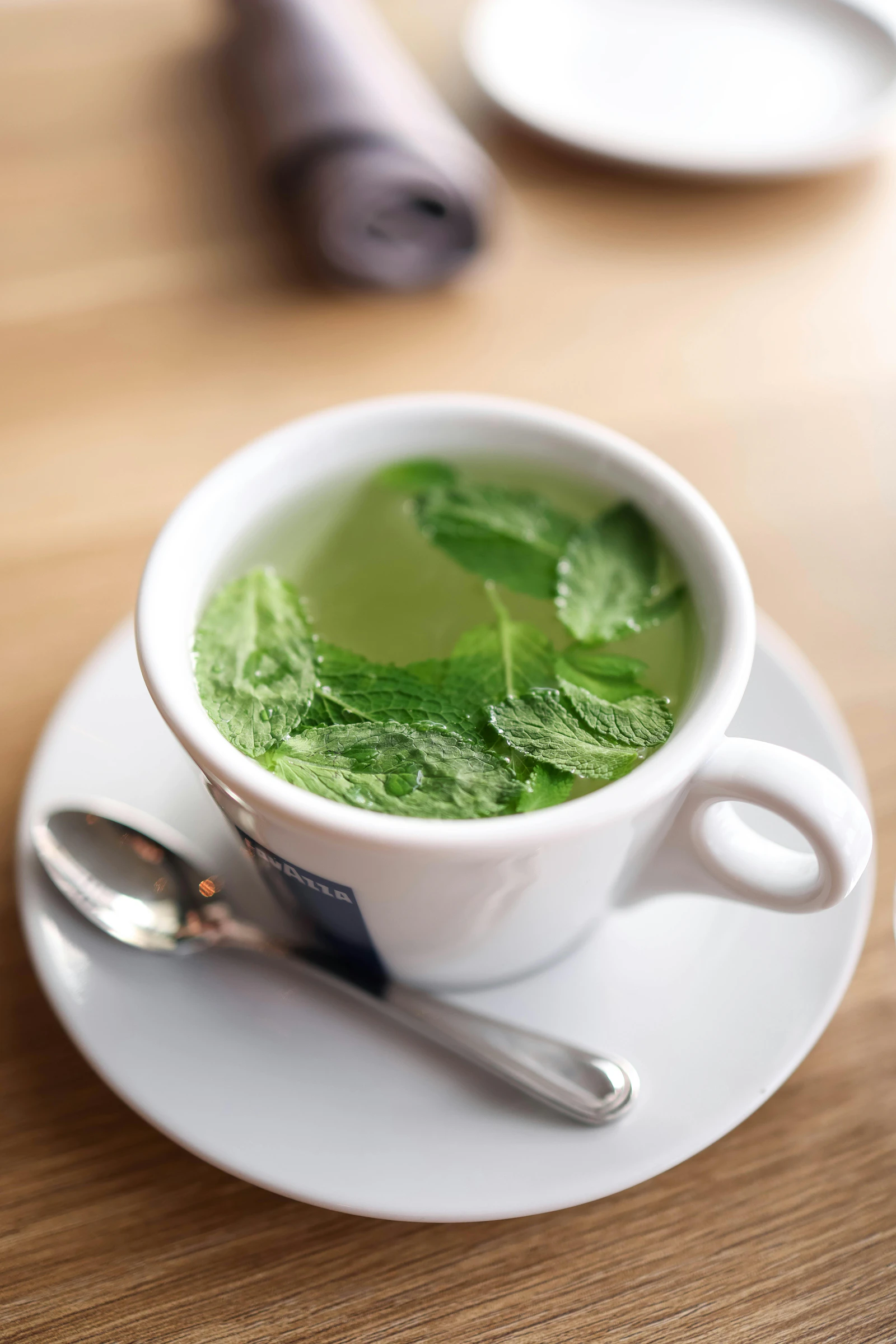
Photo: Swarnim Doegar · Unsplash
Emotional care
For the stress-stuck kind, restriction and pressing are only support acts — the main job is giving emotion a daytime exit: a walk, exercise, talking it out, writing the worry down, anything that moves it out of you. Before bed, try a parking list: write each nagging item on paper with a note of when tomorrow you’ll deal with it, and hand it to the page instead of taking it to bed. Traditional wellness says “a stomach at odds makes for restless sleep,” and the reverse holds too — when the mind won’t settle, the gut is usually the first to know.
Movement
A 10–15 minute walk after meals is gentle activity that encourages gut motility — one of the simplest ways to help gas move along. Among the traditional exercises, the baduanjin (“eight brocades,” a slow, standing sequence of eight gentle exercises) move called “raise one arm to regulate the Spleen and Stomach” targets digestion specifically; at a press briefing on spleen-stomach disorders hosted by China’s National Administration of Traditional Chinese Medicine (in Chinese), experts demonstrated what the move does and how to perform it. Run through it a few times morning and evening, to the point of a light sweat — and avoid vigorous exercise on a full stomach.
Sleep and daily rhythm
- Three regular meals, dinner to 70% full. An erratic schedule is what the production line handles worst; fixed mealtimes are more basic than any supplement.
- Finish eating 3 hours before bed. Give the stomach time to empty — the night shift runs lighter, and your sleep isn’t disturbed.
Same symptom, three patterns, three directions — that’s exactly the question the traditional constitution framework answers. If you’d like to know which way you lean, the free constitution test below is a reference point; it’s a self-observation tool, not a diagnosis.
A one-week bloating log
A week of notes will tell you more about your bloating than any generic advice. Spend one minute after meals recording four things:
| What to record | Example |
|---|---|
| What and how much you ate | A bowl of pasta, a glass of milk, sautéed onions; 80% full |
| Speed and setting | Finished in 10 minutes / ate through a work meeting |
| How bad, where, and when | Started 30 minutes after eating, upper abdomen, lasted about 2 hours |
| Bowel movements that day | Normal / none / loose |
After a week, look back. If the bloating reliably follows beans or dairy, food testing is your direction. If it shows up on rushed, working-through-lunch days, eating pace is the lever. If it tracks constipation, fix the bowels first. If it arrives with stressful events and wanders in position, start with the emotional side. Your notes will tell you which one thing to change first — far more effective than trying ten methods at once. Bring the log to an appointment too; it helps a doctor size things up faster.
Note: this is a self-observation tool, not a diagnostic scale. It shows you patterns; it can’t tell you what disease you have.
How long until you see improvement
Different methods work on different clocks — don’t measure them with the same ruler:
- Eating-style changes (slower chewing, less talking, no fizzy drinks): these target swallowed air, and you should feel a difference the same day or within two or three. If the bloating drops off noticeably, the cause was probably here.
- Food testing: each category needs two weeks; there’s no rushing it, which is also why you test one at a time.
- Constipation-related bloating: once bowel movements regularize, expect visible change within one to two weeks.
- Acupressure, food therapy, belly rubs: run traditional methods in two-week observation cycles, and judge after two to four weeks of consistency.
The rule across the board: any method that shows zero change after two solid weeks gets dropped for the next one. If you’ve worked through the list and four to six weeks bring no improvement — or things get worse — the problem probably isn’t at the lifestyle level. That’s when you take your log to a doctor; the signals are in the next section.
When to see a doctor
Self-care suits occasional, mild bloating. Get professional evaluation first if any of the following apply — don’t rely on self-care alone:
- Bloating that persists for weeks without easing, or steadily worsens;
- Bloating with weight loss, blood in the stool or black tarry stools, anemia, ongoing abdominal pain, or difficulty swallowing;
- Bloating with long-term diarrhea or a clear change in bowel habits, especially new after age 40;
- Bloating severe enough to interfere with eating and daily life;
- Suspected lactose intolerance, IBS, or coeliac disease — all have established testing pathways, and for coeliac in particular the test must come before any diet change, in that order.
This article is general health education and can’t replace a doctor’s diagnosis or individualized advice. If you take medication or live with a chronic digestive condition, check with your doctor before changing your diet.
Common questions
Should I take probiotics for bloating?
An NCCIH overview finds that probiotic effects are strain-specific, and the evidence for bloating-type complaints is inconsistent — they may help some people, but they’re no universal fix. If you want to try, pick a product that names its specific strains, use it consistently for four to eight weeks, then judge. If nothing has changed, stop.
Is “Spleen-Stomach deficiency cold” a diagnosis?
No. It’s the traditional framework’s way of grouping a set of presentations (discomfort after cold or raw food, an abdomen that feels cold and prefers warmth and pressure, and so on), and it exists to point daily care in a direction — it isn’t a disease diagnosis in the modern medical sense. Whether a pattern actually applies to you takes an in-person TCM practitioner; don’t self-prescribe herbs based on a web article.
Does lying down right after eating make bloating worse?
Yes. Lying flat slows stomach emptying and makes it easier for gas and acid to travel upward, so both bloating and reflux can worsen. Staying upright or taking a slow walk after meals is the safer bet — and the same reasoning sits behind finishing dinner 3 hours before bed.
To dig into how constitution relates to digestion, read the nine TCM constitution types, or get the fuller care framework from the digestive health hub.
Recurring bloating? Start by finding out how your body leans
The same bloated feeling has different roots: some people overload the system, some seize up under stress, some run underpowered — and the fixes point in different directions. The free constitution test shows your tendencies from a traditional wellness perspective and pairs well with the tracking log in this article. It's a self-observation tool, not a medical diagnosis.
References11 sources
- 01
UK National Health Service (NHS)
- 02
U.S. National Institute of Diabetes and Digestive and Kidney Diseases (NIDDK / NIH)
- 03
U.S. National Institute of Diabetes and Digestive and Kidney Diseases (NIDDK / NIH)
- 04
U.S. National Institute of Diabetes and Digestive and Kidney Diseases (NIDDK / NIH)
- 05
U.S. National Institute of Diabetes and Digestive and Kidney Diseases (NIDDK / NIH)
- 06
UK National Health Service (NHS)
- 07
U.S. National Center for Complementary and Integrative Health (NCCIH / NIH)
- 08
U.S. National Center for Complementary and Integrative Health (NCCIH / NIH)
- 09
Evidence-Based Complementary and Alternative Medicine (PMC / NIH)
- 10
National Administration of Traditional Chinese Medicine (China)
- 11Huangdi Neijing: Suwen (The Yellow Emperor's Inner Classic: Basic Questions)
Classic of Chinese medicine, ~2nd century BCE
Personalized guidance
Use the app for constitution-friendly ideas and structured plans when available.
Download the App
Get personalized TCM health recommendations