What to Eat When Constipated and Bloated? Clear the Gas First, Then Get Things Moving
When constipation and bloating show up together, loading up on bran usually backfires. Why the right order is less fermentation first, gentle motility second, fiber later — which foods help both, which worsen both, and when to change course.
By WellTao · Published: · Editorial Policy
More articles in this topicTable of contents
The short version
When constipation and bloating arrive together, the most common mistake is immediately loading up on coarse fiber. The fiber reaches the colon, bacteria ferment it, gas volume rises — and the constipation slows the exit, so the bloating gets worse. The right order runs the other way: cut the fermentation first, get the stool moving gently, then rebuild fiber gradually.
As a flexible starting point, notice whether a particular food reliably worsens your symptoms and try reducing that one food temporarily, while keeping a varied diet. Avoid cutting out whole food groups without guidance. Add fiber gradually if tolerated; the pace varies. The sections below break down each step. If the bloating comes with persistent pain, vomiting, blood in the stool, or an inability to pass gas, skip self-care and read when to see a doctor.
Which combination is yours
Same bloat-and-block, different drivers:
- Blocked first, bloated second: days of sluggish bowels, then bloating building up. Slow transit stretches fermentation time, and gas accumulates. Priority: gentle motility.
- Bloated first, blocked second: you were already gassy, and the constipation showed up after you ramped up fiber or gas-forming foods. Priority: pull the added fiber back down and rebuild slowly.
- Simultaneous and wandering: the bloating moves around, eases after a burp or passing gas, and syncs with stress. Priority: eating rhythm and pressure — see can stress make you constipated.
The NHS describes bloating as a full, tight belly after eating, sometimes with extra gas. Occasional bloating that settles within hours needs no intervention; several-times-a-week bloating for weeks is what this article is for.
What modern medicine says
Bloat and block feed each other. The colon’s daily work is reclaiming water from residue and moving it toward the exit. When transit slows (constipation), bacteria get longer to ferment, and gas output rises. When gas pools in the colon (bloating), the discomfort discourages normal eating and bathroom habits, slowing the gut further. NIDDK’s explainer on digestive gas identifies bacterial fermentation of unabsorbed carbohydrates in the colon as a primary gas source.
Why a fiber surge backfires. Insoluble fiber (bran, raw vegetables) adds bulk and prods motility, but it ferments and forms gas. Soluble fiber (oats, kiwifruit) absorbs water into a gel and produces less gas. A constipated gut is already backed up — pour in a big load of fermentable material and the gas has nowhere to go. Restore flow first, then add material.
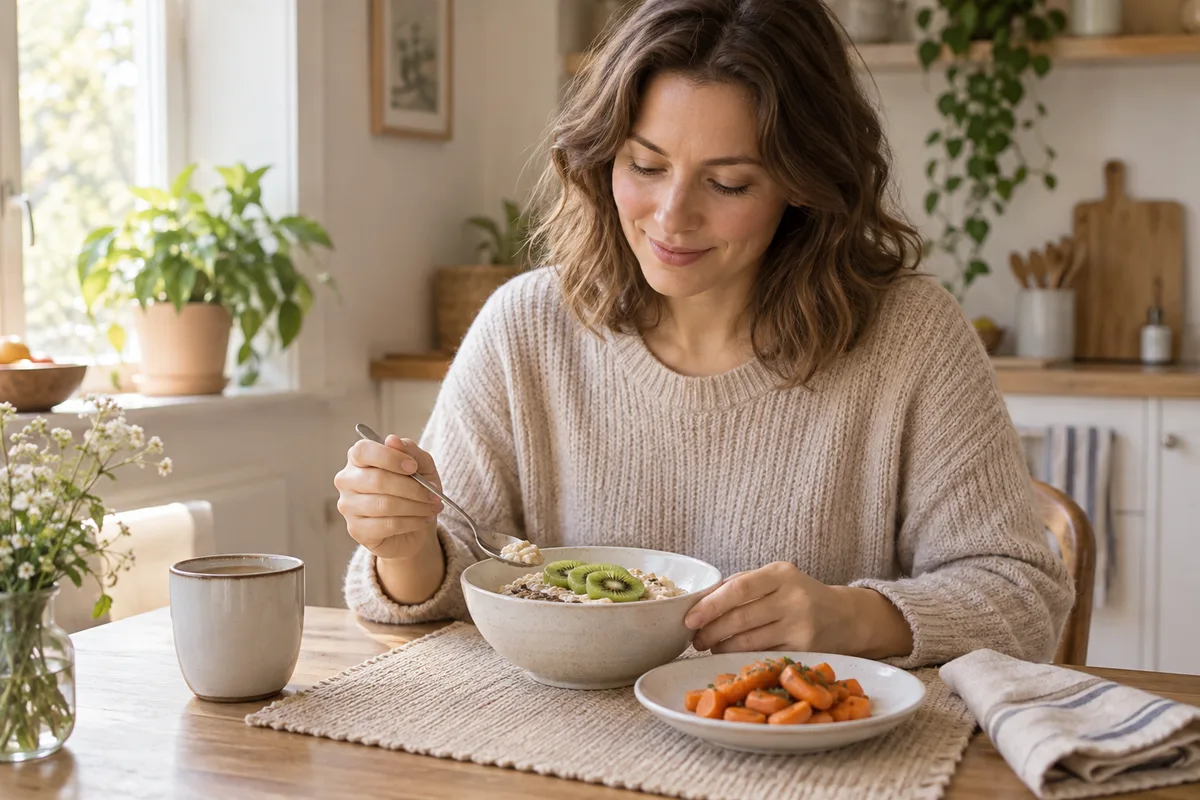
Some foods help both, some worsen both. Help both: oats, kiwifruit, cooked carrots, rice, ripe bananas — low fermentation, gentle motility. Worsen both: beans, onions, broccoli, carbonated drinks, sugar-free-gum sweeteners — high gas, often with a heavy load of insoluble fiber. NIDDK’s constipation diet advice stresses adding fiber “a little at a time,” precisely so gas production stays within what the gut can adapt to.
How Chinese medicine understands it
In the traditional Chinese medicine (TCM) framework, bloating and blockage sit on the same production line: the Spleen and Stomach transform and transport food, qi drives the conduction, and any slowdown means food, residue, and gas pile up. The roughly 2,000-year-old Basic Questions (Suwen) says “when food and drink double themselves, the stomach and intestines are harmed.” What makes the traditional frame interesting here is a specific observational habit: where the bloating sits, and whether it moves, is itself a clue. Bloating fixed in one place reads as “tangible accumulation” (residue parked in the tract); bloating that wanders and eases after a sigh reads as “formless qi constraint” (a scheduling failure). That echoes, in different language, the modern distinction between obstruction-type and functional bloating.
This framework is a traditional empirical model, not a modern diagnosis (for an overview, see NCCIH’s TCM page). When bloat and block arrive together, tradition sees two common patterns:
- Qi-constraint-led: the bloating dominates, wanders in position, eases after burping or passing gas, and syncs with mood — noticeably worse under pressure. The scheduler has failed. Direction: unjam the qi and the rhythm first; a sudden pile of coarse grain is the wrong move here, because a constrained system lacks the strength to process heavy fiber.
- Spleen-weakness-led: the blockage dominates, a few bites bloat you, the fullness lingers dully, with general fatigue, cold hands and feet, and stools either dry or loose. The line itself is underpowered. Direction: warm, soft, cooked small meals — not a raw salad, which a weak engine struggles with most.
Qi-stagnation constitution tendencies call for attention to mood and eating rhythm; qi-deficiency constitution tendencies call for portion size and digestive load. The link runs one way — a qi-stagnation leaning means watching those things, not that bloating proves you’re qi-stagnant. Patterns mix and shift with state; formal differentiation takes an in-person TCM practitioner.
Everyday adjustments
Work in order: clear gas, move gently, rebuild fiber.
Start by looking for personal triggers.
- Notice whether a particular food reliably worsens your symptoms. If so, try reducing that food temporarily while keeping a varied diet. Avoid cutting out whole food groups without guidance; a clinician or dietitian can help with persistent symptoms.
- Staples: rice or oats. Vegetables cooked (carrots, zucchini, spinach). Fruit: kiwifruit or ripe banana.
- Eat to 70% full; no talking-while-wolfing, no straws.
For gentle support:
- Breakfast: 40–50 g oats or two kiwifruit; one or two extra glasses of water a day.
- Hold a 15-minute bathroom window after breakfast; walk 10 minutes after meals.
Add fiber gradually if tolerated:
- One notch a week, in this order: more cooked vegetables → more fruit → half a cup of legumes → whole-grain swaps.
- If a change brings the bloating back, reduce or pause that change and reassess.
TCM methods
The five categories below are tailored to the bloat-and-block combination, each marked with the constitution tendencies it suits. Everything in the food section is a food-therapy use of culinary ingredients; if you intend to use them as medicinal herbs, consult a licensed TCM practitioner.
Acupressure and self-massage
On bloated days, rub first and press second — give the gas an exit before working the points. Keep the pressure comfortable and the abdomen warm:
- Belly rub: palm on abdomen, slow strokes along the colon’s path (lower right → upper right → upper left → lower left) for 5 minutes. The direction helps gas move toward the exit; wandering bloating responds best.
- Tianshu (ST25): about three finger-widths to either side of the navel, 60 seconds per side. Traditionally regulates Large Intestine conduction — the priority point when blockage dominates.
- Zhongwan (CV12): about one palm-width above the navel (midpoint between the bottom of the breastbone and the navel), gently rubbed with a fingertip for 1–2 minutes. Traditionally used for stomach fullness and early satiety — add it for the Spleen-weak kind who bloats after a few bites.
- Neiguan (PC6): palm side of the forearm, about three finger-widths above the wrist crease, between the two tendons, 60 seconds per side. Traditionally loosens the chest and regulates qi — for bloating that syncs with mood.
Cautions: pregnant women should not press abdominal points or do the belly rub; skip on a full stomach and over unhealed abdominal surgery or hernias; stop if it hurts. Qi-deficiency leanings halve the pressure; qi-stagnation leanings pair the pressing with slow exhales.
Food therapy
Chinese home-style track (ingredients at Asian supermarkets or online):
- Daikon radish soup: 150 g daikon chunks simmered with 2 slices of ginger in 500 ml water for 20 minutes, lightly salted. Traditionally daikon “descends qi and disperses food,” suiting the qi-constraint kind of bloating; qi-deficiency leanings can add 3 red dates to balance the cool nature.
- Chinese yam and millet congee: 100 g fresh Chinese yam (shan yao) and 40 g millet simmered in 500 ml water for 30 minutes. Traditionally supports the Spleen and Stomach with a neutral nature — warm, soft, small servings for the Spleen-weak kind; yang-deficiency leanings can add a little shredded ginger.
- Chenpi water: 3 g dried tangerine peel (chenpi) steeped in 300 ml hot water. Traditionally moves qi and supports the Spleen — a daily drink for the qi-constraint kind; use sparingly if you run dry-mouthed.
Western everyday track:
- Pumpkin-oat porridge: 100 g pumpkin and 40 g oats simmered in 400 ml water until soft. Pumpkin is mild and low-gas; oats bring soluble fiber — the Spleen-weak kind’s breakfast.
- Roasted fennel and carrots: 100 g fennel bulb and 100 g carrot slices roasted at 180°C for 20 minutes with olive oil. Fennel is a traditional European kitchen remedy for after-meal digestion — a low-gas side for the qi-constraint kind’s dinner.
Emotional care
For qi-constraint bloat-and-block, eating rhythm is the first lever: 15–20 minutes per meal, seated, chewing each mouthful 15–20 times, no work messages at the table. Rushed eating swallows air and half-chewed food — the raw materials of bloating. Before bed, do 1–2 minutes of slow belly breathing (inhale 4 seconds, exhale 6) to give the gut-brain axis a clock-out signal. If you lean qi-stagnant, fix this after dinner daily; on days when an argument bloats you, take a 10-minute walk before reaching for diet rules.
Movement
A 10–15 minute walk after meals is the simplest way to help gas move along — pace at “can talk in full sentences.” On very bloated days, skip crunch-type abdominal compression and switch to walking or gentle twisting stretches. Qi-deficiency and yang-deficiency leanings stop at a light warmth; yin-deficiency leanings don’t chase sweat.
Sleep and daily rhythm
- Three regular meals; dinner to 70% full, finished 3 hours before bed.
- On very bloated nights, rest on your left side — the colon’s anatomy lets gas clear more easily that way.
- Don’t prop the afternoon up with coffee right after lunch; take a 10-minute walk instead — diving straight from lunch into intense work is a classic trigger for the qi-constraint kind.
Bloat-and-block food log
Track two weeks, four entries a day:
| What to record | Example |
|---|---|
| What you ate (flag gas-formers) | Lunch: onion beef wrap + cola |
| Bloating severity and timing | Started 1 hour after eating, lasted about 3 |
| Bowel movement | None / hard / formed |
| Which phase you’re in | Gas-cut week / motility week / fiber notch 2 |
After two weeks, look back. Bloating that reliably follows a specific food points to a personal trigger. Bloating that eases as movements improve means the direction is right — stay the course. Bloating unchanged despite better bowels suggests a sensitivity component; take the log to a doctor.
Note: this is a self-observation tool, not a diagnostic scale.
How long until you see improvement
There is no reliable timetable for these changes. Keep the food log as a way to notice personal patterns, not as a diagnosis. Seek medical advice if bloating or constipation persists, worsens, or interferes with eating or daily life.
When to see a doctor
- Bloating severe enough to interfere with eating, or persisting for weeks;
- Blood in the stool, unexplained weight loss, or persistent fatigue;
- Persistent or severe abdominal pain, vomiting, fever, or inability to pass gas — prompt care;
- A sudden change in bowel habits, especially new after age 40;
- Long-term alternation between diarrhea and constipation — this can point to IBS and deserves a proper diagnostic pathway.
This article is general health education and can’t replace a doctor’s diagnosis or individualized advice. If you suspect a food intolerance (lactose, gluten), don’t run a long-term self-exclusion first — test first, adjust second. The order matters.
For the fuller picture of bloating, read bloating after eating; once movements normalize, transition to the standard framework in what foods help with constipation and the constipation hub.
Blocked and bloated at once — which do you fix first?
Some people bloat from gas-forming foods; others bloat because slow transit stretches out fermentation time. The order of fixes differs. The free constitution test shows your tendencies from a traditional wellness perspective and pairs well with the tracking log in this article. It's a self-observation tool, not a medical diagnosis.
References6 sources
- 01
U.S. National Institute of Diabetes and Digestive and Kidney Diseases (NIDDK / NIH)
- 02
U.S. National Institute of Diabetes and Digestive and Kidney Diseases (NIDDK / NIH)
- 03
U.S. National Institute of Diabetes and Digestive and Kidney Diseases (NIDDK / NIH)
- 04
UK National Health Service (NHS)
- 05
U.S. National Center for Complementary and Integrative Health (NCCIH / NIH)
- 06Huangdi Neijing: Suwen (The Yellow Emperor's Inner Classic: Basic Questions)
Classic of Chinese medicine, ~2nd century BCE
Personalized guidance
Use the app for constitution-friendly ideas and structured plans when available.
Download the App
Get personalized TCM health recommendations