Why Do I Feel Tired After 8 Hours of Sleep?
Sleeping long enough but waking unrefreshed usually points to sleep quality and timing, not duration. From fragmented sleep and sleep apnea to the Chinese medicine idea that a restless stomach spoils the night, here's how to find your reason for waking up tired and what to change first.
By WellTao · Published: · Last updated: · Editorial Policy
More articles in this topicTable of contents
The Short Version
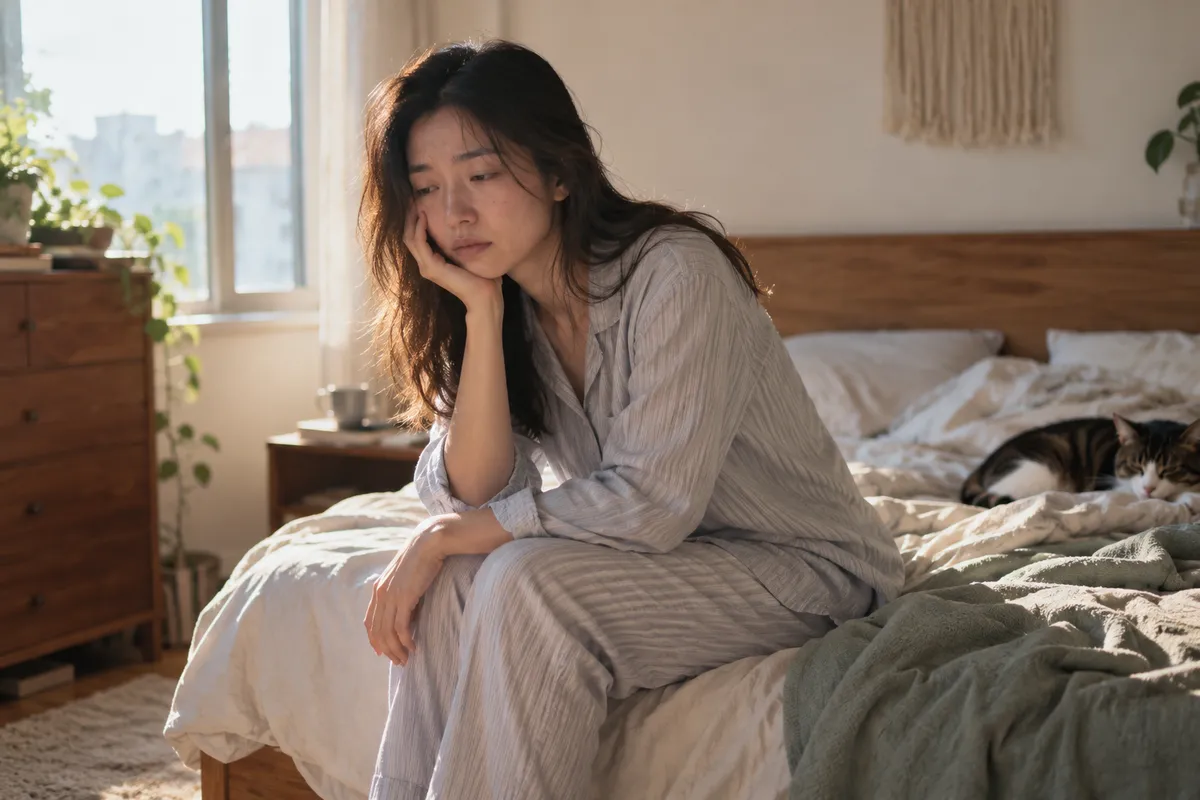
If you’re wondering why you feel tired after 8 hours of sleep, the most direct answer is that you got enough time but not enough quality. Whether sleep refreshes you comes down to three things: how much of your time in bed is actual sleep (lying in bed isn’t sleeping), whether your sleep structure stayed intact (deep sleep and dream sleep not chopped into pieces), and whether you slept at the right time for your body clock. Any one of these going wrong can waste the whole 8 hours. In the CDC’s definition of sleep quality, “still feeling tired after sleeping the recommended hours” is itself one of the classic signs of poor sleep.
Most people can find their cause in daily life: broken sleep, an irregular schedule, alcohol or caffeine, a late-shifted body clock forced awake early. But one possibility needs ruling out before anything else: sleep apnea. If you also snore loudly, wake gasping at night, or get morning headaches, don’t start with self-care experiments. Book a sleep evaluation first (see the doctor guidance at the end of this article).
Five Ways to Sleep 8 Hours and Still Wake Up Tired
“Waking up tired” isn’t one feeling. See which morning sounds like yours:
- The alarm-clock hangover: when the alarm goes off you feel dredged up from deep water, head thick, needing half an hour to two hours to come around. Common when the alarm catches you in deep sleep.
- The night-shift feeling: you slept all night but wake as if you’d been on duty. You remember the dreams, the tossing, the traffic outside. Your sleep was sliced thin; you just can’t remember the few-second awakenings that did the slicing.
- The snorer: a bed partner complains about your snoring, you wake gasping or choking at night, you get headaches when you wake up, your mouth is dry, and you can fall asleep in afternoon meetings. This is the textbook picture of sleep apnea, and the right direction is a medical workup, not self-care.
- The weekend catch-up: up at 6:30 all week, asleep till noon on weekends, and Monday is the worst day of all. That’s a rhythm problem, and extra sleep can’t repay it.
- Tired no matter how much you sleep: 9 or 10 hours and still exhausted, rest doesn’t touch it, possibly with low mood, unusual cold intolerance, or a pale face. This kind needs medical causes ruled out first; see the last section.
What’s a normal wobble: a week or two of unrefreshing sleep after a crunch at work, a change of season, or a few late nights is common and usually fixes itself. More than a month, with no improvement after you regularize your schedule, deserves a real look. Two boundary notes: if your problem is not being able to fall asleep in the first place, read why you’re tired but can’t sleep; if you keep waking at the same time every night, read why you keep waking up at 3 a.m.. This article handles one question only: you slept enough, so why are you still tired?
What Modern Medicine Says
Time in bed is not time asleep. Spend 8 hours in bed, subtract the time it took to fall asleep, the night wakings, and the lying-there-awake before the alarm, and actual sleep may be just over 6 hours. The sneakier thief is the micro-arousal: dozens of awakenings a night, each only seconds long, none of them remembered, every one of them cutting your sleep once more. Sleep runs in stages. Deep sleep (slow-wave sleep) is the heaviest, hardest-to-wake stage, concentrated in the first half of the night, when most physical repair and the growth-hormone pulse happen. Dream sleep (REM) weighs more toward the second half. When sleep gets chopped up, deep sleep is usually sacrificed first: the hours are still there, but the part that refreshes you is gone.
Sleep inertia: being woken from deep sleep hurts the most. The alarm doesn’t pick its moment. If it lands in a deep-sleep stage, the grogginess and dullness on waking are noticeably heavier and can last tens of minutes or longer. This also explains why “half an hour more” sometimes backfires: the extra half hour drops you back into deep sleep, and the alarm drags you out of it again.
Sleep apnea: the first thing to rule out when no amount of sleep refreshes you. The cycle goes like this: the airway collapses during sleep, breathing stops and oxygen drops, the brain fires a micro-arousal to rescue you, you fall back asleep, and the airway collapses again. This can repeat dozens or even hundreds of times a night. You remember none of it, but your sleep structure is shredded, which is why no daytime nap is ever enough. The NHLBI says plainly: if you’re told you snore or gasp in your sleep, or you’re excessively sleepy during the day, talk to a doctor; diagnosis takes a sleep study. Untreated sleep apnea raises the risk of high blood pressure, heart disease, and stroke, so this isn’t something to tough out.
Circadian misalignment: not too little sleep, but sleep at the wrong time. Sleepiness is set by two systems. One is adenosine, a chemical that builds up in the brain while you’re awake (the more accumulates, the sleepier you get) and clears while you sleep. The other is the body clock: morning light pushes cortisol up to wake you, and darkness at night lets melatonin rise to bring sleep on. A natural night owl forced up at 7 a.m. is being dragged out of bed at their biological 4 a.m., and the grogginess is guaranteed. Sleeping till noon on weekends is another kind of misalignment: it’s the equivalent of flying two time zones every weekend and flying back on Monday. NIGMS is explicit about what jet lag and shift work do to the body’s rhythms, and “social jet lag” is the same mechanism in miniature.
Alcohol and caffeine: one fakes sleep, the other fakes wakefulness. Alcohol does get you to sleep faster, but as it metabolizes, the rebound arrives: the second half of the night turns lighter, more broken, and full of awakenings. The drowsiness alcohol sells you gets repaid after midnight. Caffeine’s half-life is about 5 to 6 hours, and it works precisely by blocking adenosine; an afternoon coffee can still be standing guard at midnight.
Medical causes worth ruling out. Fatigue is a symptom, not a diagnosis. MedlinePlus lists common causes including anemia, thyroid disease, depression and anxiety disorders, diabetes, and sleep apnea; depression’s classic sleep signature is waking earlier than usual and being unable to get back to sleep. If yours is the kind of tired that rest doesn’t fix, and it’s been going on for weeks, the right move is testing, not endurance.
How Chinese Medicine Reads Unrefreshing Sleep
Chinese medicine has never judged sleep by hours alone. What follows is the traditional framework, an empirical model, not a diagnosis in the modern medical sense.
Traditional theory explains the sleep switch with “wei qi,” which you can picture as the body’s guard-duty energy: it runs at the surface by day and you stay awake; it returns to the interior at night and you fall asleep. The Lingshu, the second half of the roughly 2,000-year-old Yellow Emperor’s Inner Classic, puts it this way: “When yang qi is spent and yin qi prevails, the eyes close; when yin qi is spent and yang qi prevails, you wake.” Unrefreshing sleep, in this frame, means wei qi failed to settle properly overnight: it didn’t sink deep enough (light sleep), it got disturbed midway (heavy dreaming, an unsettled stomach), or it couldn’t rise on duty in the morning (waking with a heavy head and a sluggish body).
Which kind of “failed to settle” you have, tradition reads through several classic clues:
Late, heavy dinners: “when the stomach is not at peace, sleep is not at rest.” The line comes from the Suwen, the other half of the Inner Classic, quoting an older text. If your gut is still working overtime at bedtime, qi that should descend doesn’t, and sleep stays shallow. You get the 8 hours on the clock and a discount on the quality. This is the most direct and the most testable kind of “slept enough, still tired”: eat an earlier, lighter dinner for a few days and compare how you wake.
Heavy dreaming: liver blood too thin to anchor the spirit. The Lingshu says “the liver stores blood, and blood houses the hun,” the hun being the part of the mind that tradition says should rest anchored in the blood at night. With ample liver blood, mental activity settles at night and sleep is steady and quiet; with too little, dreams turn frequent, tense, and vivid, and you wake as if you never rested. About 1,800 years ago the Jin Gui Yao Lue (Essential Prescriptions from the Golden Cabinet) left the famous formula Suanzaoren Tang (Sour Jujube Seed Decoction) for “deficiency vexation and sleeplessness,” and sour jujube seed is still the most-used calming herb in Chinese medicine. That’s background knowledge from the classics, not a prescription; any herbal use needs a licensed practitioner’s in-person judgment.
Waking with a heavy head and body: dampness weighs things down and the clear yang can’t rise. The Suwen describes it as “with dampness, the head feels wrapped.” People whose digestion generates dampness wake with a swaddled head, a body like wet sandbags, and sleepiness that more sleep only deepens. In the traditional frame, this isn’t too little sleep; it’s the “clear qi” failing to rise, like an engine that started but can’t get up to speed.
Four common morning patterns
- Heavy-headed, heavy-bodied: you wake with a thick head and a leaden body, a thick greasy tongue coating, and it gets worse after late or greasy dinners. Tradition usually reads this as dampness bogging down the digestive system, and it often appears alongside a phlegm-dampness constitution tendency. Direction: earlier and lighter dinners, and get moving during the day.
- Dreamy and irritable: frequent, tense dreams, waking annoyed, sighing through the day, worse after stressful events. Tradition usually reads this as liver blood running short and qi failing to flow freely, and it often appears alongside a qi-stagnation constitution tendency. Direction: give emotion and movement an outlet in the daytime.
- Light sleep, racing heart: shallow sleep, waking with your heart thumping and slow to settle, daytime fatigue, a yellowish complexion. Tradition usually reads this as qi and blood not nourishing the heart-mind, and it often appears alongside a qi-deficiency constitution tendency. Direction: regular meals and a steady rhythm are more fundamental than any calming trick.
- Hot and dry-mouthed: waking with a dry mouth, warm palms and soles, possibly night sweats. Tradition usually reads this as yin fluids running short, and it often appears alongside a yin-deficiency constitution tendency. Direction: in the evening, go easier on spicy food, alcohol, and intense mental work.
One caution: these are descriptions of how your mornings feel, not constitution verdicts. One person can be a mix of several patterns, and the pattern shifts with your state. Formal differentiation needs an in-person TCM practitioner. For the framework itself, see the nine TCM constitution types.
Everyday Adjustments
- Fix your wake time. Get up at the same time every day (within 30 minutes), no more than an hour later on weekends. This is the strongest anchor for the body clock, far more useful than weekend catch-up sleep, which is exactly the move that scrambles the rhythm again.
- Get 10–20 minutes of sunlight within an hour of waking. Morning light is the strongest clock-setting signal there is, and it drives the morning cortisol peak directly, which is precisely what’s missing when you’re groggy in the morning and wired at night.
- No caffeine after 2 p.m. With a half-life of 5 to 6 hours, sensitive people should stop after lunch.
- No alcohol within 3 hours of bed, and finish dinner 3 hours before bed, at about 70% full. The fast sleep alcohol buys is repaid in second-half-of-the-night fragments; a late, heavy dinner is the modern version of “when the stomach is not at peace, sleep is not at rest.”
- Set the bedroom to 64–68°F (18–20°C), dark, and quiet. A cooler, darker room reduces second-half awakenings.
- When the alarm rings, get up; don’t snooze. Snooze sleep is fragmented sleep, and the more you snooze the foggier you get. If you’ve spent years hitting snooze for 20 more minutes, just set the alarm 20 minutes later.
- Nap 20–30 minutes, finished by 3 p.m. Longer than that and you drop into deep sleep, wake foggier, and spend down the sleepiness you need for the night.
TCM Methods
The five categories below can be combined. Start with the one or two easiest to keep up; you don’t have to do them all at once.
Acupressure
Every night before bed, press with the pad of a finger, 30–60 seconds per point, firm enough for a mild, bearable ache, with slow breathing.
Shenmen (HT7) Location: on the wrist crease, at the pinky-finger end, in the hollow on the inner side of the tendon. Traditional use: the most-used calming point in Chinese medicine, traditionally for an unsettled heart-mind and frequent dreaming. 60 seconds per hand.
Zusanli (ST36) Location: about four finger-widths below the hollow on the outer side of the knee, one finger-width to the outside of the shinbone. Traditional use: traditionally strengthens the digestive system and boosts qi, suiting the heavy-headed, damp-bogged morning type. 60 seconds per leg.
Sanyinjiao (SP6) Location: about four finger-widths above the tip of the inner ankle bone, just behind the inner edge of the shinbone. Traditional use: traditionally regulates liver, spleen, and kidney together, suiting the hot, night-sweating type. 60 seconds per leg. Do not use during pregnancy.
Anmian Location: the midpoint of the line between the hollow behind the earlobe (Yifeng) and the hollows at either side of the back hairline (Fengchi). Traditional use: an extra point outside the regular channels whose name literally means “peaceful sleep.” Rub gently for 1–2 minutes before bed.
All four points are gentle, and every tendency can press them. People whose mornings run heavy and foggy can give Zusanli extra time. People who run hot and dry should skip warming stimulation such as moxibustion.
Food Therapy
Dinner at 70% full, all eating finished 3 hours before bed. This is the most direct daily answer to “when the stomach is not at peace, sleep is not at rest,” and both tracks below build on it.
Chinese home-style track:
- Millet congee: traditional food therapy holds that millet settles the stomach and calms the mind. Millet is a small yellow grain sold in the grains aisle of Asian supermarkets or online. Simmer it into a thin porridge and have one warm bowl as a light, no-burden dinner.
- Plain rice porridge: simmer 50 g rice in about 500 ml water until soft. Serve as an ordinary light meal, not a sleep treatment. Sour jujube seed is a medicinal ingredient; its use belongs with a qualified clinician.
- Chinese yam and Job’s tears congee: simmer 30 g of Chinese yam (shanyao, a starchy white root sold fresh in Asian supermarket produce sections or dried in the dried-goods aisle) with 30 g of Job’s tears (yi yi ren, also called Chinese pearl barley, same sources). Traditionally it strengthens digestion and drains dampness, suiting people who wake heavy-headed and leaden. Job’s tears are not for use during pregnancy.
- Longan and red date tea: simmer 3–5 pieces of dried longan flesh (longyan, a sweet dried fruit related to lychee, sold as dried longan meat in Asian supermarkets) with 2–3 red dates (jujubes) in water. Traditionally it replenishes the heart and spleen, suiting light sleepers who drag through the day. Not for frequent drinking if you run hot or carry a lot of dampness.
Western everyday track: the same directions done with ingredients from any American or British supermarket, ready to cook even if you can’t find the Chinese ones.
- Oatmeal: the counterpart to millet congee’s stomach-settling direction. Simmer 40–50 g of old-fashioned rolled oats in 300 ml of water for 5–8 minutes into a thick porridge, and have a warm bowl for dinner, light and easy. If you want flavor, half a spoon of honey; no sugar.
- Warm banana-cinnamon milk: the counterpart to the jujube seed congee’s calming direction. Warm 200 ml of milk over low heat without boiling, mash half a ripe banana, stir in a small pinch of cinnamon, and combine. Take it warm 1–2 hours before bed.
- Pumpkin, sweet potato, and chicken soup: the counterpart to the yam and Job’s tears congee’s digestion-and-dampness direction. Cube 200 g of pumpkin and 1 sweet potato (about 150 g); blanch 1 chicken drumstick, then simmer it with 2 slices of ginger for 40 minutes; season lightly with salt. Have it with a small half-bowl of rice as dinner, stopping at 70% full.
- Ginger-date tea: the counterpart to the longan and red date tea’s replenishing direction. Pit 3 dates, add 3 slices of fresh ginger and 400 ml of water, and simmer for 10 minutes. Drink it warm in the afternoon or early evening; if you run hot, halve the ginger.
People whose mornings run heavy and foggy should lead with the yam–Job’s tears congee or the pumpkin–sweet potato soup; people with a qi-deficiency tendency do better with the longan–red date tea or the ginger-date tea; and people who run hot and dry are steadier with the millet congee, the jujube seed congee, or plain oatmeal. Everything in this section is a food-therapy use of culinary-grade ingredients; if you intend to use any of them as medicinal herbs, consult a licensed TCM practitioner first.
Emotional Care
If you have the dreamy, irritable type, the work is in the daytime, not at bedtime: give emotion an outlet during the day (a walk, exercise, talking it out, writing it down), and the “spirit” has somewhere to settle at night. Before bed, write a set-it-down list: every nagging item goes on paper, each with the time tomorrow you’ll deal with it, handed to the pen instead of carried into bed. And in the morning, don’t lie there scrolling your phone waiting for the fog to lift; get up, get into the light, and move, and the grogginess retreats faster. Emotional care is something everyone can do, and it matters most for the dreamy, irritable type. No tendency needs to avoid it.
Movement and Exercise
If ordinary activity causes delayed worsening lasting days, stop increasing exercise and seek assessment. Persistent unexplained fatigue or fatigue affecting daily life warrants an appointment now; a self-care trial is not a prerequisite. See the fatigue topic’s care guidance.
- Regular daytime exercise is one of the most widely agreed-on ways to improve sleep quality: 30-plus minutes a day, ideally in the 3–5 p.m. window, when body temperature and muscle function peak.
- Traditional qigong routines like Baduanjin (Eight Pieces of Brocade, a slow sequence of eight stretches) run at a gentle pace and suit early-evening practice. If your mornings are heavy and foggy, spend extra repetitions on the move called “raise one arm to regulate the spleen and stomach.”
- No vigorous exercise within 2 hours of bed: the rise in body temperature and alertness takes a few hours to come back down.
Daytime movement matters most for people whose mornings run heavy, because dampness needs an exit and motion provides it. People with a qi-deficiency tendency should start at low intensity, using “not more tired the next day” as the ceiling.
Sleep and Daily Rhythm
- Fixed wake time, no weekend catch-up beyond an hour. Traditional regimen and modern sleep medicine reach the same conclusion here.
- In bed by 11 p.m. where possible. On the Chinese body clock, the Haishi hours (9–11 p.m.) are “the time of human rest,” when everything should quiet down. In the modern view, an early bedtime protects the first half of the night’s deep sleep all the same.
- Nap 20–30 minutes, finished by 3 p.m.
A steady rhythm is the foundation under every tendency, and it matters most for people running low on energy reserves and those who run hot and dry. No tendency needs to avoid it.
The same “unrefreshing sleep” calls for different work: someone bogged down in dampness needs to lighten and drain, while someone running on empty qi and blood needs steady replenishment. If you’d like to know which way you lean, take the free constitution test at the end of this page. It’s a self-observation tool, not a medical diagnosis.
A One-Week Sleep Quality Log
Log for one straight week and you’ll know more about why your sleep isn’t refreshing you than any generic advice can tell you. Each morning, spend one minute recording:
| What to record | How to record it | Example |
|---|---|---|
| Bedtime / wake time | Include weekends, to see whether your schedule drifts | 11:40 p.m. / 7:10 a.m. (Saturday: noon) |
| First feeling on waking | Refreshed / groggy / heavy-headed / irritable / racing heart | Heavy-headed |
| Dreams | No sense of dreaming / many calm dreams / many tense dreams | Many tense dreams |
| Snoring and gasping | Ask whoever shares your room, or use a phone recording app | Told I snore |
| Caffeine | Time of the last one | 4:00 p.m. latte |
| Alcohol | Whether, and when | Two glasses of wine with dinner |
| Dinner | What time you finished, how full (out of 10) | 9:00 p.m., 9/10 full |
| Daytime state | Nap length, daytime sleepiness (0–10) | 40-minute nap, sleepiness 7 |
After a week, read it back. If unrefreshing mornings always follow drinking or big meals, fix the food first. If weekends are worse than weekdays, fix your wake time first. If snoring reports pile up and your daytime sleepiness scores run high, go book the sleep study directly. Your log will tell you which one thing to change first. The log has a second use: the CDC advises bringing a sleep diary to medical appointments, so if you do end up seeing a doctor, the homework is already done.
How Long Until You See Improvement
Use the dates in your plan as review points, not promises of recovery. Responses to sleep, food and activity changes depend on the cause of fatigue and your circumstances. There is no established recovery timetable for the acupressure or food-therapy suggestions here.
- Review your notes weekly: compare sleep, daytime energy and the effects of activity. One better day does not identify a cause.
- Watch for delayed worsening: if ordinary activity brings a marked decline hours to a day or two later that lasts for days, reduce the load, stop increasing activity and seek assessment. Do not push through a fixed exercise plan.
- Arrange care when needed: unexplained fatigue lasting weeks or affecting daily life warrants a medical appointment. Do not wait to complete a diary or self-care trial; worsening symptoms or the warning signs below need earlier attention.
See NHS advice on fatigue and CDC guidance on post-exertional malaise.
When to See a Doctor
Self-adjustment suits unrefreshing sleep that’s driven mainly by lifestyle. Get a professional evaluation first if any of the following apply:
- Loud snoring, witnessed pauses in breathing or waking up gasping, morning headaches, and severe daytime sleepiness: the telltale cluster of sleep apnea clues. Self-care cannot fix it. See a sleep specialist or a respiratory (pulmonary) doctor, who will arrange a sleep study (an overnight lab study called polysomnography, or a home sleep test after evaluation) to confirm the diagnosis. Untreated apnea raises the risk of cardiovascular and cerebrovascular disease, so the earlier you check, the better.
- Fatigue that lasts for weeks and doesn’t lift with rest, with a pale complexion, unusual intolerance of cold or heat, or a clear change in weight: anemia and thyroid problems need ruling out, usually starting with a complete blood count and thyroid function tests.
- Low mood and loss of interest in everything for more than two weeks, or waking earlier than usual and being unable to get back to sleep: a common depression combination, worth a conversation with a mental health professional or your GP.
- Night sweats heavy enough to soak clothing or bedding, with fever or weight loss: other medical causes need ruling out.
This article is general health education and can’t replace a doctor’s diagnosis or individualized advice. If you’re taking sleep medication or any other long-term medication, talk to your doctor before making changes, and don’t stop any medication on your own.
For the bigger picture on daytime fatigue, start at the fatigue hub. Not being able to fall asleep and waking at the same time every night are sister problems with their own guides: why you’re tired but can’t sleep and why you keep waking up at 3 a.m.. To plan your whole day along your rhythm, read the Chinese body clock; for the constitution framework, see the nine TCM constitution types.
Same unrefreshing sleep, different fixes: which way does your body lean?
Waking up tired looks similar from the outside, but the right direction differs by tendency: damp heaviness, running low on qi and blood, and depleted yin each call for a different emphasis. The free constitution test shows your tendencies across nine traditional body types and helps you read your own pattern. It's a self-observation tool, not a medical diagnosis.
References12 sources
- 01
U.S. National Heart, Lung, and Blood Institute (NHLBI / NIH)
- 02
U.S. National Heart, Lung, and Blood Institute (NHLBI / NIH)
- 03
U.S. National Heart, Lung, and Blood Institute (NHLBI / NIH)
- 04
U.S. National Heart, Lung, and Blood Institute (NHLBI / NIH)
- 05
U.S. Centers for Disease Control and Prevention (CDC)
- 06
U.S. National Institute of General Medical Sciences (NIGMS / NIH)
- 07
U.S. National Institutes of Health, MedlinePlus
- 08
U.S. National Center for Complementary and Integrative Health (NCCIH / NIH)
- 09
U.S. National Center for Complementary and Integrative Health (NCCIH / NIH)
- 10Huangdi Neijing: Suwen (The Yellow Emperor's Inner Classic: Basic Questions)
Classic of Chinese medicine
- 11Huangdi Neijing: Lingshu (The Yellow Emperor's Inner Classic: The Spiritual Pivot)
Classic of Chinese medicine
- 12Jin Gui Yao Lue (Essential Prescriptions from the Golden Cabinet)
Classic of Chinese medicine (Zhang Zhongjing)
Personalized guidance
Use the app for constitution-friendly ideas and structured plans when available.
Download the App
Get personalized TCM health recommendations