Why Do I Get a Headache After Eating?
Headaches after meals can have several causes; timing alone cannot establish low glucose or a food trigger. Learn possible associations, keep a food and symptom log, and recognize when recurrent symptoms need assessment.
By WellTao · Published: · Last updated: · Editorial Policy
More articles in this topicTable of contents

The Short Version
Meal-related headaches have several possible explanations, including migraine, cold-stimulus headache and symptoms associated with low blood pressure or low glucose. The timing of a headache cannot establish any of these. Recurrent episodes, worsening pain or associated dizziness deserve assessment; do not assume a meal makes the headache harmless.
Working out your direction is simple: note what you ate, how long afterward the pain started, and how bad it got, for two weeks straight (there is a ready-made log at the end). The pattern usually reveals itself. Genuinely food-triggered headaches tend to show up within minutes to a few hours of eating, and they repeat.
One situation cannot wait: a sudden, explosive headache that feels like the worst of your life, or any headache with fever, a stiff neck, weakness on one side of the body, or blurred vision needs medical care immediately. The full red-flag list is in the doctor section.
Which Kind of Post-Meal Headache Is Yours?
Start by matching yourself against “how long after eating does it start”:
- Hits within minutes, gone in 30 seconds to two minutes: a sharp stabbing pain in the forehead or temples, most common when you eat ice cream or gulp a cold drink too fast. This is a cold-stimulus headache (the famous “brain freeze”). It arrives fast, leaves fast, is harmless, and needs no treatment.
- One to three hours after a meal, with a racing heart, sweating, shaky hands, irritability: feels like someone pulled the plug, and eating something brings you back. This points toward blood sugar swings, and a headache after lunch that always lands mid-afternoon is the classic version.
- Thirty minutes to two hours after eating, with dizziness, vision going dark, weakness, nausea: most noticeable after breakfast and most common in older adults. This points toward a post-meal blood pressure dip, and the dizziness can come with a heavy, tight feeling in the head.
- One-sided throbbing, sensitivity to light and sound, nausea, lasting hours to days: that is the shape of migraine. The meal was just the finger on the trigger.
- Foggy and heavy after eating, head wrapped in something, dull and stuffed: not severe but persistent, often with drowsiness and poor appetite. This one reads more like a combined signal of digestive load and body state, and both the medical and Chinese medicine sections below address it.
What counts as normal fluctuation: an occasional brain freeze, an occasional food coma after a big meal. Both are ordinary body responses. What deserves real attention is this: a headache after nearly every meal, lasting more than two weeks, or pain that keeps getting stronger. “Every time” means a stable mechanism is behind it, and the log exists to find it.
How Modern Medicine Explains a Headache After Eating
Blood Sugar’s Spike and Crash
Reactive hypoglycemia means a measured drop in blood glucose after eating, sometimes within 2–4 hours. Headache, hunger, shaking or improvement after food alone cannot confirm it; similar symptoms have other causes. Repeated episodes should be assessed by a clinician, especially if you use glucose-lowering medicine. Follow your existing hypoglycemia plan if you have one. NHS patient information.
Food Ingredients That Keep Showing Up on Trigger Lists
The NINDS headache page states plainly that some people get headache attacks after certain foods, and gives a common list: aged cheese, cured or processed meats (deli ham, sausage), chocolate, MSG, aspartame, nuts, wine and other alcohol, and caffeine (too much or suddenly stopped both count). The Mayo Clinic’s migraine trigger list largely matches, and adds the opposite case: skipping meals and going hungry can also trigger one.
Two mechanisms have been studied the most. Tyramine is produced when protein ferments and ages, so aged cheese, cured and fermented foods carry the most of it. It can affect blood vessel tone and neurotransmitter release, which is how it sets off headaches in sensitive people. Nitrites are common preservatives in processed meats; they dilate blood vessels and are thought to explain why some people get a headache after sausage, bacon, or other processed pork products. Foods high in histamine (wine, aged cheese) also appear on the NHS food intolerance list.
MSG: More Controversy Than Answers
MSG has a terrible reputation, so the evidence deserves a careful telling. The FDA classifies MSG as “generally recognized as safe” (GRAS), and the headache and nausea reports it has collected over the years have never reproduced reliably in strict double-blind trials. An independent assessment commissioned by the FDA found that only when sensitive people consumed 3 grams or more of MSG on an empty stomach did some of them report brief, mild symptoms like headache or facial flushing. A typical dish seasoned with MSG contains less than 0.5 grams. So the honest conclusion: MSG is not a headache trigger for the vast majority of people. If your own log points at it repeatedly, avoid it, but don’t let the old “Chinese restaurant syndrome” scare convict an entire meal.
Ice Cream Headaches: A Nerve Reflex
When something ice-cold hits the roof of your mouth, local blood vessels constrict and then rapidly dilate. The trigeminal nerve picks up that change, and because the same nerve carries pain signals from the face, the brain misreads the location and projects the pain to the forehead. The pain is in your forehead; the source is your palate. Cleveland Clinic notes this pain usually lasts only tens of seconds to two minutes, resolves on its own, and comes with no other symptoms. People with migraine get iced more easily. The only fix needed: slow down and let your mouth warm the food.
Blood Pressure Dips After Meals
After you eat, a large share of blood is redirected to the stomach and intestines for digestion. Normally the heart speeds up and blood vessels elsewhere tighten to hold blood pressure steady. If that compensation falls behind (common in older adults and people whose vessels have lost elasticity), blood pressure drops noticeably within 30 minutes to two hours of eating. Cleveland Clinic defines postprandial hypotension as a systolic drop of about 20 mmHg, showing up as dizziness, vision going dark, weakness, and nausea, often with a heavy, tight head. One pooled study found roughly four in ten people aged 65 to 86 have some degree of it. The clues: dizziness is the main event, a measured blood pressure reading really is lower, and breakfast brings it on most.
Caffeine and Alcohol
Caffeine and headache run in both directions. If you drink coffee at the same time every day, skipping it lets your vessels loosen from their habitual constriction, and withdrawal headache arrives. Many weekend headaches work exactly like this: the coffee that arrives at 7 a.m. on workdays doesn’t show up until 10 on Saturday. Alcohol is more direct: it dilates blood vessels and dehydrates you through its diuretic effect, and wine carries tyramine and histamine on top, which keeps it on the migraine trigger list.
Food Intolerance Is Not Food Allergy
This distinction is about safety, so it has to be clear. A food allergy is an immune system reaction. Even one bite can bring hives, swelling of the lips or eyelids, and wheezing within minutes, and severe anaphylaxis is life-threatening. That is an emergency. A food intolerance involves no immune response. Symptoms usually appear hours after eating, mostly digestive ones like bloating and diarrhea, though the NHS notes headache and fatigue can be part of the picture too. Intolerance is judged through an elimination-and-reintroduction trial plus your records, not through mail-order “intolerance test kits.” The NHS explicitly does not recommend these products: the evidence is lacking, and they can push you into needlessly cutting out half your diet.
Trigger Lists Are Personal
The key consensus about food triggers for migraine: the lists are statistically “common,” not your personal “forbidden.” The red wine, cheese, and chocolate at the same dinner may trigger you or may not touch you at all, which is why one person gets a migraine after eating a cheese board while everyone else at the table feels fine. That is why every major authority recommends keeping a food and headache diary instead of memorizing an avoidance list. Records beat restriction. It is the entire reason the log below exists.
How Chinese Medicine Understands It
Chinese medicine locates post-meal headaches on the “spleen-stomach” processing line. What follows is the traditional theoretical lens, offered as a self-observation framework. It is an experiential model, not a causal diagnosis in the modern medical sense.
In traditional theory, the spleen “governs transformation and transportation,” which you can picture as the body’s food-processing line: what you eat has to be broken down, converted, and delivered throughout the body. When the line runs well, you feel nourished and energized after a meal. When it is overloaded or running slow, the half-processed material piles up, and tradition calls this buildup “dampness” or “phlegm-dampness”: sticky, heavy residue that rides the circulation upward, fogs the head, and produces a heavy, muddled, stuffed ache. Two thousand years ago the Suwen (Basic Questions), in its chapter on Bi syndrome, put it in one sentence: “When food and drink double what the body can handle, the stomach and intestines are harmed.” Eating past your processing capacity damages the line itself first. That is the root of the traditional advice to stop at about 70 percent full: leave the line some slack. For how this direction relates to digestion more broadly, see the digestive health topic.
Along this main line, post-meal headaches show three common patterns:
Heavy and foggy after meals (the phlegm-dampness direction): the pain is not sharp. It is muddled, heavy, bloating, like a wet towel wrapped around the head. Drowsiness after eating is pronounced, the tongue coating runs thick and greasy, the body feels weighted, stools tend to be sticky. Common in people who sit all day, eat a lot of sweet, greasy, or cold food, and eat large portions.
Tight and pressing (the qi-stagnation direction): the pain feels like a band tightening or a blocked pressure, often at the temples or the crown. It shows up more after rushed meals, working lunches, and tense dinners, with chest tightness and frequent sighing. Stress and eating stacked on top of each other stalls the flow of qi (the body’s functional energy, in traditional terms), and what is blocked hurts.
A fixed spot that distends or stabs (the blood-stasis direction): the pain sits in roughly the same place every time and does not wander. It may come with a darker complexion or darker lips. The clue in this pattern is the word “fixed.”
Traditional accounts also discuss tendencies using categories such as phlegm-dampness constitution, qi-stagnation constitution, blood-stasis constitution. These are classifications within the traditional framework, not validated predictions of symptoms or explanations of a medical cause. A few episodes, a clock time or a quiz result cannot establish a diagnosis. Persistent symptoms need medical assessment; any TCM pattern needs individual practitioner assessment. See the NCCIH overview for research and safety limits.
The research footing is narrower than the tradition. The U.S. National Center for Complementary and Integrative Health (NCCIH) sums up TCM this way: acupuncture has studies suggesting it may reduce the frequency of tension-type headaches and help prevent migraine, though some trials find real and sham acupuncture perform about the same, and herbal research is too uneven in quality for firm conclusions. So everything here sits inside a self-observation and daily-care framework, never a stand-in for evaluation and treatment. One more caution: the acupuncture research studied professional needling, and its results cannot be transferred directly to pressing points with your own fingers.
Everyday Adjustments You Can Start Now
In order of “cheapest change first”:
- Record first, restrict second: don’t start by cutting a pile of foods off an internet list. Use the log for two weeks, then avoid only the one or two items your records keep pointing at.
- Eat to steady blood sugar: every meal gets protein (eggs, soy milk, lean meat, fish). Halve the refined starch and mix in whole grains, and keep sweets small and after the meal rather than on an empty stomach. If your headaches land two or three hours after eating, split three meals into smaller, more frequent ones with a snack mid-morning and mid-afternoon (a handful of nuts, a cup of yogurt).
- Slow down cold food: take small bites of ice cream and sips of iced drinks, letting each mouthful warm for a few seconds before swallowing. If brain freeze hits, press your tongue flat against the roof of your mouth or sip warm water; it eases within seconds.
- Caffeine on a schedule: roughly the same time and the same total every day, weekends included. If you want to cut down, taper week by week. Stopping abruptly is itself a headache trigger.
- Alcohol, wine especially: check your log before deciding: two recorded timelines of post-drink headaches tell you more than a blanket ban.
- If post-meal dizziness is your main event (especially for older adults): drink about 350 ml (a large glass) of water before the meal, split big meals into smaller ones, trim the carbohydrate share of each meal, sit for a while after eating, and stand up slowly. These are Cleveland Clinic’s home recommendations for postprandial hypotension. If you take blood pressure medication, any change to medication timing has to go through your doctor first.
- The pace of the meal itself: give eating 15 to 20 minutes of actual attention; no conference calls over lunch. This one doesn’t look like medical advice, but for the tight, pressing kind of headache it is the most direct intervention there is.
TCM Self-Care Methods
The five categories below correspond to the three patterns above. Start with the one or two easiest to keep up; there is no need to do everything at once.
Acupressure
Once a day, press with a fingertip pad, firm enough to feel a mild soreness or distension, 60 seconds per point.
Zusanli (ST36) Location: about four finger-widths below the outer hollow of the knee, one finger-width to the outside of the shin bone. Traditional use: the most-used point for supporting the spleen and stomach, traditionally applied for weak digestion and post-meal drowsiness. Suits the heavy, foggy pattern. 60 seconds each side.
Neiguan (PC6) Location: about three finger-widths up from the center of the wrist crease, between the two tendons. Traditional use: traditionally settles the stomach and eases nausea and chest stuffiness. Use it when a post-meal headache comes with nausea or a blocked feeling in the chest. 60 seconds each side.
Sanyinjiao (SP6) Location: about four finger-widths above the tip of the inner ankle bone, just behind the inner edge of the shin bone. Traditional use: connects to the liver, spleen, and kidney channels at once; used when the foggy heaviness comes with poor appetite and a weighted body. Do not use during pregnancy.
Hegu (LI4) Location: in the web between thumb and index finger on the back of the hand, at the midpoint of the second metacarpal bone on the thumb side. Traditional use: the traditional saying goes “for face and mouth, seek Hegu”; a standard point for head and face discomfort, useful for the tight, pressing pattern. Do not use during pregnancy.
This set centers on supporting the spleen and stomach and fits a phlegm-dampness tendency best. With a qi-stagnation tendency, prioritize Neiguan and Hegu. Pause during a cold or fever, and press more gently if you are notably run-down.
Dietary Therapy
Chinese home-style track (each ingredient is available at Asian supermarkets or online; amounts are culinary-grade):
- Chinese yam and millet congee: 100 g fresh Chinese yam (shan yao, sometimes sold as nagaimo; look in the produce section of Asian supermarkets, or use dried slices online), peeled and cubed, with 50 g millet. Simmer in water for 30 minutes into a soft porridge for breakfast. Tradition holds that Chinese yam supports the spleen and millet nourishes the stomach; suits the heavy, foggy pattern.
- Dried tangerine peel and ginger tea: 3 g dried tangerine peel (chen pi, the aged peel of mandarin oranges, sold in packets at Asian supermarkets or online) with 2 slices of fresh ginger. Steep in boiling water or simmer 10 minutes, and sip after meals when bloated or nauseous. Dried tangerine peel is traditionally used to move qi and dry dampness, while ginger settles the stomach; for everyday ginger preparations see the ginger tea page (food-therapy use; consult a licensed TCM practitioner before using these as medicinal herbs).
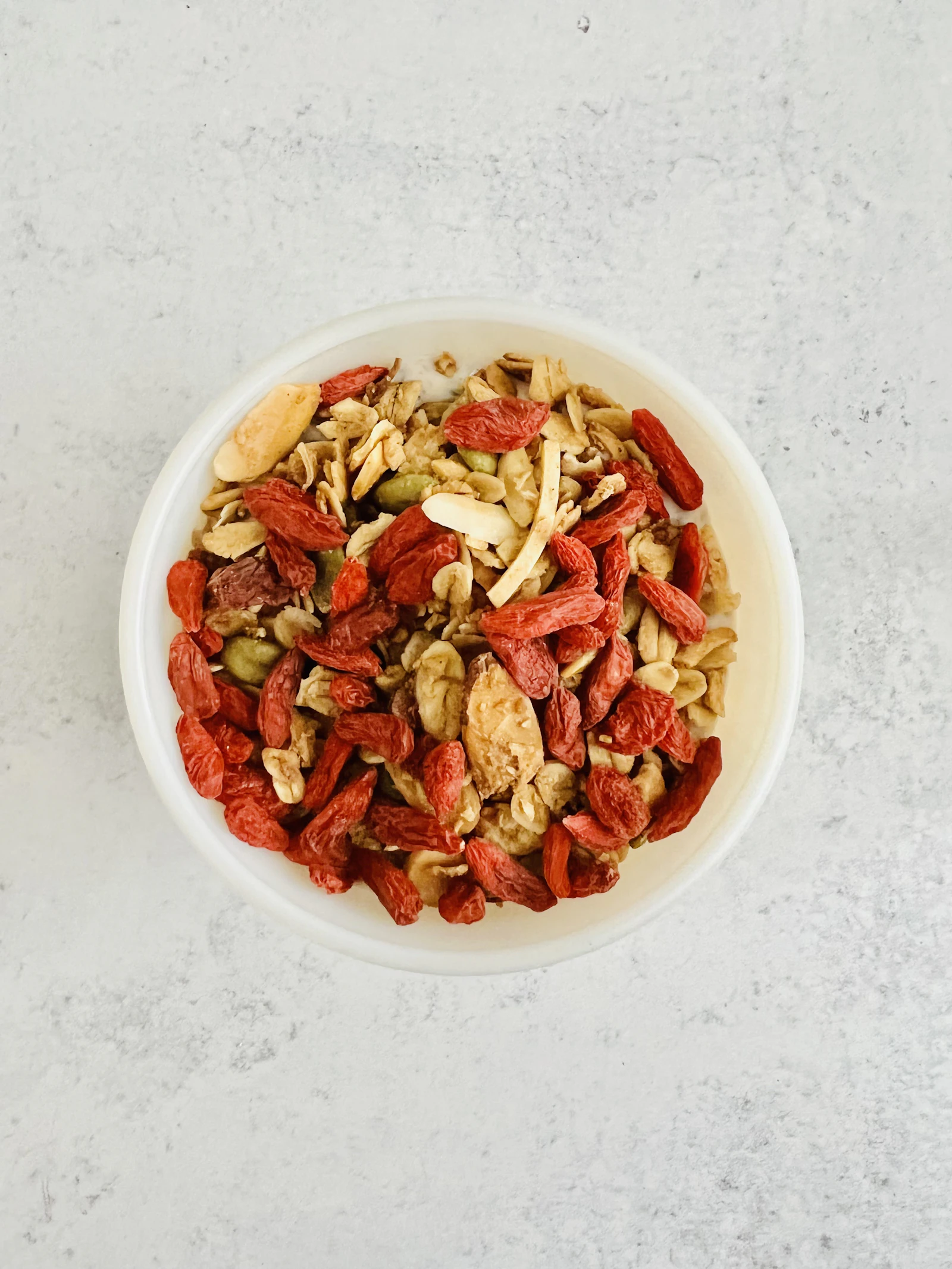
- Goji berry breakfast bowl: scatter a small handful of goji berries (about 10 g, bulk bins at Asian supermarkets or online) over congee or yogurt, with 2 to 3 red dates (jujubes, pitted and chopped) if you like. Goji berries are traditionally used to nourish the liver and kidney, a gentle daily accent at breakfast (food-therapy use; consult a licensed TCM practitioner before using these as medicinal herbs).
When the dampness direction is pronounced, tradition also commonly cooks dried tangerine peel into rice congee (3 g peel simmered with rice until the grains fall apart) as a breakfast or dinner staple.
Western everyday track (all from a regular supermarket):
-
Oat and pumpkin porridge: 50 g old-fashioned rolled oats with 150 g peeled, cubed pumpkin, simmered in water 15 to 20 minutes until soft. Both are mild and easy to digest, the same direction as the yam-millet congee; suits the heavy, foggy pattern.
-
Ginger tea: 2 to 3 thin slices of fresh ginger (about 10 g) steeped in boiling water for 10 minutes, with a small spoon of honey stirred in once it cools slightly. Drink after meals when bloated or queasy. This is the Western-kitchen version of the tangerine peel and ginger tea.
-
Sweet potato and egg breakfast: 1 medium sweet potato (about 200 g), steamed or baked, with 1 to 2 boiled eggs. Starch paired with protein rises blood sugar gently; the first choice for the mid-morning or mid-afternoon “power-cut” kind of headache.
-
Cinnamon oatmeal: 50 g rolled oats cooked with water or milk, dusted with 1/4 teaspoon ground cinnamon (about 1 g), optionally with half a sliced banana. Cinnamon runs warm in the traditional reading, which suits people who feel cold and whose fog is worst after breakfast; cook the extra half banana into tomorrow’s batch or save it as a morning snack.
-
Chicken and rice soup: 500 ml low-salt chicken broth simmered with 50 g rice for about 15 minutes, then 100 g shredded cooked chicken stirred through for another 5. Warm, soft, protein plus slow carbohydrate; a gentle lunch on days when your head feels fragile after eating.
-
Red lentil soup: 80 g red lentils simmered 15 to 20 minutes with a chopped carrot until they collapse, lightly salted. Lentils deliver protein and slow-digesting carbohydrate together, which keeps the post-meal curve flat for the crash-prone.
-
Less sweet, less greasy, less cold, and stop at 70 percent full: this line is more fundamental than any recipe, and both tracks start here. Sweet, greasy, and cold food feeds the dampness direction’s fog, and as the classic says, eating past capacity harms the stomach and intestines first. Eating to the point of being stuffed is the first thing the heavy, foggy pattern has to change.
This section’s food therapy mainly supports the spleen and dries dampness, so it suits a phlegm-dampness tendency best. With a qi-stagnation tendency, prioritize the tangerine peel and ginger tea (or plain ginger tea). Food therapy is not the home ground of a blood-stasis tendency; put the effort into the movement section instead.
Emotional Care
“Talking business over food” is the classic setup for the tight, pressing pattern: stalled emotion stacked on top of eating, blocked from both sides.
- Give yourself two minutes before the meal: before walking into the restaurant or picking up the chopsticks, take a few slow breaths and put down whatever you were just doing.
- No bothersome business for ten minutes after eating: emails, arguments, chasing people for things; all of it waits until half an hour after the meal. Heavy sighers need this one especially — when a sigh comes up at the table, let it out instead of swallowing it. That’s the pressure leaving on its own.
- Untie qi stagnation from eating: if your log shows headaches cluster around work lunches and business dinners while weekend meals at home are fine, the problem is probably not the food. It is the emotional setting.
This section maps most directly onto a qi-stagnation tendency, but any constitution can use it during a stressful stretch.
Movement and Exercise
- A 10 to 15 minute walk after meals, at a pace where you can still talk normally. This one has modern backing too: Cleveland Clinic lists post-meal walking among the home management methods for postprandial hypotension. In the traditional view, a slow walk after eating helps the spleen and stomach do their work, which addresses the post-meal fog directly.
- Baduanjin (Eight Brocades) is a slow, gentle traditional exercise set. One of its eight moves, “holding a single arm aloft to regulate the spleen and stomach,” traditionally targets exactly this direction. The heavy, foggy pattern can do the full set once a day (about 12 minutes).
- Intensity: slightly warm, not breathless, not tired afterward, and no vigorous exercise within an hour of a meal.
Gentle movement suits both phlegm-dampness and qi-stagnation tendencies. For a blood-stasis tendency, regular brisk walking is the stronger recommendation: blood moves well only when you move, and 20 to 30 minutes a day is more fundamental than any “circulation-boosting” supplement.
Daily Rhythm
- Meals at roughly fixed times: a regular schedule lets the body build a rhythm of digestive secretion. Alternating starvation and feasting is a source of both blood sugar swings and what tradition calls “eating without measure.”
- Breakfast, not skipped and not late: finish it within an hour of getting up. Skipping meals is itself a migraine trigger, and running empty until noon and then eating big is the textbook script for a spike and crash.
- Dinner at 70 percent full, done three hours before bed: processing slows at night, and eating too late or too much carries the dampness direction’s fog into the next morning.
- Don’t lie down right after a meal: going flat after a full meal aggravates reflux and the heavy feeling. Wait at least 30 minutes; if you need rest, sit propped up.
Fixed times and amounts suit everyone. People with a phlegm-dampness tendency especially need to hold the two lines of “70 percent full” and “early dinner.”
Different constitution tendencies genuinely call for different first moves against the same post-meal headache: phlegm-dampness starts with food and portion size, qi stagnation starts by untying emotion from eating, blood stasis starts by getting the body moving. If you want to know which way you lean, the free constitution test at the end is a self-observation tool (not a diagnosis): it shows your tendencies across the nine body types and helps you decide what to do first.
The Two-Week Food and Headache Log
This is the single most worthwhile thing to do in this article. Record for fourteen straight days, and spend two minutes filling in the day each time a headache hits:
| What to record | How to record it | Example |
|---|---|---|
| What you ate | The main foods and drinks of each meal, rough amounts | Lunch: white rice, braised pork, iced cola |
| How long until the pain | Time from eating to headache | 2 hours after the meal |
| Pain score | 0 to 10 | 5 |
| Location and quality | Forehead / temples / one side; stabbing / distending / foggy | Forehead, foggy and distending |
| Accompanying feelings | Racing heart, sweating, nausea, light or sound sensitivity, dizziness | Racing heart, sweating |
| Caffeine | Time and amount of coffee or tea that day | One coffee at 9:00 |
| Skipped meals and fasting | Any meal you skipped | No breakfast |
| Sleep and stress | Last night’s sleep, that day’s stress events | 6 hours of sleep, lunch was a client dinner |
After two weeks, read it back and the pattern speaks for itself: pain always landing two or three hours after a meal with a racing heart points to blood sugar; pain following red wine, cheese, or sausage points to food ingredients; pain clustering around business dinners while home cooking is fine points to the emotional setting; dizziness-dominant episodes with genuinely low readings point to postprandial hypotension. This record is also the best possible material to hand a doctor. NINDS likewise recommends headache patients keep a food diary to aid diagnosis. Once you have a suspect, avoid it for two to four weeks and then retry a small amount to confirm it really is the culprit. That beats restricting forever.
How Long Until You See Improvement
Treat review dates as opportunities to assess symptoms, not guarantees of relief. Headache courses differ, and self-pressure, tea, posture or routine changes do not share an established timetable for benefit.
- During an attack: note whether rest or optional gentle pressure makes you more comfortable. Stop if it does not help, worsens symptoms or hurts; do not delay your agreed treatment to finish a routine.
- Review your diary weekly: summarize headache days, severity, associated symptoms and medicine days. The record helps a clinical conversation; it cannot establish a cause.
- Get assessed when needed: first exertional headache, pain worsened lying down, or new, changing or persistent headache warrants assessment rather than a mandatory one- or two-week trial. Discuss frequent acute-medicine use with a clinician; they decide any medication change. The emergency signs below need immediate help.
See MedlinePlus advice on seeking care.
When to See a Doctor
Self-care suits mild to moderate post-meal headaches that follow a findable pattern. Please prioritize medical care over self-management if any of these apply:
- A sudden, explosive severe headache, the “worst of my life” kind, possibly with a stiff neck;
- Headache with fever, repeated vomiting, confusion, or convulsions;
- Headache with weakness or numbness on one side of the body, slurred speech, or double vision; these can be stroke signals. Call emergency services immediately;
- Headache that started after a head injury;
- A clear change in pattern: more frequent, more severe, or a persistent headache newly appearing after age 50;
- Hives, swelling of the lips or eyelids, wheezing, or a tightening throat after eating; that is an allergic reaction, and a severe one is an emergency;
- Repeated post-meal dizziness to the point of vision blacking out or falls, especially in older adults. The fall risk from postprandial hypotension deserves more attention than the headache itself.
No red flags, but 2 to 4 weeks of self-adjustment with no improvement: book an appointment with your primary care doctor, bring your two-week log, and describe the pattern and what you have already tried. Depending on the clues, your doctor may check blood sugar, monitor blood pressure, or evaluate further, which happens to cover the main directions in this article.
This article is general health education and cannot replace a doctor’s diagnosis or individualized advice. If you take blood pressure or other prescription medication, talk to your doctor before changing any timing or dosage. Do not adjust medication on your own.
Common Questions
A Headache After Eating Sugar: Does That Mean Diabetes?
A post-meal headache alone cannot tell you whether you have diabetes. The more common mechanism behind a headache after eating sweets is blood sugar spiking and insulin overshooting on the way down, and healthy people get that too. But diabetes and prediabetes can produce similar swings. If your headaches come with unusual thirst, frequent urination, weight loss, or blurred vision, or if you are overweight or have a family history, it is worth checking a fasting glucose and HbA1c. Let the test answer; don’t guess.
Why Do I Get a Headache Every Time I Eat, Even Plain Food?
“Every time, no matter what I eat” suggests the trigger may not be an ingredient at all, but the act of eating itself: the blood pressure shift after a meal, the vessel dilation that comes with eating, or a migraine-prone system’s sensitivity to disrupted routine (eating after a long gap is itself a blood sugar swing). This is exactly the case where the two-week log earns its keep: break “every time” down into specific times, accompanying feelings, and that day’s state before analyzing. If even the log shows no pattern, take it straight to a doctor. That is more efficient than continuing to troubleshoot at home.
Most post-meal headaches yield to records and adjustments: blood sugar, food ingredients, cold stimulus, blood pressure, emotional setting, ruled through one by one. For the broader framework on headache types and care, start with the headache topic. If your headaches concentrate around or behind the eyes, continue with what a headache behind the eyes means. And if bloating and reflux come along with the post-meal headache, see the digestive health topic.
Same dinner, so why is your head the only one hurting?
Food reactions are highly individual, and individual differences are exactly what body-type thinking is about. The free constitution test shows your tendencies across nine traditional body types, because the heavy, foggy kind of post-meal headache and the tight, pressing kind call for different first steps. It is for self-observation, not medical diagnosis.
References10 sources
- 01
U.S. National Institute of Neurological Disorders and Stroke (NINDS / NIH)
- 02
Mayo Clinic
- 03
MedlinePlus, U.S. National Institutes of Health
- 04
Cleveland Clinic
- 05
Cleveland Clinic
- 06
U.S. Food and Drug Administration (FDA)
- 07
UK National Health Service (NHS)
- 08
U.S. National Center for Complementary and Integrative Health (NCCIH / NIH)
- 09
U.S. National Center for Complementary and Integrative Health (NCCIH / NIH)
- 10Huangdi Neijing, Suwen (The Yellow Emperor's Inner Classic, Basic Questions)
Classic of Chinese medicine
Personalized guidance
Use the app for constitution-friendly ideas and structured plans when available.
Download the App
Get personalized TCM health recommendations