Always Sleepy During the Day? Causes, Self-Checks, and What Actually Helps
Sleepy and tired are two different problems, and they point in different directions. Work out which kind of daytime sleepiness you have, what modern medicine and Chinese medicine each say about it, what to adjust at home, and which signals mean see a doctor.
By WellTao · Published: · Last updated: · Editorial Policy
More articles in this topicTable of contents
The Short Version
If you’re always sleepy during the day, the first job is to separate “sleepy” from “tired,” because they point in completely different directions. Sleepiness means you can’t stay awake: eyelids dropping in meetings, nodding at your screen, dozing off the moment you sit down. Fatigue means no strength and no motivation, though you still might not fall asleep if you lay down. The UK’s NHS lists excessive daytime sleepiness and “feeling tired all the time” as two separate problems, because the causes and the handling differ.
Here’s a quick self-test: if you lay down for ten minutes right now, could you fall asleep? If yes, your problem leans toward sleepiness, and this article is for you. If no, you’re more likely dealing with fatigue or with being tired but unable to sleep, which is a different track.
The most common causes of daytime sleepiness are not mysterious: not sleeping long enough, not sleeping well enough, or sleeping at the wrong time. But one group of signals can’t wait: dozing off while driving despite yourself, snoring with gasping awakenings at night, or suddenly and irresistibly falling asleep during the day. Those need a professional evaluation, and the last section of this article covers them on their own.
Which Kind of Sleepy Are You
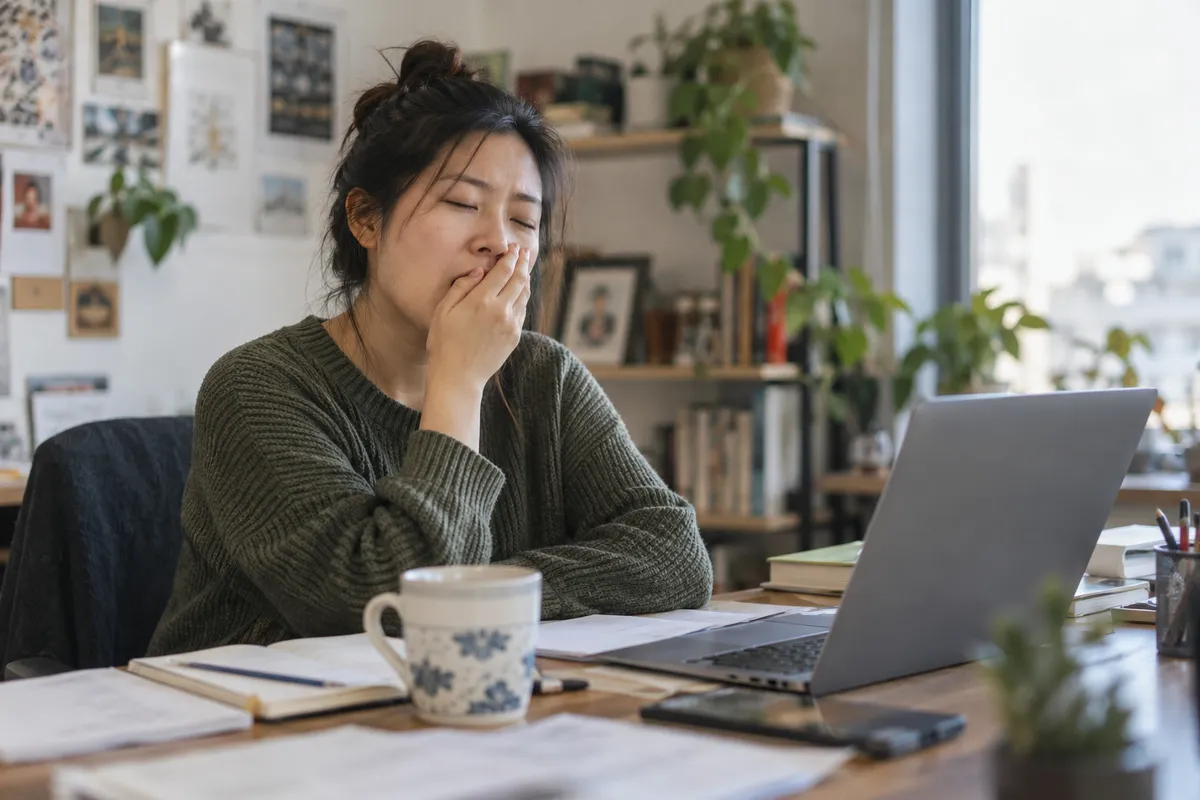
“Always tired during the day” describes several different patterns, and the differences are the clues. See which one sounds like you:
- Sleepy after meals: the drowsiness arrives on schedule after every meal, lunch especially, with a heavy head, and you have to put your head down for a while. This kind has a lot to do with what and how much you eat.
- The afternoon crash: mornings are fine, then around two or three the power cuts out and coffee is the only thing holding you up. This is usually your body clock’s natural afternoon dip stacked on top of too little sleep.
- Groggy all day: from morning to night everything feels wrapped in fog, focus keeps slipping, and weekend catch-up sleep doesn’t clear it. This pattern usually points at a long-running problem with sleep duration or quality.
- Falling asleep against your will: in any setting, mid-conversation, mid-meal, mid-task, you drop off and can’t stop it. This is not ordinary sleepiness. It’s a signal to get evaluated promptly; see the last section.
A note on this article’s boundaries: if your issue is waking up unrefreshed (a full eight hours and still exhausted), read why you can sleep 8 hours and still wake up tired. If you wake at the same time every night, read why you keep waking up at 3 a.m.. This piece covers daytime sleepiness itself.
What Modern Medicine Says
Daytime sleepiness comes down to one thing: the quantity or quality of last night’s sleep fell short, and the debt gets collected during the day. The causes below often show up alone or stacked together.
Not Enough Sleep: the Most Common Cause
Most adults need 7 to 9 hours a night, and U.S. CDC figures show about a third of adults chronically fall short. One hour less seems harmless, but sleep debt compounds, and persistent daytime drowsiness is the most direct bill that comes due. Many people asking “why am I so sleepy lately” aren’t sick at all; they’ve just underestimated their sleep gap for a long time.
Poor Sleep Quality: Time in Bed Isn’t the Same as Sleep
The problem to catch here is sleep apnea: after you fall asleep, the upper airway collapses again and again, breathing stops dozens or hundreds of times a night, and every stoppage comes with a micro-awakening. You think you slept eight hours; in reality your deep sleep was shredded. Daytime sleepiness is the central daytime signal of apnea, typically accompanied by loud snoring, waking up gasping, and morning headaches. Catching up on sleep won’t fix this one. It needs a medical sleep evaluation.
A Body Clock Out of Sync, and Shift Work
Your built-in clock decides when you get sleepy and when you wake. Staying up late for years pushes the clock later, while workdays force you up early; that “short sleep on weekdays, catch-up on weekends” pattern is called social jet lag, and it’s the equivalent of flying across time zones every week. Shift workers have it more directly: the body is asked to stay alert through what the clock considers night, and daytime sleepiness is nearly guaranteed.
Narcolepsy and Idiopathic Hypersomnia (Rare, but Worth Knowing)
The core feature of narcolepsy is sudden, irresistible sleep attacks during the day. Some people also have cataplexy: a sudden loss of muscle tone, knees buckling, triggered by laughter or strong emotion. It’s related to a shortage of hypocretin, a brain chemical that maintains wakefulness. Idiopathic hypersomnia looks different: very long sleep with heavy grogginess on waking and no clear cause. Both are uncommon, and both matter to identify, because each has its own specialist care path.
Medications and Other Health Issues
Plenty of common medications list drowsiness as a side effect: antihistamines for allergies, sedatives, some painkillers, and some psychiatric medications can all leave you sleepy in the daytime. Beyond that, depression often shows up as daytime sleepiness alongside low mood, and an underactive thyroid or anemia can keep you foggy all day. When doctors work this up, blood tests are usually the first step.
A Safety Warning That Stands Alone: Drowsy Driving
Drowsy driving is dangerous. Pull over somewhere safe and do not resume driving while sleepy. Arrange sufficient sleep or alternative transport. Coffee and a short nap may briefly improve alertness, but cannot establish that it is safe to drive. See NHTSA drowsy-driving advice.
How Chinese Medicine Understands It
Chinese medicine reads daytime sleepiness as a question of whether the “clear yang” can rise. In the traditional model, daytime alertness depends on an upward current of clear, light qi nourishing the head and face; when that current can’t rise, the head feels heavy, the eyelids droop, and drowsiness sets in. What follows is a traditional framework for self-observation, not a diagnosis in the modern medical sense.
Dampness Clogging the Spleen: Sleepy After Meals, Head Feels Wrapped
The Suwen, a roughly 2,000-year-old classic, describes it in a single line: “with dampness, the head feels as if wrapped.” In the traditional view, the spleen’s job is to transform food and drink into useful essence and send it upward. A long stretch of rich, greasy, sweet eating plus hours of sitting leaves the spleen’s processing behind schedule, and the surplus “dampness” settles in the body as “phlegm-damp.” Phlegm-damp is classed as a yin influence: heavy, turbid, sticky, and it blocks the path the clear qi takes upward. So the moment a meal adds load to the spleen and stomach, the sleepiness arrives on time, along with a heavy head, a heavy body, and a thick, greasy tongue coating. Body weight tends to run high with this pattern too.
Not Enough Yang: Low All Day
The same chapter of the Suwen says “yang qi, when refined, nourishes the spirit”: daytime vigor is warmed into being by yang qi. Someone short on yang runs like a stove with a weak fire: foggy all day, always cold, a voice without force, tired after the slightest effort. This kind of sleepy is “the battery was never charged from the moment I woke up,” which feels different from the dampness kind that rolls in after meals.
Common Patterns and Constitution Tendencies
Dampness-heavy pattern: sleepy without fail after meals, heavy head, heavy body, thick greasy tongue coating, heavier build, worse on rainy days. This often tracks with a phlegm-dampness constitution tendency. Daily direction: fewer sweets and rich foods, a walk after meals, supporting digestion and clearing dampness.
Low-energy pattern: foggy all day, a quiet voice, tires easily, catches colds easily, the drowsiness a continuous low hum. This often tracks with a qi-deficiency constitution tendency. Daily direction: regular meals and regular hours are the foundation, and overwork gets cut back first.
Cold-and-low pattern: everything in the low-energy pattern plus stronger cold sensitivity, cold hands and feet, the hardest time getting out of bed in the morning, clearly worse in winter. This often tracks with a yang-deficiency constitution tendency. Daily direction: stay warm, get morning sunlight, go easy on cold and raw food.
One caution: these are summaries of common ways daytime sleepiness shows up, not constitution verdicts. One person can be a mix of several patterns, and formal differentiation needs an in-person TCM practitioner. The U.S. National Center for Complementary and Integrative Health (NCCIH), in its overview of Chinese medicine, likewise frames these traditional approaches as a complement to overall health care. For the framework itself, see the nine TCM constitution types.
Everyday Adjustments
These methods target the most common cluster: short sleep, poor sleep, and a misaligned body clock. If you suspect apnea or narcolepsy, see a doctor first; these don’t replace an evaluation. This is also the practical answer for anyone wondering how to stop feeling sleepy all day.
- Pay the sleep debt first. Fix your wake time (no more than an hour later on weekends) and count back 7 to 9 hours for lights-out. The least clever item on this list, and the most effective.
- The 20-minute power nap. When the drowsiness wins, nap 15 to 20 minutes, finished before 3 p.m. Past 30 minutes you risk dropping into deep sleep and waking up groggier; a late nap spends tonight’s sleepiness in advance.
- Get 10 to 20 minutes of morning sunlight. Morning light is the strongest calibration signal your body clock gets, and it’s especially on-target for the “clock out of sync” kind of daytime sleepiness.
- Manage caffeine on both timing and total. Caffeine’s half-life is about 5 to 6 hours, so an afternoon coffee can still be sitting on your adenosine receptors at midnight: it masks daytime sleepiness, then manufactures a bad night, and the loop closes. Keep caffeine before 2 p.m. For the total, the U.S. FDA cites 400 mg a day (roughly two or three 12-ounce coffees) as the amount not generally associated with negative effects for most adults. If you’re pregnant or breastfeeding, ask your doctor first.
- Build a balanced lunch: include vegetables, protein and a portion of starch. After-meal sleepiness can reflect sleep loss, circadian timing or meal size; feeling sleepy does not establish a blood-sugar crash. Repeated shaking, sweating or palpitations need assessment, especially if you use glucose-lowering medicine.
- Give your body real activity during the day. Sit all day and nothing gets spent, so alertness drifts down. Stand up and move for a few minutes every hour, and aim for 30-plus minutes of exercise a day.
TCM Methods
The five categories below answer to the three patterns above. They stack, and you can start with whichever one or two are easiest to keep. Acupressure and food therapy are traditional self-care practices; results vary from person to person, and they don’t replace a medical evaluation.
Pressure Points and Self-Massage
Press when the sleepiness hits, or once every morning. The right pressure produces a mild, bearable ache, 30 to 60 seconds per point.
Baihui (GV20), the crown point Location: at the very top of the head, where the line between the two ear tips crosses the midline. Traditional use: the classic point for “raising yang and lifting what has sunk,” aimed squarely at the heavy, drowsy head of clear yang failing to rise. Rub gently with a fingertip pad for 1 to 2 minutes, keeping the pressure light. Stop if the scalp is broken or pressing feels wrong.
Fengchi (GB20), the base-of-skull point Location: in the hollows at the hairline on the back of the neck, on the outer sides of the two large neck muscles. Traditional use: for a heavy, foggy head and a tight neck. Press with the thumbs, 60 seconds per side, angled toward the opposite eye. Don’t jab hard.
Zusanli (ST36), the leg point Location: four finger-widths below the outer hollow of the knee, one finger-width to the outside of the shinbone’s edge. Traditional use: the classic point for supporting the spleen, used when the spleen is weak and meals bring on drowsiness. Press 1 to 2 minutes per leg, and not within half an hour after eating.
Fenglong (ST40), the lower-leg point Location: at the midpoint of the line between the outer knee hollow and the tip of the outer ankle bone, just outside the front shin muscle. Traditional use: the classic “transforms phlegm” point, suited to the dampness-heavy pattern. Press 1 to 2 minutes per leg.
If you’re pregnant, or the local skin is broken or inflamed, ask your doctor before doing acupressure.
Of these points, the spleen-supporting, phlegm-clearing ones like Zusanli and Fenglong suit people leaning toward the dampness-heavy or low-energy patterns. If you lean toward the cold-and-low pattern, keep the area warm after pressing, and treat comfort as the right pressure; you don’t have to chase the ache.
Food Therapy
Chinese home-style track:
- Chinese yam and Job’s tears congee: 30 g Chinese yam (dried shanyao slices, sold at Asian supermarkets or online) and 30 g Job’s tears (also labeled Chinese pearl barley or yi yi ren, same sources), soaked, then simmered with rice into a congee as part of breakfast or dinner. Traditionally it supports the spleen and clears dampness, squarely aimed at the dampness-heavy pattern. Note: Job’s tears are traditionally considered moving and slippery, and are not recommended during pregnancy. Pregnant readers can swap in white hyacinth bean (dried bai biandou, also at Asian grocers). These are food-therapy uses of culinary-grade ingredients; if you intend to use any of them as medicinal herbs, consult a licensed TCM practitioner.
- Tangerine peel and ginger tea: 3 g dried tangerine peel (chenpi, at Asian supermarkets or online) and 2 slices of fresh ginger, steeped in freshly boiled water and sipped as a morning tea. Traditionally it moves qi, resolves dampness, and wakes up the spleen.
- Cut three categories: sweet and greasy pastries, deep-fried food, and iced drinks. All three traditionally “feed dampness and bog down the spleen,” and from the modern angle, high-sugar eating drives after-meal sleepiness too. Both logics land on the same conclusion here.
Western everyday track:
The same care direction, built from ordinary American and British supermarket ingredients:
- Pumpkin oatmeal: 40 g rolled oats and 100 g pumpkin cut into small cubes, simmered in about 400 ml of water for 10 minutes into a thick porridge, with a small pinch of cinnamon stirred in at the end. Warm, soft, and low on sweetness, it fills the “easy on the spleen” slot at breakfast.
- Sweet potato and white bean soup: 1 sweet potato (about 200 g), peeled and cubed, plus half a can of cannellini beans, drained, simmered in 500 ml of light chicken broth with 2 slices of ginger for 15 minutes, until the sweet potato is soft. This takes the congee’s slot: filling without grease, and paired with lunch it helps flatten the post-meal blood sugar swing.
- Ginger, cinnamon, and date tea: 2 slices of fresh ginger, half a cinnamon stick, and 1 dried jujube (red date, sold at Asian supermarkets), split open, steeped in freshly boiled water for 5 minutes as a morning tea. It answers to the same “wake the spleen, warm the stomach” direction as the tangerine peel tea.
- The “cut three” list works in Western form too: donuts and pastries count as sweet and greasy, fried chicken and fries count as deep-fried, and iced coffee and cold sodas count as cold. Start by cutting frequency; you don’t have to quit everything at once.
The congee, soup, and teas in both tracks lean toward the dampness-heavy and low-energy patterns. They also suit the cold-and-low pattern; keep ginger stocked, and the cold-and-iced rule matters most for you.
Emotional Care
Traditional practice holds that “overthinking taxes the spleen”: long stretches of seated, concentrated thought slow the spleen’s processing along with everything else, and after-meal sleepiness gets more pronounced. The countermeasure is simple: after an hour of continuous mental work, get up and walk for a few minutes, giving the thinking a break. This point is especially relevant for the low-energy and dampness-heavy patterns, where the underlying problem is often a spleen slowed by sitting and rumination. Separately: when daytime sleepiness comes with low mood or lost interest lasting more than two weeks, think of depression as a possibility. That’s beyond what self-care covers; please seek professional help.
Movement and Exercise
If ordinary activity causes delayed worsening lasting days, stop increasing exercise and seek assessment. Persistent unexplained fatigue or fatigue affecting daily life warrants an appointment now; a self-care trial is not a prerequisite. See the fatigue topic’s care guidance.
- Baduanjin (Eight Pieces of Brocade), the “hold one arm aloft” move: from the traditional Baduanjin set, the move called “raising one arm to regulate the spleen and stomach” alternates one arm pressing up and the other pressing down, slow and gentle, aimed at the weak-spleen-with-dampness direction. Do 5 to 10 repetitions a day.
- Brisk walking to a light sweat: the dampness-heavy pattern especially needs the body in motion. Walk briskly 30 minutes a day, enough for a light sweat. The traditional framing is “movement generates yang”; the modern framing is that exercise directly raises daytime alertness.
- No vigorous exercise within 2 hours of bed, so the night stays protected. Daytime sleepiness often has its roots at night.
Brisk walking pays off most directly for the dampness-heavy and cold-and-low patterns. If you lean low-energy, start with shorter sessions and use “no more tired the next day” as your ceiling; a light sweat is enough.
Sleep and Daily Rhythm
- A fixed wake time is the first anchor, no more than an hour later on weekends.
- In bed by 11 p.m. whenever possible. Closing the sleep-duration gap is more fundamental than any daytime rescue.
- Nap 20 to 30 minutes, finished by 3 p.m., in line with the traditional midday “ziwu” rest. Longer backfires into grogginess.
- Eat a warm breakfast (porridge, noodle soup). Traditional thinking holds that the spleen’s yang is just rising in the early morning, and a cold breakfast is the quickest way to douse it.
The anchors in this section apply to all three patterns. The cold-and-low pattern is especially sensitive to morning warmth and a hot breakfast and gains the most from them, while the dampness-heavy pattern needs to guard nap length the hardest.
A Two-Week Sleepiness Log
Record for one to two weeks straight, and your pattern will surface on its own. Four entries a day:
| What to record | Example |
|---|---|
| When the sleepiness hits, and how hard | 2:00–3:00 p.m., strong enough to nod off / mild fog all day |
| Last night’s sleep | 11:30 p.m.–6:30 a.m., woke once / snoring (partner’s report) |
| Food and caffeine that day | Big bowl of pasta for lunch; 2 coffees, last one at 4 p.m. |
| The setting | After lunch / in a meeting / while driving / any setting, suddenly asleep |
When you review, read three lines: does it always follow meals (look at diet and the dampness direction), is it evenly spread across the whole day (look at sleep duration and quality), or does it strike in any setting, irresistibly (go straight to a doctor; no more self-observation needed). The log doubles as excellent material for an appointment. The CDC likewise recommends keeping a sleep diary before you see a doctor about sleep.
How Long Until You See Improvement
Use the dates in your plan as review points, not promises of recovery. Responses to sleep, food and activity changes depend on the cause of fatigue and your circumstances. There is no established recovery timetable for the acupressure or food-therapy suggestions here.
- Review your notes weekly: compare sleep, daytime energy and the effects of activity. One better day does not identify a cause.
- Watch for delayed worsening: if ordinary activity brings a marked decline hours to a day or two later that lasts for days, reduce the load, stop increasing activity and seek assessment. Do not push through a fixed exercise plan.
- Arrange care when needed: unexplained fatigue lasting weeks or affecting daily life warrants a medical appointment. Do not wait to complete a diary or self-care trial; worsening symptoms or the warning signs below need earlier attention.
See NHS advice on fatigue and CDC guidance on post-exertional malaise.
When to See a Doctor
Get a professional evaluation first, rather than relying on self-care, if any of these apply:
- You can’t stop yourself nodding off while driving. Stop driving tired, and see a doctor promptly. The driving risk from sleepiness is on par with drunk driving.
- Daytime sleepiness with loud snoring, gasping awakenings at night, or morning headaches: sleep apnea needs ruling out, which usually means a sleep study.
- Suddenly falling asleep in any setting, against your will, or sudden muscle weakness with strong emotion (cataplexy): get to a sleep specialist soon to evaluate for narcolepsy and other sleep disorders.
- Daytime sleepiness that persists for weeks despite enough time in bed, clearly affecting work and life.
- Sleepiness with persistent low mood, feeling cold, marked weight gain, or a pale complexion: depression, thyroid problems, and anemia need checking.
This article is general health education and can’t replace a doctor’s diagnosis or individualized advice. If you’re taking any medication that can cause drowsiness, talk to your doctor before changing anything, and don’t stop a medication on your own.
Daytime sleepiness and poor nights feed each other: if you wake at a fixed time every night, see why you keep waking up at 3 a.m.; if you sleep enough and still wake unrefreshed, see why 8 hours of sleep can still leave you tired. For the full fatigue picture, start at the fatigue hub, and for the constitution framework behind the patterns above, read the nine TCM constitution types.
Daytime sleepiness isn't one thing — which way does your body lean?
The care direction for a dampness-heavy pattern is different from the direction for a qi-deficiency one. The free constitution test shows your tendencies across nine traditional body types and helps you keep the self-observation going. It's a self-observation tool, not a medical diagnosis.
References10 sources
- 01
UK National Health Service (NHS)
- 02
U.S. National Heart, Lung, and Blood Institute (NHLBI / NIH)
- 03
U.S. National Heart, Lung, and Blood Institute (NHLBI / NIH)
- 04
U.S. National Heart, Lung, and Blood Institute (NHLBI / NIH)
- 05
U.S. National Institutes of Health MedlinePlus
- 06
U.S. Centers for Disease Control and Prevention (CDC)
- 07
U.S. National Institute for Occupational Safety and Health (NIOSH / CDC)
- 08
U.S. Food and Drug Administration (FDA)
- 09
U.S. National Center for Complementary and Integrative Health (NCCIH / NIH)
- 10Huangdi Neijing: Suwen (The Yellow Emperor's Inner Classic: Basic Questions)
Classic of Chinese medicine, ~2nd century BCE
Personalized guidance
Use the app for constitution-friendly ideas and structured plans when available.
Download the App
Get personalized TCM health recommendations